
NOTE: The following is a revised version of an article originally published on Medium, where I’ve published a number of writing advice pieces.
Warning: Contains spoilers for Planet of the Apes, One Day, Dead Poets Society, Rebecca, The Hound of the Baskervilles, Harry Potter and the Chamber of Secrets, 24 series 2, Death on the Nile, and The Sixth Sense.
Big story twists can be brilliant or dreadful, depending on the skill of the writer. Many a budding screenwriter or novelist would love to pull off a gasp-inducing twist of The Sixth Sense proportions, but doing so in a manner that feels organic, plausible, and above all inevitable is extremely difficult. However, it is not impossible.
Successful big twists can be intellectually thrilling and emotionally exhilarating; The Murder of Roger Ackroyd, The Usual Suspects, and Memento are examples of the former, Rebecca, Jane Eyre, and The Empire Strikes Back the latter. Some are a combination: Snape’s true allegiance in Harry Potter and the Deathly Hallows for instance. The big reveals at the end of Les Diaboliques, Planet of the Apes, and The Sixth Sense generate tremendous cerebral and emotional pleasure, whilst the latter even operates on a spiritual level.
Conversely, a bad plot twist feels bolted on, gratuitous, and irritating. How many times have you encountered a film or novel with a promising plot, only to be sideswiped by a random, contrived plot twist that seems to have gate-crashed from another story? Ambushing an audience with ill-conceived, implausible, shock tactic twists only serve to undermine intellectual or emotional engagement. The big twist ending cannot seem tacked-on as an afterthought. It must be an essential final component.
Twist versus Unexpected Plot Turn
To avoid confusion, it is important to define a plot twist. I do not mean an unexpected plot turn, which is slightly different. In an unexpected plot turn, the story may veer off in a new and unforeseen direction, but it does not mean earlier events are viewed in a different light. A plot twist is a reversal; a revelation that turns the entire story on its head, provoking a rush of insight and causing the audience to see the entire narrative from a completely new angle. The tragic death near the end of One Day, the suicide at the climax of act two in Dead Poets Society, or the aftermath of the sucker-punch received by Hilary Swank’s character in Million Dollar Baby are examples of unexpected plot turns rather than twists.
Most great, narrative-defining twists occur towards or at the end because that’s the natural place for them. Withholding the most essential facts from the audience for as long as possible creates the immensely satisfying thrill of delayed gratification. However, there are rare occasions when revealing the major twist earlier adds depth to the work. The Crying Game and Reservoir Dogs are both good examples.
The major bombshell central to the mystery in Hitchcock’s Vertigo occurs at one hour and fifteen minutes in. This surprised me the first time I saw it, but every subsequent viewing has underlined why screenwriters Alec Coppel and Samuel A. Taylor made this unconventional choice. Audience knowledge regarding Kim Novak’s character creates a sense of impending dread and despair, as we watch James Stewart’s character spiral into ever increasing obsession over the remaining forty-five minutes. How will he react when he finds out the truth?
Know your ending
I know this won’t appeal to “pantser” writers, but if your ambition is to craft a story with a major twist ending, simply seeing where a character takes you will almost certainly lead to far more agonised rewriting than if you work from a well-planned outline. I always prefer to start with an ending that completely blows me away, then work backwards, discovering how the characters ended up at that point. As I’ve already noted, twists of plot-defining magnitude typically occur in the latter stages, so with this kind of story, it really pays to plan.
It is also worth asking, does my story need a big twist ending? It might not. However, as an aside, every story should at least feature crisis in the climax. If the final act of a heist thriller features everything going precisely to plan during the heist, how boring would that be?
The most obvious skill in writing a major plot twist is the ability to conceal it from the audience. In some genres, such as the murder mystery, the author must summon an arsenal of misdirection weaponry, because the reader is already on the alert to expect the unexpected. Here are some examples of tactics that can be deployed in whodunit type narratives.
Red Herrings
The use of red herrings — seemingly important plot points that prove irrelevant — is an obvious genre trope, but they should be deployed sparingly. Too many will lead to frustration and confusion in the reader. However, slipping one in now and again can work wonders for plot misdirection.
Conan Doyle’s Sherlock Holmes stories provide a masterclass in red herrings. In The Hound of the Baskervilles, Holmes himself turns out to be one, as he is latterly identified as the mysterious figure Watson observed on the moors. That same novel includes many other false trails, including a subplot involving an escaped convict.
In Harry Potter and the Chamber of Secrets, JK Rowling deploys multiple red herrings concerning the identity of the heir of Slytherin. Everyone from Hagrid to Draco Malfoy is suspected. At one point, Rowling even cast a suspicious eye at Percy Weasley (when he is seen reading about “Prefects that gained power”). There is also a monstrous red herring in the form of giant spider Aragog.
Incidentally, red herrings aren’t necessarily confined to detective fiction. Romantic stories can contain emotional red herrings. These take the form of misunderstandings, or secondary characters attempting to win the affections of our protagonist in their quest for true love. There are often plenty of red herring dalliances before the reveal of who the protagonist ends up with. Jane Austen’s novels, such as Pride & Prejudice and Sense and Sensibility, indulge in such romantic red herrings, as do latter romantic comedies following the Austen template, like Bridget Jones’s Diary.
Multiple Suspects
When writing any story featuring a mysterious, perhaps murderous unidentified figure manipulating events behind the scenes, I incorporate at least three suspect characters into the narrative. The first is the individual to whom all evidence points, and they are suspected by characters or investigators in the story. Since the audience invariably considers themselves smarter than the protagonist, it is vital to feed them a second character, not suspected by anyone in the plot, over whom clouds of suspicions can gradually form. There can be more than one of these second suspects, as required. The final suspect is the genuine culprit or manipulator, who is considered by both reader and protagonist to be above suspicion. Yet when unmasked, the solution must appear obvious and make complete narrative sense.
Agatha Christie’s Death on the Nile features a particularly clever example of this technique, with multiple suspects, all of whom have means, motive, and opportunity for the murder. Yet the two characters with cast-iron alibies, who are emphatically above suspicion, prove to be the killers. What’s more, their scheme is convincing, plausible, and fiendishly clever.
In TV series 24, agent Jack Bauer suspects young Muslim Reza of being involved in a terrorist plot. Reza protests, and we believe him. But we’re not so sure about his shifty father-in-law to be, who has secretly worked for the CIA and clearly has some dark secrets. Yet the real snake in the grass turns out to be Reza’s seemingly sweet and innocent wife-to-be, Marie. She was completely above suspicion, yet she has been brainwashed into murderous fundamentalism.
Hiding in plain sight
The final misdirection device, and one of the most effective, is the hiding-in-plain-sight technique. The Sixth Sense is a case in point. Everything you need to figure out the big twist is contained within the opening scene, which in retrospect ought to be obvious. Yet the audience doesn’t see it coming. Why? Clever screenwriting sleight of hand, from M Night Shyamalan. The subsequent scenes with Bruce Willis’s character Malcolm interacting with his estranged wife Anna, and with his young patient Cole, appear to be straightforward. Yet the final reveal points to the elephant in the room, so to speak, in every one of those sequences. It was there, the entire time, yet we failed to spot it.
The Murder of Roger Ackroyd is another example of hiding in plain sight. It features a phenomenally cunning twist that works best on the page rather than in onscreen adaptations, for reasons that will be clear to anyone that has read it. Whenever I encounter snobby dismissals of Agatha Christie, I point to that novel as one of the finest examples of hiding in plain sight misdirection ever written.
Daphne Du Maurier’s gothic mystery Rebecca features my all-time favorite hiding in plain sight twist. The young, nameless protagonist marries widower Maxim de Winter in a whirlwind romance, but once back at ancestral family home Manderley, finds herself endlessly and unfavorably compared to Maxim’s first wife Rebecca. She is torn apart over the belief that Maxim adored Rebecca, whose wit, intelligence, sophistication, and beauty is remarked upon by all around her. Sinister housekeeper Danvers seems particularly determined to torment the new Mrs de Winter, and she does so with devilish cruelty.
Yet eventually, a dramatic turn of events forces Maxim to confess his true feelings regarding Rebecca to his new bride: “I hated her.” Those three words reverberate in the reader’s mind, as a shocking rush of insight. Maxim’s subsequent explanation, concerning how their marriage had been a sham, forces the reader to re-evaluate everything they thought they knew about Maxim up to that point. Every time a memory of Rebecca was triggered, he wasn’t upset because he had loved her. He was upset because he had hated her. More importantly, he had been indirectly responsible for her death, and had made it look like an accident.
Inevitability
There is one other major factor in creating a twist ending that genuinely wrong-foots the audience: It must seem inevitable. If the audience instantly imagines an alternative scenario, or a better plot twist, the writer has failed. The reader or viewer needs to experience the big twist in such a way that it not only makes complete sense, but that the plot could not have unfolded any other way.
In the original 1968 Planet of the Apes film, Charlton Heston’s character Taylor is an astronaut on a mission to explore the far reaches of the universe. After years in suspended animation, his spaceship crashes on a strange world where apes seemingly evolved from men. With ape the master and mankind their mute slaves, Taylor spends the entire film trying to validate his existence as intelligent being rather than savage. In the process he upsets the religious, theocratic apes, who don’t believe in evolution, but stubbornly cling to their religious texts which warn man is dangerous and must be suppressed. They also want to suppress recent archaeological evidence of a society of intelligent men predating apes.
Taylor exposes this conspiracy, and leaves the apes feeling rather pleased with himself. But then he has to confront the appalling truth when he discovers the ruins of the Statue of Liberty, revealing the planet to have been Earth all along. Taylor pounds the sand in despair, cursing the men who pushed the button of (presumably) nuclear annihilation that turned evolution upside down. It’s an astonishingly dramatic, powerful reveal, which answers all the questions of the film in a rush of insight, through a single devastating image. Impossible to see coming, but also, in retrospect, inevitable.
Conclusion
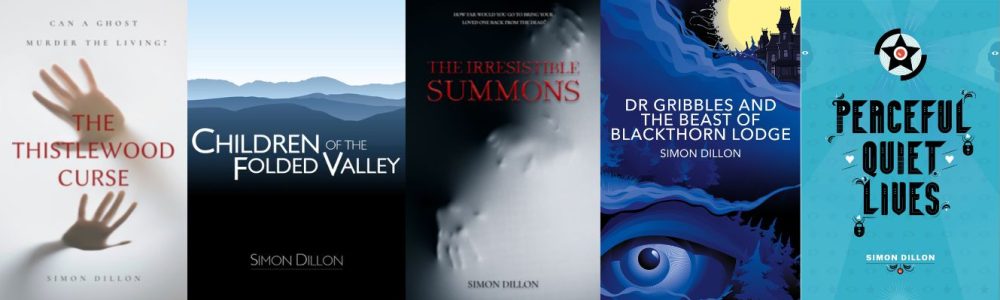
With good planning, and by factoring in some or all of the above disciplines, in my experience it is possible to write a convincing, thrilling, unexpected twist ending. I have crafted a few in some of my own novels, which I believe fulfill the criteria of being organic, plausible, and inevitable. I hope the above advice is useful to anyone with similar ambition.
 Simon Dillon Books