How long should a chapter be?

 studies

How long should a chapter be?

Like so many writing related questions, my answer is: it depends.

Many contemporary thrillers seem to consist of literally hundreds of chapters, with each lasting no more than two pages. I am Pilgrim is a good recent example, and anyone familiar with the works of Michael Crichton will also know what I am talking about.

Other texts, surprisingly often stories aimed at children, contain chapters that at times seem very long. Harry Potter and the Order of the Phoenix contains many lengthy chapters, for example.

Both approaches work well for their respective formats – fast contemporary thriller, versus more traditional fairy tale. The short chapter approach doesn’t necessarily mean the writer considers the reader to have the attention span of goldfish. Other novels have a mixture of short and long chapters for artistic reasons – Life of Pi, for instance.

In my own writing, I generally stick to average length chapters in both my novels for children and for grown-ups, regardless of genre or subject matter. My stories seem to naturally gravitate to a relatively straightforward format. However, the stories themselves are often anything but.

On a related note, I generally do not title chapters in a novel aimed at grown-ups (with rare exceptions), but I always do in a novel aimed at children. Why? I have no idea. Perhaps chapter titles in books aimed at children just sound cool.

Writing horror for children

The term “horror for children” might appear to be an oxymoron. However, I am personally of the opinion that no subject matter or level of scariness should be off limits to children, provided the treatment is appropriate.

I am currently writing a very dark fairy tale aimed at “the Harry Potter demographic”, although I suspect many will categorise it as horror. Think Neil Gaiman’s Coraline and you’ll get an idea of the tone.

Coraline

My novel is, without question, the scariest book I have written that is primarily aimed at children. I think open-minded adults will enjoy it too, even if some are uneasy or disapproving – hopefully for all the right reasons.

Frankly, all good fairy tales should make parents uneasy – or else I question their parental veracity. Wherever we find abused, traumatised or terrorised children in literature, in everything from Oliver Twist to Hansel and Gretel, children often identify with the journeys taken by these characters, whereas parents are rightly predisposed to be appalled by their treatment.

However, just because something is dark, scary and difficult does not necessarily mean it should be out of bounds to children. I accept that parents are always the final arbitrator in these matters, as they know best the temperaments of their offspring, but children know when they are being patronised, and talking down to children is a terrible mistake.

The thing to bear in mind when writing horror for children is to keep the treatment appropriate. No subject matter should be off limits, but how this subject is approached is what makes the difference. Here is one simple principle: depict all horrifying events through the eyes of your child characters. That way, you can place them in the most terrifying situation imaginable, and it will still read in an honest and innocent way. Example: the Holocaust. How do you tackle that darkest of subjects in a way appropriate to children? The Boy in the Striped Pyjamas manages, by depicting events through the eyes of a child protagonist. By contrast, horror for adults that features children is generally seen through the eyes of adult protagonists, with all their terrible knowledge of what the world is really like.

By the way, viewing events through the eyes of a child doesn’t necessarily mean keeping blood and gore out of it – quite the contrary in fact, since children often have a lurid fascination with such things (witness the enduring popularity of the Horrible Histories series if you don’t believe me).

Finally, and most importantly, horror stories for children are about confronting difficult truths in a way that is ultimately empowering. The afore-mentioned Coraline – both the book and Henry Selick’s film adaptation – provide excellent examples of this principle. Amid all the scariness, that story is about encouraging children not to take their parents for granted, whatever their shortcomings.

By contrast, horror stories for adults do not necessarily offer such empowerment. One could hardly accuse Stephen King’s The Mist of being particularly empowering. Adult horror can also contain political allegory or satire often lost on children, or else it is designed to shake the reader/viewer out of their apathy with dire warnings of one kind or another. For example Threads – a 1984 BBC television production about nuclear war – is quite possibly the most frightening and horrific warning of any kind I have ever witnessed.

Ultimately horror, like romance, weepies and even comedy, is about catharsis. These genres all offer a way for the reader to identify with something they would never want to go through in real life and leave them either laughing, crying or shaking with terror. Or, because the reader has unfortunately been through a similar situation in real life, they identify with events all the more – even if they are metaphorical (such as last year’s horror film The Babadook, which is essentially about coming to terms with grief).

As a consequence, the reader (or viewer) feels alive. Children are no different, and can experience a similar catharsis, often a very empowering one, in spite of their innocence. That is the power of storytelling and that is why – for me at least – a horror story for children is not an oxymoron.
Slow isn’t necessarily boring

A slow pace doesn’t necessarily mean a story is boring.

For some, this is an anathema. But should all stories zip by at a relentless pace; twisting, turning and generally behaving as if the audience or reader has the attention span of a goldfish?

To which I reply, it all depends.

Obviously in a certain kind of thriller, a fast pace is an important aspect of the genre. Also adventure stories and often children’s stories require a fast, attention grabbing pace that carries the reader or viewer along for a thrilling ride.

Yet frenetically paced stories – in film, onstage or in print – can sometimes come off as rushed, inconsequential and above all boring. This is what I like to call the Michael Bay effect. One hundred miles per hour is not necessarily the kind of pace required for a story like, say, The Remains of the Day, which is an utterly fascinating and gripping tale in both film and print. However the gentle, gradually getting under the skin approach is vital to the success of the story.

200px-KazuoIshiguro_TheRemainsOfTheDay

Sticking with film for a moment, many great movies – including Lawrence of Arabia, 2001: A Space Odyssey and The Assassination of Jesse James by the Coward Robert Ford – have a very slow, deliberate pace. Yet every frame of those movies, especially if seen in the cinema, arrests the attention of the viewer. Well, they certainly arrested my attention, at any rate. Obviously tastes differ, but the point remains: slow does not necessarily mean boring.

Even if you are dealing with an adventure story, sometimes a slow build and a decent set-up of the characters will make the dangerous predicament of the protagonist all the more palpable. Life of Pi is a good example. Or Batman Begins, wherein the first appearance of Batman comes over an hour into the film.

Even a fast slapstick comedy needs to be properly paced. There’s a climactic point about halfway through What’s up Doc? so funny that director Peter Bogdanovich was probably in danger of actually injuring his hysterical, laughter-gripped audience. So he allows them a brief romantic interlude before throwing them back into the relentlessly funny fray.

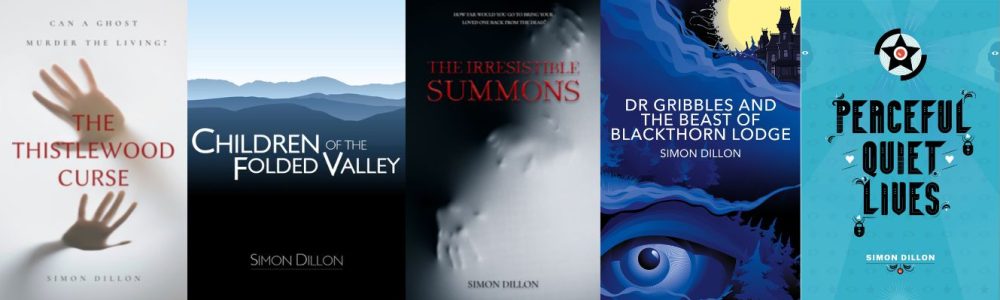
In my own work, I try to maintain an appropriate balance, depending on the subject matter and genre. Even in a fast paced adventure like Dr Gribbles and the Beast of Blackthorn Lodge (which features a monster, a mad scientist and a haunted house in the opening chapter alone) I try to make sure the reader doesn’t become too exhausted by the frantic plot developments, allowing breathing spaces and time for the characters to develop.

DrGibbles_1600x2400_front cover

Other books I have written – such as Love vs Honour, which I plan on releasing later this year – have a much more slow-burn approach, gradually building to what I hope is a climax that will satisfy and reward the patience of the reader.

In any event, I reiterate that slow and boring are not necessarily words that belong together.

Choosing an ending

I always know how a story ends before I write it. Only when I have that ending do I then work backwards, trying to find the best and most dramatic way to arrive there.

When endings are very clear cut – for example, the answer to whodunit – writing becomes all about how you make the big reveal; what details should emerge first, how the mystery should build to this crescendo that will hopefully wrong-foot and delight the reader.

However, when the ending is more esoteric – for instance, when it is about a character’s emotional and spiritual journey – choosing the specifics of a satisfying emotional and spiritual resolution can be much trickier.

As a case in point, my novel Children of the Folded Valley presented me with a serious dilemma in early outlines. I always knew what would happen to the protagonist James Harper inwardly, but I was stuck between three different act three scenarios that would demonstrate how it happened.

(SPOILERS FROM THIS POINT FOR Children of the Folded Valley)

My earliest idea involved having James buy his model train from an older man who turned out to be Paul Crow’s long lost father. They would share a mutual catharsis in that James would explain what happened to Paul, whilst the old man presented James with the long lost train set of his childhood he had sought for so long. In this version, Paul had a much more active role in the uprising prior to the destruction of the Folded Valley, and died heroically in the fiery horror of that sequence.

I rejected this version of the ending because it placed too much emphasis on Paul Crow, who is a secondary character. Thus, he had a reprieve and survived the Folded Valley apocalypse.

I then prepared a version of the ending more or less as it is now, but shorn of the supernatural elements. Arthur Lord was not an ambiguous figure, but definitely human. However, whilst this ending worked, it still didn’t feel quite right to me. I realised that however far-fetched it might seem, my own belief in the supernatural meant the ending required something a little more mysterious.

Subsequently I arrived at the ending as it is now, which can be read a number of ways. I do not presume to offer any correct interpretation, as I designed it so the reader can make up their own minds. This element of the plot was a big worry to me initially, but given how much readers have embraced the novel it seems I was correct in devising an ambiguous ending with an air of the mysterious and supernatural.

Children of the Folded Valley is available from Amazon for Kindle.


Print copies can be ordered from Lulu.com: http://www.lulu.com/shop/simon-dillon/children-of-the-folded-valley/paperback/product-21812308.html