“I must caution you that I am a writer. Anything you say or do could be used in my next novel.”
Muses are integral to any writing process, whether they inspire characters directly, indirectly, in part or in full. If a writer writes what they know, as conventional advice dictates, then their writing will be full of people who have inspired their work, consciously or unconsciously.
In my own writing, I have consciously written about people, and also unconsciously, realising that I had after the fact. For example, my wife – my greatest inspiration – consciously inspired elements of the three central female characters in my as yet unreleased fantasy magnum opus Goldeweed. However she also unconsciously inspired Meredith, or significant elements of her, in the George Hughes trilogy. Only after my mother pointed out the obvious connection between Meredith and my wife (after the first novel George goes to Mars) did I realise. Meredith’s defining characteristic is her fierce loyalty, and that comes directly from my wife. She also often comes up with the plan that saves the day, and generally has the best lines too, especially in the final novel George goes to Neptune. Again, this is very characteristic of my wife.
Love vs Honour is another example of a novel where the characters (and also situations) in some cases were inspired by people from my past.

There are dangers, however, of crowbarring unworkable elements into fictional characters if one relies too much on direct inspiration from real individuals. There is a balance to be struck. For example, earlier this year, when writing a supernatural thriller entitled The Irresistible Summons, I based the central character, and two other supporting characters, on friends of mine (in one case, my closest friend). For the central character I’d say about 70 percent is based on the muse in question, and the other 30 percent made up. At times I was tempted to make this protagonist more like her real-life counterpart, but it would have weakened the overall novel. The same was true for the supporting characters.
Elsewhere many of my novels (particularly Children of the Folded Valley) feature characters minor and major that are directly inspired from figures in my past or present. But they are always cloaked in fictionalised elements, mostly for the purposes of the novel but also very occasionally to differentiate sufficiently from real life incidents. This is to avoid potential offence being taken, should the real people ever realise they inspired the character in question. After all, I don’t always own up to people if they have ever ended up in a novel in some form, especially if their portrayal is less than flattering.
And make no mistake – some of the people I write about are deeply unpleasant individuals. An odious left luggage attendant in The Irresistible Summons is based entirely on a truly obnoxious person I once had the misfortune to encounter in Paddington railway station. In The Birds Began to Sing, Alice’s boss is an officious, corporate non-entity based very much on a person I know, though I suspect he would not recognise himself in print. Much more seriously, cult leader Benjamin Smiley in Children of the Folded Valley is also based on someone (now deceased) that I knew as a child. Of all my novels, Children of the Folded Valley contains more characters that are either composites or else directly inspired from people I know or knew than any of my other works.
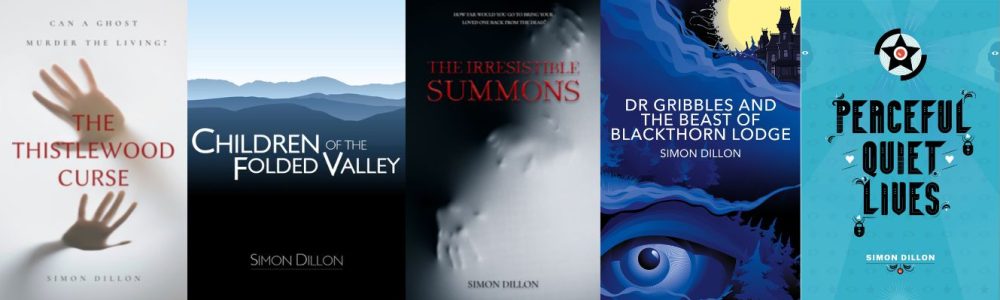

 Simon Dillon Books
You must be logged in to post a comment.