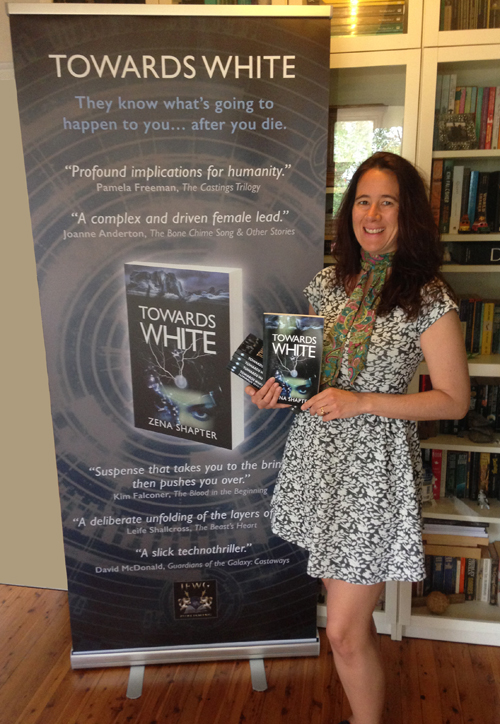
Award-winning author Zena Shapter has just had her new novel – a gripping, speculative fiction techno-thriller entitled Towards White – released by IFGW Publishing. Here’s the blurb from the back cover:
They know what’s going to happen to you… after you die.
Scientists in Iceland think they’ve figured out one of our greatest mysteries – where the electrical energy in our brains goes after we die. According to the laws of physics, one form of energy must always become another form. So the electrical energy in our brains and nervous system can’t simply disappear…
When ex-lawyer Becky Dales travels to Iceland to track down her missing brother, she doesn’t care about the groundbreaking discoveries, or the positive-thinking practiced by the Icelanders – she just wants her brother back. Having stumbled on something she thinks the Icelandic government wants covered up, Becky must piece together the answers fast… before she becomes a victim herself.
In this post I interview Zena, discussing the novel and all things writing, as well as her inspirations, metaphysical matters and more.
What inspired Towards White?
I grew up around elderly people, for whom death was never far away, and loved studying science at school, so knew all about the energy and nitrogen life cycles. As a teenager, I also enjoyed philosophical contemplations – wherever I could get them! So when I was about eighteen – home from University where I was reading English – I was up late one night philosophising with friends about life after death and I found myself layering our discussion with my scientific background. The conservation of energy theory states that one form of energy must always become another form of energy, energy cannot simply disappear. Our brains are powered by electricity, so I simply made the leap to wondering what happened to it after death. Our bodies go to the worms, what about our electricity? It can’t simply disappear, and it’s far too efficient an energy to simply dissipate, or entropy, as heat. I dwelled on the idea, pondered it, and extended it as far as I could. What if… what if that was the answer to one of man’s greatest mysteries: life after death?
Over the years I played with the idea but it wasn’t until I went to Iceland in 2001 that the story that would become Towards White took shape. I fell in love with the country’s austere beauty and inspiration simply poured into my brain from there. There were some delays along the way – moving to Australia, marriage, two children, a new career and finding the right publisher – but the story evolved so much it demanded to be told, and finally it’s here!
Is the protagonist Becky based on you in any way?
I try to put a little of myself into every story, not only because it helps make characters more authentic, but because I read to connect with others, their stories and challenges, and assume others do too. So when I’m writing, I like to offer readers the opportunity to spend time in another person’s shoes, and to do that I have to search through my own closet of shoes and find the right pair to offer up (BTW I don’t actually have a closet for shoes, my shoes are bundled up on wardrobe shelves!). Once I’ve found an experience I might be able to share, I imagine what it would be like to intensify that experience and go through it in extreme conditions, and once I know what those conditions might be, I build my character. During character development, I also think of friends and family who resemble my character in some way, and borrow bits of them to add into the mix. So there’s a bit of me in Becky Dales, there are bits from a few lawyer friends I know, but Becky’s also herself because none of us have ever been in her situation in Towards White – I’m sure we wouldn’t want to be either! We all fall apart sometimes, face the darkest of dark hours, question the essence of our being, then seek a way back to ‘normal’ life. Unfortunately for Becky, she faces having to do this during a crisis. Sometimes when it rains, it pours!
Becky has some strong views on those in the legal profession. Is that inspired by personal experience?
No comment (he he!).
Does Towards White hint at your personal philosophy of the afterlife, or are you simply speculating during the metaphysical aspects of the novel?
Since I like to write stories in first person from a single character’s perspective, I need to understand everything I can about that character before I write – where they come from, what they think and why they do the things they do, what they want to do in the future. This allows me to know them so well they start to take over the plot I’ve created for them and do things I hadn’t planned for them to do. I love it when that happens! This also means that, when I’m writing, I believe what they believe 100% – their personal philosophies become mine, I make discoveries with them, I wonder at life the same as they do. Their personal philosophies become mine. But when I switch to a new story, I leave those philosophies behind me and immerse myself in a new character.
Outside of that process I’m an agnostic atheist who speculates a lot!
Did any other personal experiences inform the novel?
My love of Iceland! There’s something magical about Iceland. Nothing can prepare you for the stark beauty of its geography – its lonely lava plains, steamy natural springs, volcanoes, glaciers, geysers, waterfalls and auroras. Once you’re exploring, you can’t help but develop a profound connection with the landscape. It’s also an incredibly friendly and open-minded place and, when I was there in 2001, this led me to think of it as a kind of utopia. I guess that’s why I then asked myself ‘what if’, added my life-after-death theories, and went from there.
Do the Heimspeki philosophy and the Sannlitro-Volva technology have any basis in fact?
Of course! Once I knew I wanted to write a story based on my scientific ideas set in Iceland, I thoroughly researched those ideas. For the scientific side of things, I went to libraries in the UK and over here in Sydney, read online and asked scientist friends, putting together a folder of research and ideas about energy. I researched all kinds of other relevant things too like gravity and electromagnetism, how colour works, magnetic field therapy, Reiki, astronomy, genes, artic phenomena, the auroras, the constitution and history of Iceland, and of course the brain and nervous system, including brain death and methods of execution. I also bought an Icelandic dictionary and got to know the language as best as I could, including famous cultural quotes and swearing. Many of these ideas have been ingrained in the story from the very first draft back in 2002, but I cut out a lot of the language as my writing technique developed because it didn’t bring anything to the story but ambiguity. Some of the research I cut too because it was too lengthy – but I still have it all somewhere! So there are tons of facts and figures behind the creation of both the Heimspeki philosophy and Sannlitro-Volva technology – that’s why they’re intriguing so many people!
Human corruption interfering with what could be a perfect system lies at the core of the questions raised by Towards White. Were a device akin to the Sannlitro-Volva come about in reality, to what extent should we be suspicious and distrustful of such a major scientific advance?
One of my favourite movie quotes of all time is by Dr Ian Malcolm in Jurassic Park: “Your scientists were so preoccupied with whether or not they could, they didn’t stop to think if they should.” We should always be sceptical and distrustful of major scientific advances.
How difficult was it to get from initial draft to final draft on Towards White?
Enormously. I finished my first draft in late 2003 though, at that time, hadn’t yet developed my writing voice. Between raising two kids as a full-time mum, developing a full-time creative support business and moving continents, twice, it took me another nine years to find my voice. In late 2012, an Australian agent signed Towards White after absolutely falling in love with it. I was so excited! Little did I know how downward the Australian publishing market would turn over the next few years. It came extremely close several times, but it wasn’t until mid-2016 that I actually sold it – and at that time I had a choice of two publishers at once, typical! Copy edits and proofreading happened mid-2017, publication late 2017. Finally, yay!
What is the best thing about being a writer?
The best thing about being a writer is the creativity. A blank page can be a difficult landscape to navigate, but when you fill it with delicious words you create something that didn’t exist before. That creative process gives me an enormous sense of achievement, no matter what I ultimately do with my words. I love it!
What is the worst thing about being a writer?
There isn’t a worst thing! There are plenty of challenges of course, including isolation, persevering through rejection, and diversifying your skills to support yourself financially. But those can be overcome. As long as you enjoy writing, which of course I do, and you’re doing something you enjoy, it’s never too much trouble to make it work somehow. Every job has its ups and downs.
Oh okay, more money would be nice. The worst thing about being a writer is that it’s a very low-paid job!!
To what extent do you agree with the statement “write what you know”?
When you first start writing, it’s easier to develop your writing technique if you do write what you know, which means writing from a perspective already familiar to you – that way you can focus on developing your writer’s voice. As you progress as a writer, however, you can branch out and write from different perspectives, as long as you make yourself familiar enough with that perspective that you can represent it accurately and sensitively. If you can do that, you don’t have to write only ‘what you know’.
Are you promiscuous or monogamous with your choice of genre?
Promiscuous. For me ‘story’ is paramount, over and above what shelf my book may be stocked on in a bookstore or library. I focus on character, the challenges they face and the changes they must make. After I’ve finished a story I look at genre and at finding an audience. Every well-told story has an audience. If you write specifically for that audience you may find yourself predicting their expectations, and writing something they’ve already read before. However if you write a story simply because it needs to be told, you’ve a greater chance of being original and offering readers something different or even unique. That said, I often have a primary genre in the back of my mind when I start a story, because the concept itself is likely to fall into one category or another.
Which writers inspire you?
I read widely and enjoy a huge range of writers. However, these writers definitely inspired me in some shape or form over the years:
- Cormac McCarthy, “The Road”
- Margaret Atwood, “The Handmaid’s Tale”
- Laura Ingalls Wilder, “Little House on the Prairie” series
- Malory, “Morte d’Arthur”
- Daniel Defore, “Robinson Crusoe”
- Mary Shelley, “Frankenstein”
- H. G. Wells, “The War of the Worlds”
- Salman Rushdie, “Haroun and the Sea of Stories”
- Veronica Roth, “Divergent”
- Suzanne Collins, “The Hunger Games”
- Stephen King, “The Green Mile”
- John Grisham, “The Firm”
- Shakespeare, “Hamlet”
- Mark Haddon, “The Curious Incident of the Dog in the Night-time”
How important is social media if you are a writer?
It can be useful as a resource for information and as a support group, especially if you work from home and need the interaction/encouragement. So far, however, it’s been my writing that’s helped me stand out in the crowd. Nothing is as important as having an incredible manuscript to offer publishers. Social media can also drain you of valuable time and, if you encounter any trolls, energy. So – writer beware!
What are your future writing plans?
My immediate plans involve editing a novel I’ve written, following a course I took earlier this year on ‘Writing Inclusive Fiction’. Beyond that, I’m planning writing world domination of course!
What advice would you give to any writer searching for mainstream publication?
Be prepared for a long-haul journey. Publishing is a slow business. It can take months and months for mainstream editors to read your work, take it to acquisitions, negotiate a contract, and then you have to join a queue of authors whose books are already scheduled for print. It also takes time to perfect your writing style and voice. So the key is not to get downhearted or frustrated. Set yourself realistic goals but be tenacious. Push onwards and upwards, constantly. To keep motivated, be sure to enjoy the highlights as they happen too – it’s so easy to always focus on what you’re yet to do rather than acknowledge what you’ve already achieved.
Towards White is out now. Copies can be ordered here.
![Possible Back Cover Pic_edited[2195]](https://i0.wp.com/simondillonbooks.uk/wp-content/uploads/2017/11/possible-back-cover-pic_edited2195.jpg?w=173&h=226&ssl=1 "Possible Back Cover Pic_edited[2195]")


![Pageflex Persona [document: PRS0000039_00007]](https://i0.wp.com/simondillonbooks.uk/wp-content/uploads/2017/10/towards-white-zena-shapter.jpg?w=176&h=267&ssl=1 "Pageflex Persona [document: PRS0000039_00007]")



You must be logged in to post a comment.