Sad is happy for deep people

PLACE BEYOND THE PINES

I recently had a conversation with someone about The Place Beyond the Pines in which I said that the film was the most upsetting I had seen in a long time. This person took this to mean I didn’t like the film when the exact opposite was true. I loved it.

Some people cannot comprehend why anyone would want to put themselves through such an experience, or indeed actively seek it out. An acquaintance once told me that he thought every story should have a happy ending. I countered that this was nonsense. How should The Godfather Part II end? Michael Corleone forgives his wife and Fredo, gives up organised crime and embarks on a legitimate olive oil business? Such a finale would be lunacy, and The Godfather Part II, obviously, is one of the most brilliant cinematic experiences out there.

I am interested in stories that scar, stories that make me feel something, and that doesn’t necessarily always mean feel something good. Hysterical laughter and triumphant exhilaration are not the only extremes to which I like to be taken. Being offended, terrified and even monumentally upset are equally valid and often profoundly cathartic responses to a story. Such a response makes me feel alive, and incidentally is one of the reasons I enjoy the horror genre.

How do I explain this supposedly peculiar personality trait to those who don’t relate to what I’m saying? I think Sally Sparrow said it best in the terrific Doctor Who episode Blink. When challenged by a friend who didn’t understand her penchant for abandoned, empty houses, Sally said she liked them because they were sad, and that “sad is happy for deep people”.

Doctor-Who-3.10-Blink-Sally-Sparrow-375x214

I don’t think I’ve ever heard my penchant for all things melancholy summed up so perfectly. On many occasions I have defended my taste for such things in all artistic fields (for example, one of the many things I love about pop group Pet Shop Boys is the way they have such downbeat lyrics to such up tempo music). I remember another conversation I had with someone who found The Remains of the Day (the book and the film) depressing – not because of the beautiful, poignant insights it contains into the tragedy of wasted lives, but because it had no car chases, no sex, no violence, and an unhappy ending.

On a related note, I am often struck by how much tragedy the Bible contains. For instance, Samson is one of my favourite stories ever. It is deeply, deeply moving and I want someone in Hollywood to make a proper film of it.

I wouldn’t go so far as to claim the reverse of Sally Sparrow’s assertion (ie happy is happy for shallow people), but I remain perplexed and baffled at why some individuals seem unable to appreciate tragic art. Generally I find those who have been through difficult or traumatic experiences are not that way inclined (for example, Holocaust survivors do not avoid dark or downbeat stories). Rather, it seems to be individuals who have been through no significant problems in life that are unwilling to engage with such material. Perhaps what lies at the root of this is fear – a subconscious burying-head-in-sand refusal to acknowledge that life can be pretty tough at times.

Obviously, what I have just said is a gross generalisation. All people are different, and if you don’t like tragedy then fair enough. Nevertheless, I believe what I have said has a grain of truth. Stories that are genuine and honest but upsetting allow us to come to terms with or perhaps occasionally make sense of the absurdities and cruelties of our existence.

I must be honest and admit that a couple of people who have read my upcoming novel Children of the Folded Valley found it “desperately sad”. But they meant that as a compliment. Perhaps for them sad is happy for deep people. Incidentally, I disagree with this particular verdict. I don’t think Children of the Folded Valley is desperately sad, although there are certainly upsetting scenes in it. My intention was for it to have an undercurrent of hope, but obviously readers will ultimately judge whether I was successful or not.

Children of the Folded Valley cover revealed

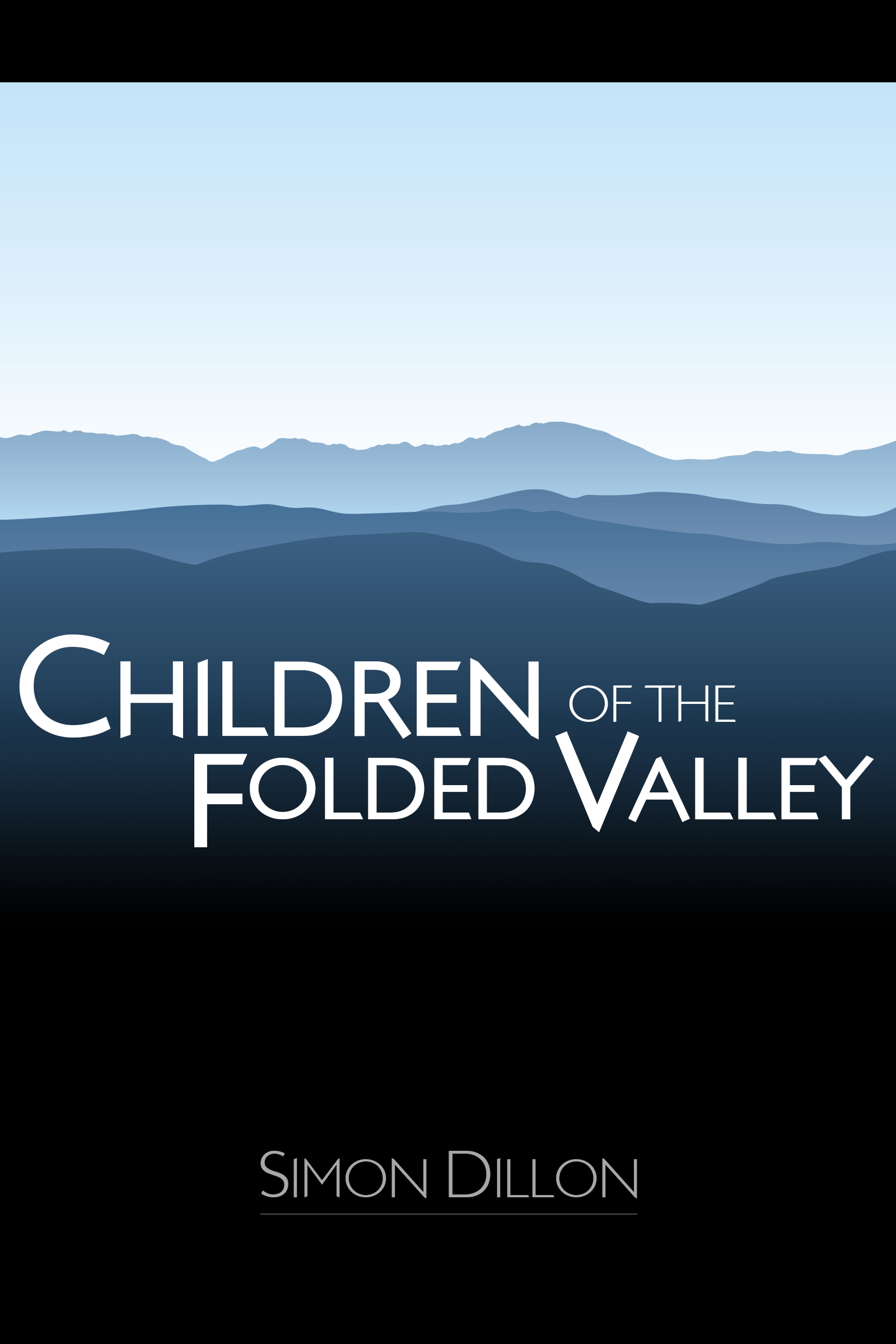
Here is the cover for my new book – my first novel for grown-ups – Children of the Folded Valley.

Folded Valley cover

The process of coming up with an appropriate image for this story was tricky for a number of reasons – not the least of which was fear of spoilers. I wanted to avoid a situation akin to the notorious Planet of the Apes DVD, where the famous twist ending was given away by the image on the cover. In the end my designer Charles Bown opted for something minimal and enigmatic. I hope you like it.

Once again, here is the blurb from the back:

“From the author of Uncle Flynn and George goes to Mars

During a journey to visit his estranged sister, James Harper recalls his childhood in a mysterious valley cut off from the outside world, where he grew up as part of a cult called the Folded Valley Fellowship.

In this seemingly idyllic world, the charismatic Benjamin Smiley claimed to be protecting his followers from an impending nuclear apocalypse.

But the valley concealed a terrifying secret.

A secret that would change Smiley’s followers forever.”

Children of the Folded Valley will be released on the 20th of July as a digital download. Print copies will be available at Lulu.com from the 27th of July.

Do you have to visit a location to write about it?

This year, in addition to the third George Hughes book, George goes to Neptune, I have also completed a first draft of a novel set almost entirely on Lundy Island. Details of this novel will remain top secret for now, but the fact it is set on Lundy got me thinking: is it possible to write convincingly about a real location if you have never actually set foot there?

The_Jetty,_Lundy

Visiting Lundy is something I could easily do since I live in South West England, but I haven’t got round to it yet. However I have researched the island in immense detail; examining photographs, poring over maps, reading guide books, discovering details about its population, history, buildings, coastline, flora and fauna… you name it. Furthermore, my mother-in-law has stayed there, and has also provided a great deal of information about what the place looks and feels like.

I am reminded of another author who did very little travel yet wrote extensively about other lands and cultures without actually visiting them: Herge. Many of the cells in the Tintin comics are based on photographs of real places, and it is clear from the text that his subjects are meticulously researched. The fact that Herge did not actually go to many of these places doesn’t seem to detract at all from the richness of his storytelling.

tintin-black-island-page-b

Frankly, if you do your research properly, I don’t think it is strictly necessary to visit a location in order to write about it. A visit can certainly help and provide inspiration, and I would always prefer to do that (I am determined to visit Lundy soon), but I don’t think it is absolutely essential.

Conversely, I would argue that writing about things outside your personal experience is a much more difficult proposition than writing about a location you haven’t actually visited. By that I don’t mean the mechanics of a plot – after all, I haven’t been to Mars, Titan or Neptune but that didn’t stop me writing about visiting them in the George Hughes series – but more the underlying themes of a story.

For example, the battle scenes in The Lord of the Rings have clearly been written by someone who has been in armed conflict (Tolkien served in the British Army during the First World War). As a result, in spite of the fantasy setting, the horrors of war are far more resonant than they would have been otherwise.

Heartbreaking themes of lost fathers crop up again and again in the works of Charles Dickens. Because his own father was imprisoned for debt, this experience no doubt informed much of his writing, making it far more poignant and believable.

My upcoming novel Children of the Folded Valley (out on the 20th of July) draws on themes of control and abuse in religious cults, of which I have personal experience. I’m not saying it is impossible to write about being in a cult unless you have been in one, but I believe personal experience on the part of the author does make a difference, and is a far more important factor in the success or otherwise of a novel than simply whether or not you have actually visited a location you are writing about.

Children of the Folded Valley: A parental tribute

This month I will announce publication dates for Children of the Folded Valley, but before I do, I wish to relate a short anecdote regarding my late father, and the vital input he had into many of my books – including this one.

popbw

As any writer will know, one of the biggest problems you face when critiquing your own work is objectivity. How can you know when something is working or not when you are that close to it? Often you are far too personally involved to be certain.

There are really two ways around the problem. One is time. I often allow a few months to elapse between drafts so I can review the book with a fresh eye.

The other is obviously to rely on advice and opinions from others you trust. My father – who taught English – was my most valued and respected critic. I didn’t always agree with his assessments of my work, but I always gave his opinion serious consideration and more often than not concluded that he was correct.

In the specific case of Children of the Folded Valley, I wrote the initial draft in the summer of 2011, and went back and forth with my Dad; getting his perspective and ideas too.

There was one particular aspect of the novel I had watered down somewhat, as I was concerned about causing offence. The story still seemed to work perfectly well, so I didn’t give this issue much thought after I had written the initial draft. However, in April 2012, during a visit to Israel, late one night I telephoned my Dad on a whim. During our conversation he said he’d had an idea as to how the current draft of Children of the Folded Valley could be improved, suggesting this particular aspect of the novel be akin to what I had originally envisaged. I hadn’t read the manuscript for a while, so I glanced at it and saw he was absolutely correct. I thanked him profusely for his input, which frankly I think made the novel more relevant, more powerful and braver.

That was the last conversation I ever had with my Dad. He died the following month, on 7th May 2012.

Children of the Folded Valley is dedicated to both my parents (see below pic), but I will never forget the vital role my father had in shaping the final version.

MUM AND POPsmall