
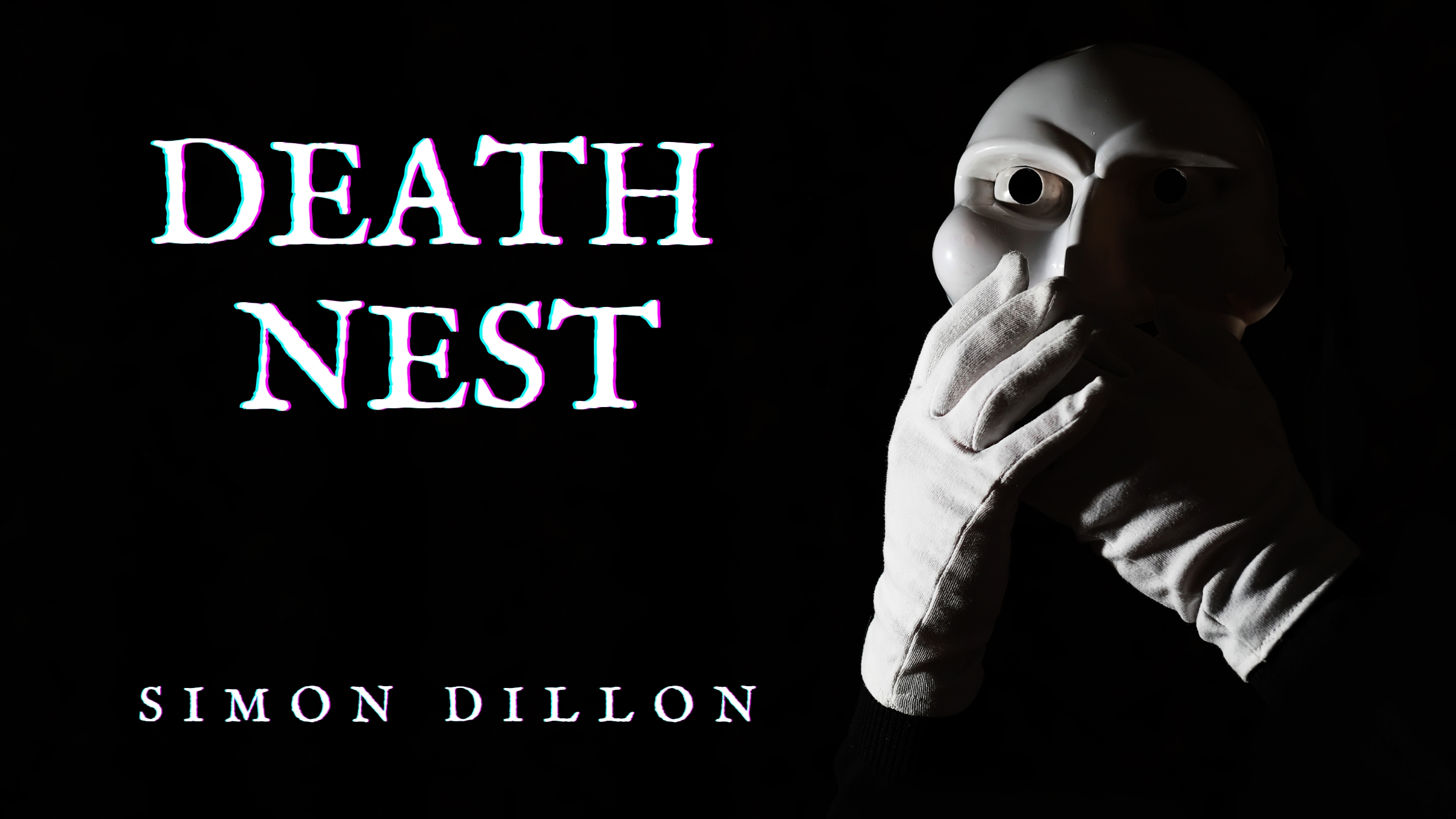
What inspired, influenced, or otherwise informed my latest novel, Death Nest? It has a strange history. I’ve already spoken on this blog about how intensely personal the book is on a metaphorical level, but whilst the novel frames this by exploring traumatic sibling relationships, parental fears, and the misleading nature of memory, the genesis of the story itself came from an altogether different source.
A cursory glance at my scribbled notes informs me the first time I conceived this story was in early 2019, but the premise is rather different. At that point, the working title was simply Film Censor and the protagonist was female. She worked at the British Board of Film Classification in London (BBFC), where films are given certificates (U, PG, 12A, 15, and 18). Here, she views a film that features an image of what appears to be a young girl who mysteriously vanished during her childhood. How has the director managed to capture this young girl on film? Is it a ghost? Or someone who simply looks like her?
Remarkably, this premise is almost identical to the film Censor, which came out in cinemas a couple of years later (though that film takes a very different turn from what I would have done with my story). I ditched the idea of making the protagonist work for the BBFC, as unlike Censor, my story wasn’t really about the issues around film censorship. Instead, I had the protagonist be a member of the general public who sees this image of her childhood friend at a public screening in the cinema. But at this point, the story went in an entirely different direction to what happens in the final version of Death Nest. I won’t say what else was in my original outline, as I may explore the subsequent plot threads in another novel at a later date.
However, when I had the dream I discussed in this article, the idea for the book radically changed. After a long period of reflection, I ditched everything except the idea that the protagonist sees the image of what appears to be a ghost at a cinema screening. The rest of the story was built from scratch, and it became a much more intensely personal work, focused on coming-of-age elements in flashbacks, and the more sinister revelations that come to light in the second half of the novel. At a certain point, I broke with tradition and switched the protagonist’s gender to male. All my other novels in the gothic mystery horror-thriller tradition feature female protagonists.
With a radically new plot outline, character profiles, and so forth, I proceeded to write the first draft in early 2020, with the working title The White Nest. Afterwards, I changed that title to Death Rattle, which eventually became Death Nest. As I’ve written about elsewhere, after completing the first draft, I set the manuscript aside for a long time, and the subsequent to-ing and fro-ing between beta readers in which the final draft was shaped isn’t worth recounting in detail here.
Perhaps unusually, the tales that informed this novel aren’t necessarily supernatural thrillers or horror stories. Instead, the influences were an eclectic bunch ranging from Great Expectations by Charles Dickens to (bizarrely) films like romantic comedy Adventureland. Obviously, my novel bears no resemblance to the latter, but it does feature a somewhat second-rate theme park as a setting, like that film. As for the Dickens classic, themes of thwarted adolescent love are in my story too, though the object of my protagonist’s affection, although enigmatic, is certainly not cruel like Estella. Elsewhere, the brainwashing elements present in A Clockwork Orange, The Manchurian Candidate, and The Parallax View also lingered in the back of my mind while writing.
Death Nest is out now. Here’s the blurb from the back of the book:
From the author of Spectre of Springwell Forest and The Irresistible Summons…
A nail-biting new mystery.After his young son Ben writes a disturbing story about murdering a boy in a forest, widower Nick Unwin is alarmed by eerie parallels between his son’s behaviour and that of his younger brother Jason, prior to his inexplicable disappearance twenty years previously. This tragic past returns to haunt Nick when he sees an image of his long-lost brother in a newly released film.
Fearing history will repeat itself, Nick decides to investigate, along with Tanith, an old flame from his early teenage years, with dark secrets of her own connected to Jason’s disappearance. But as they delve deeper into the labyrinthine mysteries of their past, long buried memories resurface. Nick is forced to face the terrible fear that has plagued him for decades: Was he responsible for the death of his brother?
A riveting coming-of-age thriller exploring traumatic sibling relationships, parental fears, and the misleading nature of memory, Death Nest is Simon Dillon’s most gripping novel yet.
Get your copy today! Available in paperback or on Kindle from Amazon (click here for the UK, and here for the US). It’s also available from Smashwords and their various outlets.



 Simon Dillon Books
You must be logged in to post a comment.