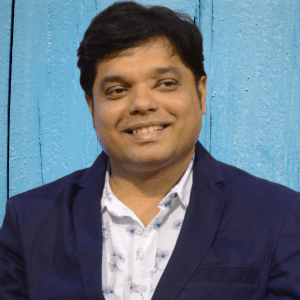
 Horror fans yet to discover Indian writer Neil D’Silva are in for a treat. His unique, Hindu folklore infused tales are grippingly gruesome, and never disappoint in the scares department. However, his novel Yakshini deserves a wider readership than just gore hounds. Incisive, challenging social commentaries about modern India bubble underneath. More on those in a moment, but first I must do my duty as a horror evangelist and urge those who consider the genre disreputable to look closer. A futile endeavour perhaps, but one D’Silva has much sympathy with.
“We are drawn to horror stories because the unknown has fascinated us since time immemorial,’ he says. “A lot of us acknowledge the “seen” world is not the only world. Our collective knowledge is just a small fraction of everything out there. We have all sensed things in the darkness and solitude… That’s what brings most of us to horror. I was quite a cowardly child, but as I began writing horror, I found myself scaling new boundaries within my phobias. There are fears that I have overcome through my writing and also reading, and I am grateful to the horror genre for that.”
I too, have found catharsis in horror, especially when it mixes supernatural elements with grounded realism (other examples include the novels of Ania Ahlborn, or Under the Shadow and The Babadook in the film world). They may sound unlikely bedfellows, but this technique is very effectively adopted by D’Silva in his writing. Yet whilst delivering the genre goods, I detected an urgency to the social issues highlighted in Yakshini, regarding rural arranged marriages, and the recent high-profile rape cases that shook India. When asked about the latter, D’Silva admits the infamous Nirbhaya case in Delhi cast a shadow over the book.
“The brutality was out there for everyone to read in the papers. When I read about it, and similar rape cases that happened in its aftermath, it both terrified and angered me. How could humans be so depraved as to brutalise another fellow human in that heinous manner? It opened in my mind a chain of thought. What if the woman in question had something in her, a kind of power, that would have helped her fight back, and mete out the same treatment to her brutalisers? But while that sort of thing sounds great on paper, it opens up another can of worms – that of moral policing, victim-shaming, and expecting women to behave in a particular manner. If women indeed did have the agency to fight back, our patriarchal system would still make her the culprit. That is the issue I addressed in Yakshini. Can a woman easily fight back the injustice meted out to her? Sadly, no. Often, we have seen that the victim is victimised more. That suffocating and infuriating thought led to the birth of Yakshini.”
 A supernatural thriller infused with Indian mythology, Yakshini concerns the eponymous immortal demi-goddess banished from her celestial dwelling. She is doomed to share the body of a human girl named Meenakshi, causing her to lead a curious, Jekyll/Hyde existence. Unable to bear Meenakshi’s rural patriarchal society, the Yakshini lashes out against lustful males, seeking bloody revenge. Serious problems ensue for Meenakshi, even leading her to be branded as a witch.
D’Silva also acknowledges the contrasting aspects of Indian society reflected within his writing, especially the differences in city and country. “Life in the urban areas of India, especially Mumbai, is very different from life in the rural zones. The urban centres have a broader worldview and, though we believe in strong family ties, the concept of individual freedom is better understood. The rural villages and small towns are infused in rich traditional values, which gives them a distinct flavour.
“Speaking specifically about the practice of arranged marriages, those are still prevalent in both small towns and huge metropolises. Marriages have always been a family affair in India and often the couple will get to know each other only briefly before they are betrothed. However, this is changing rapidly in the metros, especially Mumbai, with more and more people marrying out of love rather than a family arrangement. The sense of individual freedom has set in, but the beauty of our culture is that even in that, the value of familial ties is never forgotten.”
Despite the issues raised by the book, D’Silva is keen we don’t overthink it. “While Yakshini was strongly influenced by a particular rape case, I did not really start out with the intention of giving any kind of message. I just wanted to tell a story that would shake us from our state of complacency. But my readers have perceived it as a strongly feminist story, for which I am quite grateful. India’s leading feminist community, SheThePeople, was kind to feature Yakshini on their website, and even have me speak at their lit-fest. A few other reading clubs had discussion events around Yakshini where the feminism in the book was studied and analysed.”
Some have branded Yakshini as “the Indian Carrie” but I find Stephen King comparisons unhelpful and unfair. D’Silva’s work stands in its own right, especially in the way he fuses folklore and the supernatural with more grounded issues. Besides, when questioned on influences, D’Silva doesn’t even mention King.
“I learnt my scares and atmosphere from Edgar Allan Poe, Bram Stoker, and Mary Shelley, at a very early age. I learnt how to tell stories through conversations from Agatha Christie and Arthur Conan Doyle. I learnt how to write riveting prose from Jeffrey Archer, and other contemporaries. I was impressed by the writing of many Indian writers such as Ruskin Bond, Khushwant Singh, R. K. Narayan, and Munshi Premchand, who could bring out the essence of India with simple and yet evocative words.”
Raised in a rich literary environment courtesy of his book hoarding father, who worked translating Indian films from Hindi to English, D’Silva honed his English skills by working as an assistant. “Sitting next to him, I’d see him hack away at his Remington typewriter, and was soon fascinated about how deftly he translated those stories. I would read the scripts to him, and those stories fascinated me. I owe a lot to my father… I don’t know if he actually read the hundreds of books that he collected. But that did rub off on me. I’d spend lonely afternoons swallowing book after book.”
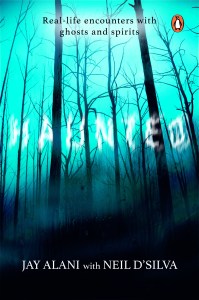
 Increasingly famous in his own country, D’Silva’s status as a significant new literary talent among Indian writers registered immediately, as his first, self-published novel Maya’s New Husband shot to number one in Amazon India’s horror bestsellers. It remained in the top ten for close to two years, which landed him attention from literary agency The Book Bakers and then traditional publishers, as well as a loyal and growing readership that has now expanded beyond India. He since quit his teaching job to write full-time. With nine books to his name, at publishers including Penguin Random House, Rupa, and Hachette India, Yakshini is one of three novels currently in development for a film adaptation. But D’Silva is particularly excited about an adaptation of his non-fiction book, Haunted: Real-life Encounters with Ghosts and Spirits.
“This book was co-authored with paranormal investigator, Jay Alani, and tells his experiences in ten of the most haunted locations in India,” D’Silva explains, “including the Bhangarh fort, the abandoned Kuldhara village, the “black magic” village of Mayong, and others. The book, published by Penguin Random House, was quite hair-raising to say the least, because these were true experiences. We have now scored a major web series deal on this book with Juggernaut Productions.”
 When pushed on whether he has ever had a supernatural experience of his own, D’Silva is more guarded, though he does relay one scary childhood story. “I grew up in a colony that was rumoured to be built on a graveyard. Of course, we had no evidence of it at all and it might all have been the kind of juvenile poppycock teenagers indulge in, but it did give rise to several hair-raising moments that led to my imaginative mind taking great leaps, fuelled by the stories I had heard. On one occasion, I saw a woman dressed in a white saree walking on the ledge of the terrace of the four-story building opposite ours in the middle of the night. The woman was just walking along, precariously, maintaining her balance somehow, singing something softly. At one point, I felt she had sensed my presence and was turning to look at me, but before that, I ducked into my covers and shut my eyes.
“The next morning, the watchman of our colony had never shown up. When people visited his house, there were five finger marks on his face. The poor watchman said that he had been patrolling the building in the night when a woman clad in a white saree had approached him from behind, tapped on his shoulder, and when he turned, struck him right across the face and vanished. No one could find out who the woman was. That incident still shakes me badly.”
 What The Eyes Don’t See, D’Silva’s most recent novel, launched today; exclusively on Wattpad. This paranormal horror thriller has already been covered by key publications including Mid-day and The Times of India. It reached 7000 reads on the very first day of release, an indication of growing and dedicated fandom. D’Silva describes the nifty premise with glee; a clever reversal on the no-one-can-see-it-but-the-protagonist ghost story trope.
“What The Eyes Don’t See… tells the tale of Anay Ghosh, a young man in the city of Mumbai who has everything going for him, until a paranormal entity enters his life. This entity, whom everyone around Anay can see but him, is bent on destroying everything he has.”
Neil D’Silva’s self-made success story has made him something of an online guru to other writers wishing to repeat the trick. His Facebook group For Writers, By Authors has over 21,000 members. In addition, he has recently started a You Tube channel featuring contributions from other authors and industry specialists. By remaining friendly and approachable to all, he has made himself immensely popular, though given his exponential success, I wonder just how long he’ll be able to keep all those plates spinning.
“I love promoting good literature,” he says. “It’s my biggest motivation in keeping my various activities going on. My YouTube channel as well as my Facebook group are geared towards giving rise to new literary talent, and I find time to do it. On a more practical note, I spend a few hours each day to keep up with my social activities. It still gives me a fair amount of time to do my primary job, i.e. to write. I also feel I owe a lot to the social media writers’ community because that was where I learnt a lot about publishing and marketing books. In a way, I am just paying it forward.”
Neil D’Silva’s official website is here, his Facebook page is here, his Twitter page here, his YouTube channel can be found here, and you can check out his books here.
 I’ve recently been interviewed on a number of blogs, mainly to promote my latest gothic mystery novel


 Simon Dillon Books
You must be logged in to post a comment.