Death Nest: Reflections on Writing My Most Personal Novel

Image created by author in Canva.

My mystery thriller novel Death Nest has recently been published. With all the will-readers-like-it anxiety that comes with a new release, this one particularly has my stomach in knots, as it is one of my most “personal” novels. Written in early 2020, I experienced an unusually intense time getting it on the page, in a way that hasn’t happened with any other novel. This one felt painful to write, and by the end, I was exhausted, emotionally drained, and didn’t even care if the manuscript was any good.

In the aftermath, for the first time ever, I found myself unable to write fiction. The voices in my head, normally yelling over each other to be heard, fell silent. It was frightening. I was worried I’d done a Truman Capote and wouldn’t be able to write anything of significance ever again. This lasted for the rest of 2020, and when I finally got back on the horse the following year, I was terrified. Could I write another novel?

Thankfully, I could. In retrospect, certain other factors besides those I’m about to discuss doubtless contributed to my inability to write in 2020. A global pandemic and redundancy from a day job in television I’d held for over twenty years will do that for you. Nonetheless, Death Nest (or The White Nest as it was tentatively titled in those days) carried a lot of personal baggage. When I finally reread the manuscript, it was much better than I remembered, and whilst I could see a fair bit of raw nerve jabbing in the story, for anyone else reading, I suspected they wouldn’t detect the same anguish. Instead, I hoped they’d think of it purely as a nail-biting mystery with hints of the supernatural, akin to previous novels I’d published, like Spectre of Springwell Forest and The Irresistible Summons.

Of course, describing a novel as “personal” is a little silly, as I consider all my fiction writing personal in some way. At the same time, I would be foolish not to acknowledge when a story is more directly rooted in personal experience. Children of the Folded Valley, my most successful book to date by far, was previously the most “personal” of my novels, as it is directly informed by some of my own experiences. In contrast, Death Nest is every bit as personal, if not more so, but not on a literal level. It is personal on a metaphorical, emotional level.

What’s it about?

The narrative concerns a widower who fears his young son is cursed when he shows disturbing behaviour akin to that of the widower’s younger brother, before he vanished without a trace in a supposedly haunted forest, twenty years previously. In fact, the protagonist, Nick, thinks there’s been a curse on his entire family ever since his late entrepreneur father developed land considered sacred in pagan folklore into a theme park.

The novel flashes back to coming-of-age incidents in Nick’s early teenage years, including his first love. Several mysterious incidents feed into the subsequent narrative, including the baffling disappearance of Nick’s younger brother. Nick has felt a weight of guilt and responsibility for years, as he was in the forest with his brother when he vanished, but has no memory of what took place, beyond a vivid recollection of fleeing the forest in terror, covered in blood and bruises.

Why is this one so personal?

Fears that Nick’s young son will end up likewise being lost are at the core of why this novel is personal to me. Time to grit my teeth and tell you the personal stuff: My youngest brother, ten years my junior, went on a deep dive into drugs during his mid-teens. He got worse and worse, and wound up being diagnosed with paranoid schizophrenia. My parents had to have him sectioned in late 2005. They had no choice, as he’d come to believe they were trying to kill him, and he was living in their coal shed with a plastic bin bag of items that weren’t “contaminated”.

Seeing this happen to my beloved younger brother, with whom I had once been so close, was distressing beyond my ability to put into words. His “disappearance” in this respect has often felt worse than death. I have grieved him many times, and also felt a sense of guilt over it for complicated reasons. For instance, I wonder if my partying days as a teenager (which didn’t involve drugs) were something to which he aspired. In my darkest moments, I ask painful questions: Was my love for drug-addled bands like The Prodigy a bad influence? Was I wrong to show him Trainspotting, a film I thought condemned drug use, but that he later claimed turned him on to drugs?

Flash-forward several years, to 2019. In my youngest son, I see eerie parallels to my youngest brother. He is sharp, quick-witted, and shares the dark sense of humour my brother had at the same age. He is incredibly clever, just like my brother was before his brain was destroyed by drugs. Complicating matters, my youngest son has an autism diagnosis, and is struggling in many respects, in school (with school culture rather than academically), in self-esteem, and socially. I sense the walls of a world hostile to the neuro-diverse moving in to crush him, and I am powerless to help.

An upsetting dream proved a catalyst for the novel

Whilst on holiday that summer, I had a vivid and profoundly upsetting dream. This dream appears, in a slightly modified form, in the novel. I saw my youngest son as an old man, holding the toy dinosaur we’d bought him that holiday, which he loved. In the dream, I know that my wife and I, and his older brother, are all long since dead. I saw him alone, with no wife, children, relatives, or friends. He sat in a room filled with packed boxes, and an orderly from an old person’s home arrived to take him away. My son put down the toy dinosaur on his chair as he stood. The orderly asked if he wanted to bring it, but my son shook his head, saying he didn’t need it anymore. The last connection with the halcyon days where he shared in the love and laughter of our family had been severed.

I awoke from this dream. It was early, and everyone else was still asleep. I took a shower, then curled up in the corner as the water ran, overwhelmed with grief. Everything collided in my head; the grief of what had happened to my younger brother, and the anguish I felt at this vision of a possible future for my youngest son. I didn’t necessarily expect my son to get into drugs, but I feared he would wind up in a future where he was completely alone. It was unbearable. I daresay anyone who loves their child would feel the same.

The upshot

When I wrote Death Nest, it was an exorcism of sorts; a cathartic exercise in turning these complicated emotions — grief over my brother, fear for my son — into a page-turning mystery. As I indicated earlier, I hoped that the anguish in which this story was conceived would not register with those who read the novel. So far, that appears to be the case, as not only was the beta-reader feedback for Death Nest overwhelmingly positive, but it was taken exactly how I had hoped, as a gripping and sinister thriller.

I hope you’ll forgive me for being so personal in this article. I wanted to provide a glimpse into what was ultimately a positive experience that helped me come to terms with some of these complicated feelings concerning my brother and my son. I don’t pretend to be a psychiatrist, and I know everyone will approach such personal matters differently based on personality, temperament, upbringing, culture, and so on. However, writing fiction is a powerful tool that has helped me process a lot of difficult feelings and events. I’m sure I’m not alone in experiencing this.

I hope this has been insightful. My novel Death Nest is out now in paperback or on Kindle from Amazon (click here for the UK, and here for the US). It’s also available from Smashwords and their various outlets.

NOTE: This article originally appeared in The Writing Cooperative on Medium.
Death Nest: Chapter 1 Excerpt

Here’s a taster of my new novel Death Nest, taken from the beginning of chapter 1.

Image created by author in Canva.

  This is the third time in as many weeks I’ve been called into school to speak to Ben’s teacher. Only last week, Mrs Trench complained of him swearing in class. The week before he got into a scuffle with another child. This time, the incident is serious enough to involve the head teacher, Mr Brown – a scrawny young man in his late twenties. From behind his desk, he addresses me in condescending tones.

‘Mr Unwin, we’re concerned about Ben. Deeply concerned. As you know, he’s been swearing at teachers, getting into fights…’

  ‘He got into one fight, and that was self-defence,’ I cut in.

  ‘He really ought to have found a teacher, and resolved the matter that way,’ says Mrs Trench, a thin, wraithlike figure sitting to my left.

  I shrug. ‘And that teaches him what, exactly? Do you think crying to HR is going to help him when he gets treated unfairly in the workplace? People have to fight their own battles. Ben didn’t start that fight, but he finished it fairly and proportionately. The fact that he’s learned that at his age is reason to be proud of him, not to punish him.’

  Mr Brown sighs. ‘We’re not here to discuss that, or the swearing.’

  ‘I really don’t see why you were so shocked by the swearing.’

  ‘We were concerned about what he might be watching on television,’ Mrs Trench says.

  I laugh. ‘Children pick up swear words at school and often don’t know what they mean. He’s seven, for God’s sake! He wasn’t trying to be aggressive.’

  Mr Brown passes me an open exercise book. ‘Ben wrote this, as part of an English exercise to write a story about taking a walk in the woods. We expected the children to write about trees, blackberry bushes, acorns, conkers, animals they might have glimpsed, and so on. However, Ben’s story is… somewhat different.’

  I scan the story. Ben’s handwriting is excellent, and his word usage articulate and vivid. I get that familiar surge of pride. He’s a very bright child.

  As the story progresses, my pride turns to unease.

  I took Sebastian into the woods to kill him. He didn’t know, and I didn’t want to tell him, because I knew how much killing him would hurt. Sebastian doesn’t understand, but there’s bad inside him, and the only way to get the bad out of him, is for him to die. So I took him deep into the trees, where we were all alone, and no one would hear him screaming. Then I stabbed him with a dagger I’d secretly brought with me. There was a lot of blood. He cried and kept asking me to stop. But I didn’t stop. I had to get rid of the bad inside him.

  At the end of the story is a gruesome illustration featuring a stick figure next to a tree with a dagger in his hand, standing over another stick figure on the ground, who appears to be bleeding out. Mr Brown and Mrs Trench scrutinise me as I look up from the picture. It is understandable why they found Ben’s story alarming. But I suppress my own creeping fears and shrug.

  ‘Yes, it’s a disturbing story, but lots of children write about dark things to express morbid fascination and macabre curiosity about violence and death. Typically, they grow out of this later in life, and don’t become killers.’

  ‘Do you know who this Sebastian might be?’ Mr Brown asks.

  I shake my head. ‘We don’t know a Sebastian, unless there’s someone called Sebastian that Ben knows in school. Is there?’

  ‘There are no Sebastians in the school,’ Mrs Trench says.

  ‘Look, obviously he’s just made him up, like the rest of the story. He doesn’t actually want to kill anyone.’

  ‘What do you make of this bit where he talks about killing Sebastian, to get rid of the bad inside him?’ Mr Brown asks.

  ‘I couldn’t say.’

  ‘We think it might be advisable to seek counselling for Ben. Between the fights, the swearing, and now this violent story, the opinion of a professional…’

  ‘The incidents are unrelated,’ I interrupt. ‘Yes, this is a peculiar story, but I really think it’s nothing to be concerned about. As I said, children often express themselves in unsettling ways that have a rawness, curiosity, and honesty to them, that perhaps…’

  ‘Mr Unwin, please remind me what it is that you do for a living?’

  ‘I help design computer games, but I don’t see how that’s relevant.’

  ‘My point is you are not medically qualified to make judgements about Ben’s mental wellbeing.’

  ‘As his father, I think I am exceptionally qualified. There is nothing wrong with my son.’ I glare at Mr Brown and Mrs Trench, trying to remain calm.

  Mrs Trench exchanges glances with Mr Brown and addresses me with a horrible expression of phoney pity. ‘Forgive me for asking Mr Unwin, but how long has it been since your wife passed?’   I stand, fuming inwardly. ‘I’m finished here. Thank you for your concern.’

Death nest, Simon dillon, 2023.

Death Nest is out now, in paperback or on Kindle from Amazon (click here for the UK, and here for the US). It’s also available from Smashwords and their various outlets.

Death Nest Out Now!

Image created by author in Canva.

My latest novel, Death Nest, is out now!

This gripping mystery thriller was originally written in early 2020. It is one of my most “personal” works to date, and I’ll expound more on why in a future article. In the meantime, I’m immensely excited to finally have this story out for you all to read and enjoy.

Here’s the blurb from the back of the book:

From the author of Spectre of Springwell Forest and The Irresistible Summons

A nail-biting new mystery.

After his young son Ben writes a disturbing story about murdering a boy in a forest, widower Nick Unwin is alarmed by eerie parallels between his son’s behaviour and that of his younger brother Jason, prior to his inexplicable disappearance twenty years previously. This tragic past returns to haunt Nick when he sees an image of his long-lost brother in a newly released film.

Fearing history will repeat itself, Nick decides to investigate, along with Tanith, an old flame from his early teenage years, with dark secrets of her own connected to Jason’s disappearance. But as they delve deeper into the labyrinthine mysteries of their past, long buried memories resurface. Nick is forced to face the terrible fear that has plagued him for decades: Was he responsible for the death of his brother?

A riveting coming-of-age thriller exploring traumatic sibling relationships, parental fears, and the misleading nature of memory, Death Nest is Simon Dillon’s most gripping novel yet.

Get your copy today! Available in paperback or on Kindle from Amazon (click here for the UK, and here for the US). It’s also available from Smashwords and their various outlets.

Look out for more about Death Nest on this blog over the next few weeks, including excerpts, information on inspiration and influences, and other exclusive insights.

Death Nest Countdown: One Day to Go

My new mystery thriller novel Death Nest is out on the 1st of October and available for pre-order at Amazon and Smashwords. Here’s a final teaser image as we count down to the release with just one day to go!

A cryptic comment on today’s image: What is the White Nest?

Created by author in Canva

Death Nest Countdown: Two Days to Go

My new mystery thriller novel Death Nest is out on the 1st of October and available for pre-order at Amazon and Smashwords. Here’s another teaser image as we count down to the release.

A comment on today’s image: Some of my earlier mystery horror-thrillers featured either (apparently) haunted forests, sinister mansions, secret tunnels, and labyrinths. This novel features all four. I’m not shy about leaning into gothic location tropes when they serve the story well.

Created by author in Canva

Death Nest Countdown: Three Days to Go

My new mystery thriller novel Death Nest is out on the 1st of October and available for pre-order at Amazon and Smashwords. Here’s another teaser image as we count down to the release.

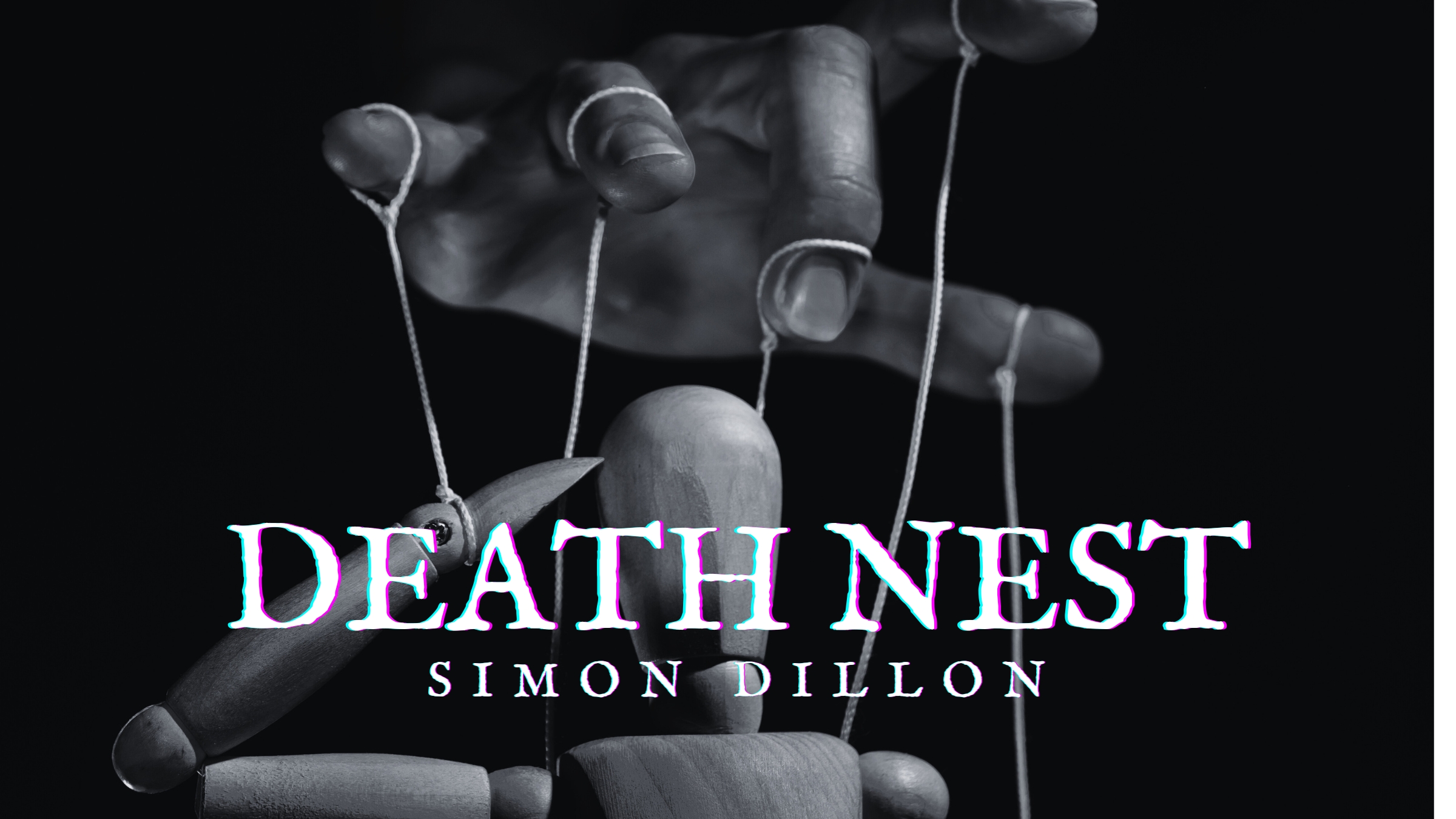
A comment on today’s image: This is more a metaphorical picture, as no one literally plays with marionette puppets in the novel. But the unsettling thematic implications ought to be clear.

Created by author in Canva

Death Nest Countdown: Four Days to Go

My new mystery thriller novel Death Nest is out on the 1st of October and available for pre-order at Amazon and Smashwords. Here’s another teaser image as we count down to the release.

A spoiler-free tease on today’s image: What terrible secret lies at the heart of the Darkfire Forest?

Created by author in Canva

Death Nest Countdown: Five Days to Go

My new mystery thriller novel Death Nest is out on the 1st of October and available for pre-order at Amazon and Smashwords. Here’s another teaser image as we count down to the release.

A brief spoiler-free comment on today’s image: There is a romantic subplot.

Created by author in Canva

Death Nest Countdown: Six Days to Go

My new mystery thriller novel Death Nest is out on the 1st of October and available for pre-order at Amazon and Smashwords. Here’s another teaser image as we count down to the release.

I won’t comment on today’s image for fear of spoilers, except to say, probably needlessly, that the novel features sinister, nail-biting, suspenseful events.

Created by author in Canva

Death Nest Countdown: Seven Days to Go

My new mystery thriller novel Death Nest is out on the 1st of October and available for pre-order at Amazon and Smashwords. Here’s the first of a few teaser images counting down to the release.

A spoiler-free comment on this image: The story features a cave on the north Cornwall coast, in the fictional village of Corthpothan (loosely inspired by the real Cornwall coastal village Porthcothan).

Created by author in Canva