

In storytelling, a great antagonist is as important as a great protagonist. The most satisfying narratives feature determined, active characters facing off against equally determined opposing forces.
A recent article on this blog listed ten of my favourite literary villains. Here are three antagonists from my own novels that I suspect, in retrospect, personify what I take a dim view of, drawn from personal experience, as well as political and spiritual outlook. Whilst some villains in my stories must remain anonymous, for fear of spoilers (particularly those in my gothic mystery horror/thriller novels), these three I can talk about upfront, without ruining the plot.


Graham Brooks (The Birds Began to Sing) – Although he isn’t the main villain, and only appears in one chapter during the first act, Graham Brooks is small-minded, petty, power-crazed, two-faced, and vindictive. He represents everything I despise about modern business management, with his meaningless targets, character assassination performance reviews, ghastly corporate lingo, and utterly phoney belief in so-called “teamwork”. I also took the opportunity to depict how much I loathe people who insist “problems” are “opportunities” (see what I did there?). As my protagonist Alice observes, alcoholics don’t have drinking opportunities.
Imalik (Echo and the White Howl) – Imalik is an ambitious and extremely dangerous wolf, who enters into a Faustian deal with a mysterious and malevolent supernatural force. He murders the pack Alpha, and forces other packs in the surrounding land into a union by systematically slaughtering the elk, moose, and other prey in their terrain, thus making them dependant on him for food. Imalik’s totalitarian dictatorship can be read as an allegory of any fascist state you care to name, especially those that have deliberately created food scarcity as a means of control. I didn’t intend Echo and the White Howl as anything more than an adventure story about wolves in Alaska, but in retrospect, some of my despair at short sighted political stupidity and greed over issues like overfishing may have crept in.
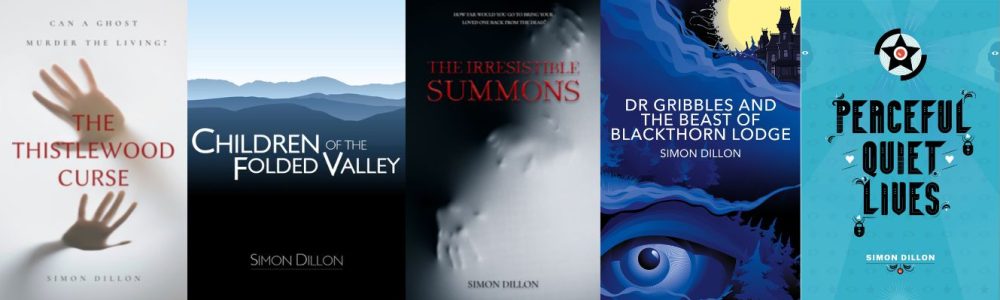
Benjamin Smiley (Children of the Folded Valley) – Of the many villainous faces of religious oppression in my stories, none are more diabolical than Benjamin Smiley. Exactly how he came to lead the mysterious Folded Valley Fellowship can’t be revealed here, suffice to say he is a master manipulator who preys on the weak and emotionally vulnerable, as per all cult leaders. His apparently miraculous powers of healing hold his congregation rapt, ensuring his more dubious activities (including assertion of sexual rights over whomever he chooses) go unquestioned. Benjamin Smiley is based on a number of real people I encountered during childhood, adolescence, teenage years, and even adulthood. Abuse of religious power remains the number one theme I return to in my novels, time and time again.
 Simon Dillon Books
You must be logged in to post a comment.