NEW RELEASE: Echo and the White Howl – out now!

My latest novel, Echo and the White Howl, is out now!

Set in the vast Alaskan wilderness, this epic story of wolves will thrill and delight. With hunts, blizzards, dangerous journeys and a mysterious, supernatural edge, Echo and the White Howl is an animal fiction adventure for all ages.

Here is the blurb from the back of the book:

When a wolf pack discovers humans lurking near their territory, Echo senses dark times ahead.

Despite the warnings and omens, Aatag, the pack Alpha, refuses to flee… leading to a cruel turn of events that forces Echo into exile, and a quest for revenge that will change the pack forever.

Echo and the White Howl is available as a download or paperback from Amazon. Order your copy here.

NEW RELEASE: Echo and the White Howl – out tomorrow!

Just one day to go! My latest novel, Echo and the White Howl, is out tomorrow!

Set in the vast Alaskan wilderness, this epic story of wolves will thrill and delight. With hunts, blizzards, dangerous journeys and a mysterious, supernatural edge, Echo and the White Howl is an animal fiction adventure for all ages.

Here is the blurb from the back of the book: 

When a wolf pack discovers humans lurking near their territory, Echo senses dark times ahead.

Despite the warnings and omens, Aatag, the pack Alpha, refuses to flee… leading to a cruel turn of events that forces Echo into exile, and a quest for revenge that will change the pack forever.

Echo and the White Howl is out tomorrow, available as a download or paperback from Amazon. Click here to pre-order your copy.

NEW RELEASE: Echo and the White Howl

Exciting news! My latest novel, Echo and the White Howl, is out on the 11th of December.

Set in the vast Alaskan wilderness, this epic story of wolves will thrill and delight. A tale of vengeance with hunts, chases, blizzards, dangerous journeys and a mysterious, supernatural edge, Echo and the White Howl is an animal fiction adventure for all ages.

Here is the blurb from the back of the book: 

When a wolf pack discovers humans lurking near their territory, Echo senses dark times ahead. 

Despite the warnings and omens, Aatag, the pack Alpha, refuses to flee… leading to a cruel turn of events that forces Echo into exile, and a quest for revenge that will change the pack forever.

Echo and the White Howl is out on Monday 11th December, available as a download or paperback from Amazon. You can pre-order the novel here.

Interfaith Romance: An Interview with DM Miller

In the next in my occasional interview series, I caught up with author DM Miller, whose interfaith romance Heart series, chiefly concerning the relationship between Muslim Abdul and Jewish Catherine, caught my interest some time ago.

The Religion of the Heart, Agony of the Heart and Secrets of the Heart are now joined by the latest entry, Holiday of the Heart, and this seemed an opportune moment in the run-up to Christmas to delve deeper into the series.

What initially inspired the Heart series?

Believe it or not, it began as a dream. I’d always been a writer, starting out with poetry, then journalism, and I even wrote a manuscript at the ripe old age of 20. But later, the writing took a backseat to real life until I had this dream, which was the catalyst to get me writing again. At the time (2011), the Arab Spring was on the news every night, and it got me thinking about Egypt. Then the story took on a life of its own.

How much of you is in Catherine?

A little, but probably not as much as people think. I actually have more fun writing Abdul’s character.

Why are you drawn to the clash of the monotheistic faiths as a major theme?

The three main Abrahamic faiths claim to worship the same God, and yet He’s characterized so differently in each religion. I love to compare and contrast because we have a great deal in common, but the differences are fairly profound if you really think about it. Otherwise, there would be no need to separate the religions. So why do Jews, Muslims and Christians see Him so differently? There’s a lot of history and culture influencing our belief systems, politics as well.

I like to explore these things because I find it fascinating to analyse our differences honestly and without the hindrance of political correctness, while also highlighting our shared views.

And why these monotheistic faiths in particular? Well, they say to write what you know, and this is what I know. If you ask me to write about Hinduism, I’d have to start researching from square one!

Are any of the other characters based on people you’ve met?

Actually yes. None of them are based on one single person but a combination of various people I know or have known in the past. For example, Abdul is a health nut and obsessed with exercise, he is controlling and has issues with his father. All of these traits and problems are exaggerated versions of my own friends and family, and in this case, they’re put together in one character.

What inspired the most recent entry, Holiday of the Heart?

Even though I love books that make you think, I also enjoy Christmas love stories. Last year I read several, but most were fluffy and forgettable. They’re fun to read, but then I brain dump them. So it came to me last December, what if I were to write an interfaith holiday book, one with real substance and grit, one that people would not be as likely to forget? The Shadids and DiMarcos were perfect for this!

Did you base any of your novels on experience, or on stories you have heard?

Just like the characters, the stories are a mixture of imagination and various real life events mashed together. But I will say this: a great deal of research has gone into every single one.

Are you going to explore the complications of raising children in interfaith marriages in later novels?

There may be a little more of that in future Heart series books. As for other novels, I’m not sure yet. My next release will be a novella in January 2018. It is romantic suspense, and my signature interfaith theme is subtly woven into the plot but takes a backseat to the action this time. It’s like no book I’ve ever written, and at the same time, you will still recognize my style.

Do you think interfaith marriage can work in real life?

It’s tricky. If both partners are extremely religious, they’re better off marrying someone who shares their beliefs. If one or both are secular, it’s a lot easier, but either way, raising the children is challenging. This is something I wrote about in my nonfiction book, Half-Jew: Searching for Identity. I was raised interfaith myself and therefore know a thing or two about it.

How long will this series continue?

It could potentially go on and on. In my head, I have the characters’ lives planned out for years to come, and then there are their children and their lives as they grow up. However, I’m thinking of taking a little break from the series for now so I can write some other things and hopefully attract new readers. Once I grow my readership and subsequently, the readership for the Heart series, I will be able to continue writing it.

How much does your initial draft change before you get to your final draft?

The Religion of the Heart was the first book, and that one changed dramatically over the course of four years. The rest of the books don’t change a whole lot, but I keep tweaking them and often get lost in the details. You know when you rewrite something so many times, you eventually come full circle and end up where you started!

What is the best thing about being a writer?

Catharsis. It’s my vice. I don’t smoke, drink or do drugs, but I write. We all need a release, and this is the healthiest release I can think of.

What is the worst thing about being a writer?

Marketing. I hate it so much, I’ve been thinking about maybe, possibly, if I don’t change my mind… looking for an agent. So far I haven’t done so because I enjoy having full control over my work.

To what extent do you agree with the statement “write what you know”?

There is some truth to that, but you can put your heart into anything you feel passionate about and do enough research to make up for what you didn’t know before. If you are inspired to write about something for whatever reason, and you don’t know a thing about it, you can learn. It depends on what it is. With that said, when you know a topic inside and out, the words flow freely, and I’m sure that comes across far better to the reader.

Which writers inspire you?

Too many to list! However, recently I’ve come to the conclusion that my absolute favourite writer is Jan Ruth. It’s a little odd because she’s a British author who focuses on Northern Wales and horses, neither of which having anything to do with the constant themes of my books. But even though I’m not Welsh, have never been to Wales and am not a rider, I find similarities in our realistic family themes. And as passionate as Ruth is about Wales, I am about Israel and my Jewish roots.

Orit Arfa is an Israeli author who writes about some of the same issues as me, I love your work, Joel Hames, Maria Gibbs, A.M. Khalifa, Saul Bellow, Ernest Hemingway, Elizabeth Gilbert, Mary Campisi… I could go on and on. My original inspiration was poetry: Lord Byron, Sylvia Plath, Emily Dickinson, Dylan Thomas, Edgar Allan Poe… But I also read the commercial darlings like Debbie Macomber, Jackie Collins, Nora Roberts, etc, to see what they’re all about. I don’t always love their work but still find inspiration in their writing.

You thought I’d give you one or two names, right? It’s hard to narrow it down!

How important is social media if you are a writer?

Extremely. I have a love/hate relationship with it, but it has definitely helped me to market my work. Lately I’ve dedicated a little more time to Twitter (which I’d practically ignored in the past), my blog and Youtube, in addition to Facebook, and I think it all helps to get your work out there to the public and find that elusive readership we all seek. I wish I could spend the day holed up and focused on my writing, but unfortunately, marketing is a must. Social media is a free but time-consuming marketing avenue available to those of us who don’t have a stash of money to spend on getting our names out there.

What are your future writing plans?

Like I said, I have a novella coming out in January, then a new poetry book in April, and I’m thinking of writing another interfaith romance that’s not part of the Heart series in the upcoming year. However, that one might go to the agents first, which means its publication date is up in the air for now. We’ll see what the future holds.

Check out DM Miller’s novels here.

Download The Birds Began to Sing FREE – for five days only

Love a gripping, page-turning psychological thriller? Download my novel The Birds Began to Sing absolutely FREE – for five days only!

Here is the blurb from the back of the novel:

When aspiring novelist Alice Darnell enters a competition to write the ending for an unfinished manuscript by late, world famous author Sasha Hawkins, it appears she might have her big break at last.

However, upon arrival at Sasha’s former home – the sinister Blackwood House – Alice is unsettled by peculiar competition rules, mysterious dreams and inexplicable ghostly visions. She begins to question her sanity as she is drawn into a terrifying web of deceit, revenge and murder.

Some review snippets:

“Mystery, drama, conspiracy theory, and some supernatural intrigue. A real page turner!” – Anonymous, Barnes and Noble.

“Well written, poetic in places, funny at times and with a plot that will keep you turning the pages…” – Al Gibson, Amazon.

“What a magical work of art! You’re really missing out if you don’t read this one.” – A Critical Reader, Amazon.

“Absolutely loved this. Properly chilling.” – Alice R Brewer, Amazon.

“This was really a great read and I loved the twist. Did not expect it at all.” – Jennifer, Amazon.

“A terrific read for lovers of suspense and mystery. Big thumbs up!” – Mickey, Amazon.

The Birds Began to Sing can be downloaded from Amazon Kindle FREE here – for five days only.

All my novels now available as paperbacks from Amazon

At long last, I have stopped procrastinating, deferring, delaying, dilly-dallying, putting off, hanging fire, dragging my feet, beating about the bush and taking a rain check (or a “precipitation verification” as I sometimes call it, since the expression, American in origin, uses the spelling “check” rather than “cheque”). At any rate, I have finally decided to get off my backside and do what I should have done long ago and, to finally come to the point, ensure all my novels are available in paperback from Amazon Create Space, complete with physical pages that you can actually turn.

With that deliberately silly paragraph out of the way, to be more succinct, all my novels are now available from Amazon in dead tree format. Simply click here, and you’ll find them all listed accordingly.

Life, Death, and Iceland: An interview with Zena Shapter

Award-winning author Zena Shapter has just had her new novel – a gripping, speculative fiction techno-thriller entitled Towards White – released by IFGW Publishing. Here’s the blurb from the back cover:

They know what’s going to happen to you… after you die.

Scientists in Iceland think they’ve figured out one of our greatest mysteries – where the electrical energy in our brains goes after we die. According to the laws of physics, one form of energy must always become another form. So the electrical energy in our brains and nervous system can’t simply disappear…

When ex-lawyer Becky Dales travels to Iceland to track down her missing brother, she doesn’t care about the groundbreaking discoveries, or the positive-thinking practiced by the Icelanders – she just wants her brother back. Having stumbled on something she thinks the Icelandic government wants covered up, Becky must piece together the answers fast… before she becomes a victim herself.

In this post I interview Zena, discussing the novel and all things writing, as well as her inspirations, metaphysical matters and more.

What inspired Towards White?

I grew up around elderly people, for whom death was never far away, and loved studying science at school, so knew all about the energy and nitrogen life cycles. As a teenager, I also enjoyed philosophical contemplations – wherever I could get them! So when I was about eighteen – home from University where I was reading English – I was up late one night philosophising with friends about life after death and I found myself layering our discussion with my scientific background. The conservation of energy theory states that one form of energy must always become another form of energy, energy cannot simply disappear. Our brains are powered by electricity, so I simply made the leap to wondering what happened to it after death. Our bodies go to the worms, what about our electricity? It can’t simply disappear, and it’s far too efficient an energy to simply dissipate, or entropy, as heat. I dwelled on the idea, pondered it, and extended it as far as I could. What if… what if that was the answer to one of man’s greatest mysteries: life after death?

Over the years I played with the idea but it wasn’t until I went to Iceland in 2001 that the story that would become Towards White took shape. I fell in love with the country’s austere beauty and inspiration simply poured into my brain from there. There were some delays along the way – moving to Australia, marriage, two children, a new career and finding the right publisher – but the story evolved so much it demanded to be told, and finally it’s here!

Is the protagonist Becky based on you in any way?

I try to put a little of myself into every story, not only because it helps make characters more authentic, but because I read to connect with others, their stories and challenges, and assume others do too. So when I’m writing, I like to offer readers the opportunity to spend time in another person’s shoes, and to do that I have to search through my own closet of shoes and find the right pair to offer up (BTW I don’t actually have a closet for shoes, my shoes are bundled up on wardrobe shelves!). Once I’ve found an experience I might be able to share, I imagine what it would be like to intensify that experience and go through it in extreme conditions, and once I know what those conditions might be, I build my character. During character development, I also think of friends and family who resemble my character in some way, and borrow bits of them to add into the mix. So there’s a bit of me in Becky Dales, there are bits from a few lawyer friends I know, but Becky’s also herself because none of us have ever been in her situation in Towards White – I’m sure we wouldn’t want to be either! We all fall apart sometimes, face the darkest of dark hours, question the essence of our being, then seek a way back to ‘normal’ life. Unfortunately for Becky, she faces having to do this during a crisis. Sometimes when it rains, it pours!

Becky has some strong views on those in the legal profession. Is that inspired by personal experience?

No comment (he he!).

Does Towards White hint at your personal philosophy of the afterlife, or are you simply speculating during the metaphysical aspects of the novel?

Since I like to write stories in first person from a single character’s perspective, I need to understand everything I can about that character before I write – where they come from, what they think and why they do the things they do, what they want to do in the future. This allows me to know them so well they start to take over the plot I’ve created for them and do things I hadn’t planned for them to do. I love it when that happens! This also means that, when I’m writing, I believe what they believe 100% – their personal philosophies become mine, I make discoveries with them, I wonder at life the same as they do. Their personal philosophies become mine. But when I switch to a new story, I leave those philosophies behind me and immerse myself in a new character.

Outside of that process I’m an agnostic atheist who speculates a lot!

Did any other personal experiences inform the novel?

My love of Iceland! There’s something magical about Iceland. Nothing can prepare you for the stark beauty of its geography – its lonely lava plains, steamy natural springs, volcanoes, glaciers, geysers, waterfalls and auroras. Once you’re exploring, you can’t help but develop a profound connection with the landscape. It’s also an incredibly friendly and open-minded place and, when I was there in 2001, this led me to think of it as a kind of utopia. I guess that’s why I then asked myself ‘what if’, added my life-after-death theories, and went from there.

Do the Heimspeki philosophy and the Sannlitro-Volva technology have any basis in fact?

Of course! Once I knew I wanted to write a story based on my scientific ideas set in Iceland, I thoroughly researched those ideas. For the scientific side of things, I went to libraries in the UK and over here in Sydney, read online and asked scientist friends, putting together a folder of research and ideas about energy. I researched all kinds of other relevant things too like gravity and electromagnetism, how colour works, magnetic field therapy, Reiki, astronomy, genes, artic phenomena, the auroras, the constitution and history of Iceland, and of course the brain and nervous system, including brain death and methods of execution. I also bought an Icelandic dictionary and got to know the language as best as I could, including famous cultural quotes and swearing. Many of these ideas have been ingrained in the story from the very first draft back in 2002, but I cut out a lot of the language as my writing technique developed because it didn’t bring anything to the story but ambiguity. Some of the research I cut too because it was too lengthy – but I still have it all somewhere! So there are tons of facts and figures behind the creation of both the Heimspeki philosophy and Sannlitro-Volva technology – that’s why they’re intriguing so many people!

Human corruption interfering with what could be a perfect system lies at the core of the questions raised by Towards White. Were a device akin to the Sannlitro-Volva come about in reality, to what extent should we be suspicious and distrustful of such a major scientific advance?

One of my favourite movie quotes of all time is by Dr Ian Malcolm in Jurassic Park: “Your scientists were so preoccupied with whether or not they could, they didn’t stop to think if they should.” We should always be sceptical and distrustful of major scientific advances.

How difficult was it to get from initial draft to final draft on Towards White?

Enormously. I finished my first draft in late 2003 though, at that time, hadn’t yet developed my writing voice. Between raising two kids as a full-time mum, developing a full-time creative support business and moving continents, twice, it took me another nine years to find my voice. In late 2012, an Australian agent signed Towards White after absolutely falling in love with it. I was so excited! Little did I know how downward the Australian publishing market would turn over the next few years. It came extremely close several times, but it wasn’t until mid-2016 that I actually sold it – and at that time I had a choice of two publishers at once, typical! Copy edits and proofreading happened mid-2017, publication late 2017. Finally, yay!
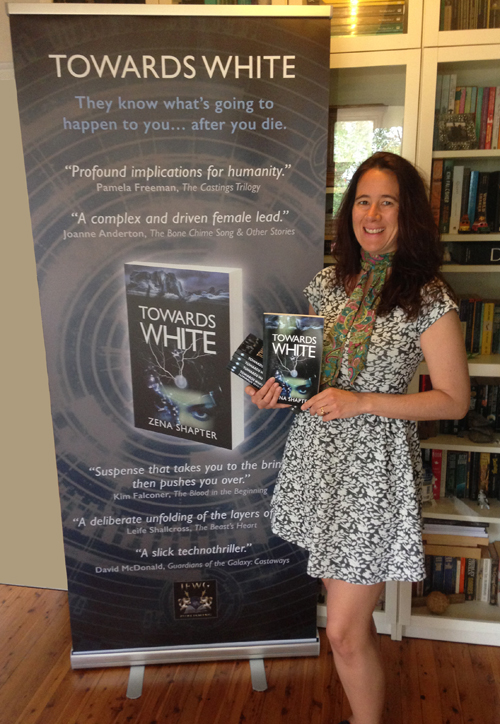
Zena Shapter Towards White Pull Up Banner

What is the best thing about being a writer?

The best thing about being a writer is the creativity. A blank page can be a difficult landscape to navigate, but when you fill it with delicious words you create something that didn’t exist before. That creative process gives me an enormous sense of achievement, no matter what I ultimately do with my words. I love it!

What is the worst thing about being a writer?

There isn’t a worst thing! There are plenty of challenges of course, including isolation, persevering through rejection, and diversifying your skills to support yourself financially. But those can be overcome. As long as you enjoy writing, which of course I do, and you’re doing something you enjoy, it’s never too much trouble to make it work somehow. Every job has its ups and downs.

Oh okay, more money would be nice. The worst thing about being a writer is that it’s a very low-paid job!!

To what extent do you agree with the statement “write what you know”?

When you first start writing, it’s easier to develop your writing technique if you do write what you know, which means writing from a perspective already familiar to you – that way you can focus on developing your writer’s voice. As you progress as a writer, however, you can branch out and write from different perspectives, as long as you make yourself familiar enough with that perspective that you can represent it accurately and sensitively. If you can do that, you don’t have to write only ‘what you know’.

Are you promiscuous or monogamous with your choice of genre?

Promiscuous. For me ‘story’ is paramount, over and above what shelf my book may be stocked on in a bookstore or library. I focus on character, the challenges they face and the changes they must make. After I’ve finished a story I look at genre and at finding an audience. Every well-told story has an audience. If you write specifically for that audience you may find yourself predicting their expectations, and writing something they’ve already read before. However if you write a story simply because it needs to be told, you’ve a greater chance of being original and offering readers something different or even unique. That said, I often have a primary genre in the back of my mind when I start a story, because the concept itself is likely to fall into one category or another.

Which writers inspire you?

I read widely and enjoy a huge range of writers. However, these writers definitely inspired me in some shape or form over the years:

  • Cormac McCarthy, “The Road”
  • Margaret Atwood, “The Handmaid’s Tale”
  • Laura Ingalls Wilder, “Little House on the Prairie” series
  • Malory, “Morte d’Arthur”
  • Daniel Defore, “Robinson Crusoe”
  • Mary Shelley, “Frankenstein”
  • H. G. Wells, “The War of the Worlds”
  • Salman Rushdie, “Haroun and the Sea of Stories”
  • Veronica Roth, “Divergent”
  • Suzanne Collins, “The Hunger Games”
  • Stephen King, “The Green Mile”
  • John Grisham, “The Firm”
  • Shakespeare, “Hamlet”
  • Mark Haddon, “The Curious Incident of the Dog in the Night-time”

How important is social media if you are a writer?

It can be useful as a resource for information and as a support group, especially if you work from home and need the interaction/encouragement. So far, however, it’s been my writing that’s helped me stand out in the crowd. Nothing is as important as having an incredible manuscript to offer publishers. Social media can also drain you of valuable time and, if you encounter any trolls, energy. So – writer beware!

What are your future writing plans?

My immediate plans involve editing a novel I’ve written, following a course I took earlier this year on ‘Writing Inclusive Fiction’. Beyond that, I’m planning writing world domination of course!

What advice would you give to any writer searching for mainstream publication?

Be prepared for a long-haul journey. Publishing is a slow business. It can take months and months for mainstream editors to read your work, take it to acquisitions, negotiate a contract, and then you have to join a queue of authors whose books are already scheduled for print. It also takes time to perfect your writing style and voice. So the key is not to get downhearted or frustrated. Set yourself realistic goals but be tenacious. Push onwards and upwards, constantly. To keep motivated, be sure to enjoy the highlights as they happen too – it’s so easy to always focus on what you’re yet to do rather than acknowledge what you’ve already achieved.

Towards White is out now. Copies can be ordered here.
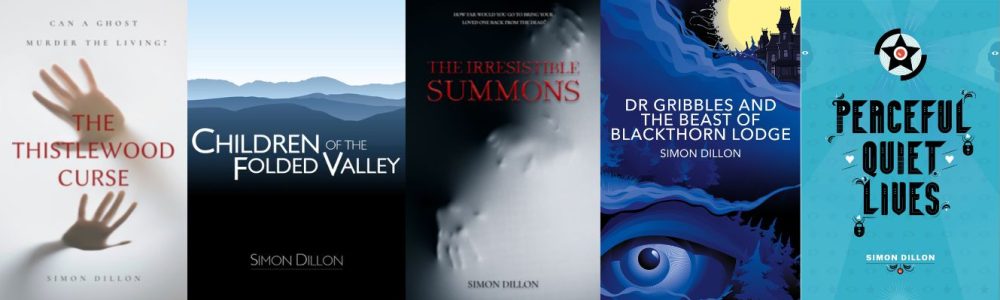
Inspiration: Children of the Folded Valley

Concluding my series on inspiration and influences for my novels, here’s a look at the stories that informed my most successful and “personal” book to date, Children of the Folded Valley.

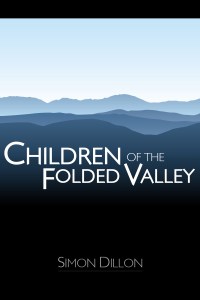
Folded Valley cover

A coming of age memoir set against a “light” science fiction backdrop, Children of the Folded Valley is about a man recalling his childhood and adolescence amid an unusual religious cult. The novel draws on some elements of personal experience, but here are seven key texts that were also influential.

The Remains of the Day (Kazou Ishiguro) – Children of the Folded Valley has a similar flashback structure to Ishiguro’s masterpiece, with the protagonist also taking a journey from Oxfordshire to the West Country during his reminiscences. Obviously The Remains of the Day has very different subject matter, but the melancholy theme of wasted lives is definitely an undercurrent in my own novel.

Never Let Me Go (Kazou Ishiguro) – Ishiguro again, and actually a novel I am less keen on because for me dystopian narratives really need to culminate in an act of rebellion (successfully or otherwise). Although brilliantly written, this one is determined to be “realistic”, with the characters resigned to their fate, at the expense of dramatic satisfaction. However, it remains a key influence for this reason: I love the way the science fiction element remains very much in the background, unrevealed until it absolutely has to be, and even then very obliquely.

The Handmaid’s Tale (Margaret Atwood) – As with Never Let Me Go, the science fiction elements are kept cleverly in the background (hence my term “light” science fiction), because they are less important than the bone-chilling themes of religious dystopia. The hideous treatment of women in this appalling future was also influential to a certain degree, though to be honest I must sadly admit I didn’t have to look too far into my own experience of real life religious organisations to find inspiration on that front.

1984 (George Orwell) – Well, obviously. I mean, anyone writing a dystopian novel has to acknowledge the granddaddy of them all. Orwell’s scathing, brilliant condemnation of totalitarianism is a clear influence, even though his novel focusses more on political dictatorship and mine on religious dictatorship. Like Shakespeare and Dickens, Orwell despised “the mob” (in this case, a political mob manipulated by the state). In my novel, the brainwashed “mob”, followers of cult leader Benjamin Smiley, are equally insidious at times, even though they too are victims. The “bleeding” scene in Children of the Folded Valley is also influenced a little by “Room 101”.

The Wizard of Oz (L Frank Baum) – The wizard being revealed as a fraud is an important moment in the novel (and in the film), although the effect is largely comical. In Children of the Folded Valley, when Smiley is revealed for what he is, the effect is devastating. However, there remains a touch of the Wizard of Oz in his character, despite Smiley’s malevolence.

Great Expectations (Charles Dickens) – Just as 1984 is the ultimate dystopian novel, Great Expectations is the ultimate coming of age story and I borrowed from it extensively. There are definitely elements of Estella and Pip in the relationship between James and Miranda, though again I know the backgrounds are very different. It’s also worth giving an honourable mention to The Kite Runner here, as there were tonal elements that were an inspiration, particularly in the novel’s latter stages.

Lost (TV series) – Yes, I know this ultimately led to an exasperating and disappointing finale, but along the way the story of “the Others” proved very influential, in the way they operated much like a cult. Benjamin Smiley is not deliberately named after Ben Linus, but it is an amusing coincidence.

You can download or buy print copies of Children of the Folded Valley from Amazon here.

Inspiration: Uncle Flynn

Continuing my series on inspiration and influences for my books, here’s a look at texts that informed my debut novel, Uncle Flynn.

uncle-flynn_cover

A thrilling treasure hunt inspired by local history and walks on Dartmoor with my oldest son, Uncle Flynn is a good old-fashioned adventure story for young and old alike, with a surprising twist in the tale. It delves into themes of overcoming fear and the dangers of mollycoddling, but the heart of the story concerns the restoration of a relationship between father and son. Here are five key influential texts:

Five on a Treasure Island (Enid Blyton) – Not my favourite Famous Five novel (that would be Five go to Smuggler’s Top) but certainly the biggest influence on Uncle Flynn in that it features a map, treasure and villainous rival treasure hunters. Like all good treasure hunt stories, the real prize is not the gold but something greater – in this case, lonely George gaining lifelong friends in her cousins. In the case of Uncle Flynn, the afore-mentioned restored relationship between Max and his father is the real prize.

Treasure Island (Robert Louis Stevenson) – I could hardly exclude this. As well as obvious treasure hunt iconography (maps, gold, etc), there are elements of Long John Silver in the darker side of Uncle Flynn. My book doesn’t have pirates though.

Swallows and Amazons (Arthur Ransome) – Another obvious touchstone, and a classic of children having adventures out of doors. The inspiration here is more tonal, though other Ransome novels contain elements that perhaps proved a more direct influence on the plot (for example Peter Duck and Pigeon Post, which are both treasure hunt stories).

The Goonies (Film) – Childhood nostalgia plays a big part in my affection for this film, a treasure hunt adventure packed with secret tunnels, maps, boobie traps, villainous treasure hunters and so forth. Obviously there are also treacherous secret tunnels and treasure chambers in Uncle Flynn, so the influence is obvious.

Mary Poppins (PL Travers) – To be fair, the film provided much of the inspiration here, since the character arc of Mr Banks isn’t really present in the novels. Uncle Flynn shares a certain amount in common with Mary Poppins, in that he enters the story at a point when Max really needs him. They go on great adventures, like Mary Poppins with the Banks children, so in that sense both the books and the film are an influence. But it is the film that features the restoration of the relationship between Jane and Michael and their parents. Just as Mary Poppins leaves “when the wind changes” so Flynn leaves once Max’s relationship with his father is restored.

You can download or buy print copies of Uncle Flynn from Amazon here.

Out of Context

I recently noticed Goodreads and Amazon contain features that allow readers to highlight quotes from my novels. Seeing these snippets out of context is interesting, because in some cases they cease to be the thoughts of my characters and become statements of belief or insights into life.

Folded Valley cover

For example, in the case of my most popular novel to date, Children of the Folded Valley, here are some out context thoughts:

On school:

“It was the culture of school I took a great disliking to; the idea that academic study is the be-all and end-all, and that to fail is to fail at life.”

On adolescence:

“When you feel the whole world wants you to act like an adult, but it continues to treat you like a child, you no longer trust the adult world.”

On selfishness:

“People often use childhood or adolescent trauma as an excuse for selfish decisions they take, and I for one refuse to offer such a simplistic explanation.”

On nostalgia:

“I do not long for the past, yet nor do I think of it as exclusively bad. I don’t ever want to go back, but I want things that are trapped there, lost forever.”

If any authors reading this have had a similar experience, by all means drop a few of your own out of context one-liners in the comments.