My recently released book Infestation: A Horror Anthology features my Infestation novella – a six-chapter sci-fi horror tale – along with five other short stories. Continuing this series unpacking each story in the collection, this week I expound a little on Influencer.
Janice Hopper is a young, Oxford-based social media influencer with a considerable following. Manufacturing an online persona that is on-trend and relevant, her writing has proved popular and lucrative. However, to say she is prone to exaggeration in her writing, stretching the truth to breaking point, would be an understatement. When an online commenter accuses her of lying in a piece about sexual abuse, events escalate into a nail-biting tale of stalking and revenge.
A previously unpublished story exclusive to this volume, Influencer draws on themes of wealth, privilege, and self-deluded, self-justifying narcissism. A series of shocking and satirical twists make this a distinct, singular take on the overall theme of guilt running through the stories in the Infestation volume.
Influencer draws inspiration from noir novels and the cycle of psycho-horror thrillers from the late 1980s and early 1990s – think Fatal Attraction, The Hand That Rocks the Cradle, Single White Female, and Martin Scorsese’s remake of Cape Fear. It also nods to satirical elements in recent TV thrillers such as Netflix’s You. Influencer is certainly the most darkly comic tale in this collection. However, I’d argue the undercurrent of suspense and dread, not to mention the bloody finale, push it firmly into the horror bracket.
Infestation: A Horror Anthology is available on Kindle and paperback from Amazon here (in the UK) and here (in the US). It can also be ordered via Smashwords here.
My newly released book Infestation: A Horror Anthology features my Infestation novella – a six-chapter sci-fi horror tale – along with five other short stories. As I stated in my article last week, I’m going to expound a little on each story in the weeks to come, continuing in this article with Once in a Lifetime.
After inexplicably awakening inside a different home with a different wife, Hayden Jones experiences an existential crisis, as memories of a new life, that of another man named John Hunter, gradually replace those of his old life.
In desperation, he tries to write down all that happened in his old life – his wife, his children, friends, and acquaintances – when he finds in his new life, he is unable to contact them. He also finds he has awoken in London, miles from his country home near Dartmoor.
Previously published by Dragon Soul Press, as part of their All Dark Places horror anthology, Once in a Lifetime is based on a surprisingly well-plotted nightmare I had some years ago. Continuing with the recurrent theme of guilt contained within this volume, the story also touches on issues such as childhood bullying, abuse, and denial. Like several of my horror stories, it is designed with deliberate ambiguity, leaving room for the reader to separate reality from fantasy; a process they undertake based on their own personal baggage.
On a lighter note, I’ve had it suggested to me that the story is an endorsement of living in the country versus living in the city. That isn’t consciously the case, although I do confess that I wouldn’t want to live in London instead of southwest England. London wouldn’t suit me at all (except for the many cinemas, and arts scene in general).
Influences for this include David Lynch films such as Lost Highway, Mulholland Drive, and Twin Peaks, which also deal in existential themes of people being subsumed into different lives/universes. Once in a Lifetime was also slightly informed by lyrics in the classic song of the same name by the seminal band Talking Heads. (“You may find yourself in a beautiful house, with a beautiful wife… You may ask yourself: How did I get here?”) Most of all though, I wanted to tell a story about the unconscious, sometimes self-destructive impulses of middle age, where it is common for people to wonder about paths not taken.
Unlike the physical, external, creature-based horrors of Infestation, Once in a Lifetime is a much more psychological piece, though emphatically still designed to rattle and disturb, especially in the shocking finale.
Infestation: A Horror Anthology is available on Kindle and paperback from Amazon here (in the UK) and here (in the US). It can also be ordered via Smashwords here.
Recently, I’ve been making a lot of noise about my newly released book Infestation: A Horror Anthology. It features my Infestation novella – a six-chapter sci-fi horror tale – along with five other short stories. Over the next few weeks, I’m going to expound a little on each story, starting in this article with Infestation itself, which I consider the collection’s main attraction.
In the near future, no one knows where the giant spider nests came from, but nations are adjusting to the challenge of living alongside dangerous oversized arachnids.
A mercenary desperate for money to purchase medical treatments that can save his wife is hired by an influential businessman. His objective: Infiltrate a spider nest on a mission of vengeance.
There is a lot more to this story than just giant spiders. The protagonist, Jonah Seymour, is deeply troubled by the nature of his mission, and throughout the story experiences doubts and dithering about whether he should go through with it. Thematically it deals in issues of denial, guilt, revenge, and punishment. The story is also open to a number of different interpretations. I have deliberately designed it with a certain degree of ambiguity, so the reader can bring their own piece of the puzzle that completes the picture.
For instance, I have had it suggested to me that the story is an allegory about Covid. I didn’t intend it as such. For one thing, I wrote the story back in 2017. However, I am pleased that for some readers, the narrative also has contemporary resonance, as a reflection on human attitudes and actions concerning the recent pandemic.
My influences for this story mostly came from cinema rather than literature, with films such as Them! (1954), The Incredible Shrinking Man (1957), The Fly (the 1958 original, rather than the more famous 1986 David Cronenberg remake), and Aliens (1986) informing the story. There is possibly a touch of Stephen King’s The Mist in there too. I should add that much of the inspiration came from a nightmare I had a few years ago.
For all its loftier aims, in the end, Infestation is a story I wanted to grip, thrill, and disturb, with plenty of action and scares along the way. If you enjoy a blend of science fiction, action, and horror, this story is definitely for you.
Infestation: A Horror Anthology is available on Kindle and paperback from Amazon here (in the UK) and here (in the US). It can also be ordered via Smashwords here.
A new anthology containing some of my horror short stories has just been released.
Infestation: A Horror Anthology primarily contains my science fiction horror novella Infestation; recently serialised in the Fictions publication on Medium. The collection also includes two entirely new short stories exclusive to this volume, as well as other previously published tales.
Infestation is set in the near future. No one knows where the giant spider nests came from, but nations are adjusting to the challenge of living alongside dangerous oversized arachnids.
A mercenary desperate for money to purchase medical treatments that can save his wife is hired by an influential businessman. His objective: Infiltrate a spider nest on a mission of vengeance.
Alongside the Infestationnovella, this volume also features the following short stories.
White Horse – Raven, a supporting character from my gothic mystery novel The Irresistible Summons, gets her own spinoff here, in a new, previously unpublished story. This is a standalone spooky mystery, with no prior knowledge of the novel required.
Influencer – Another new, previously unpublished tale. This one has a slightly satirical edge, and concerns a social media influencer who takes bending the truth a little too far.
Regression – An English teacher is haunted by a terrible secret from his past. Previously published on Medium.
Spinner – A graphic designer in an abusive relationship investigates a malevolent supernatural force in her basement. Previously published on Medium.
Once in a Lifetime – After inexplicably awakening inside a different home with a different wife, a man experiences an existential crisis, as new memories replace old. Previously published by Dragon Soul Press, as part of their All Dark Places horror anthology.
For those of you that don’t have a Medium subscription, this is an ideal opportunity for you to see some of my horror stories that have been published on that site. I’ve also released this partly in response to those who wanted to get my work as an ebook or in print. The anthology clocks in at around 77,000 words, so is good value.
I’ve selected the stories around the theme of guilt, and will discuss that a little further, as well as provide more information on each story, in upcoming articles. In the meantime, I hope you enjoy this collection.
Infestation: A Horror Anthology is available on Kindle and paperback from Amazon here (in the UK) and here (in the US). It can also be ordered via Smashwords here.
Medium publication Fictions recently published my sci-fi horror novella Infestation.
Set in the near-future, Infestation concerns the mysterious appearance of giant spider nests across the globe. Exactly where they came from is unknown, but despite the initial terror, life has settled down somewhat, especially in the UK, where humans have learned to keep away from cities lost to the spiders.
Against this backdrop, covert ops mercenary Jonah Seymour leads a dangerous and unpleasant mission of revenge into a large spider nest, at the behest of a wealthy, influential businessman. Jonah agrees to this potentially lethal assignment because his pay will ensure his wife gets the urgent medical treatment that will save her life. But the deadly ordeal that awaits is beyond anything Jonah could possibly have imagined.
All six parts are available for your reading pleasure on Medium:
I recently had a short story published in Fictions on Medium that I’m rather pleased with. It’s entitledApocalypse 1983and is inspired bythe real-life 1983 Soviet nuclear false alarm incident, which you can read about here. I won’t spoil my take on this alarming historic incident, but I will say my story was a response to a writing prompt from Fictions that specified the story be set in 1983 and feature a radio at some point.
Apocalypse 1983 is a good deal shorter than my usual short stories (just north of 2,000 words as opposed to the usual between 10,000 and 15,000 words), but it packs in quite a lot. I hope you find it interesting. You can read it in full on Medium here.
This year marks the 10th anniversary of my debut novel Uncle Flynn. Well, sort of. Technically the first version appeared on 30th December 2010, but paperbacks followed in 2011, so it’s sort-of the 10th anniversary. Either way, this treasure hunt adventure for the young and young at heart still holds an important place in my heart.
Uncle Flynn was in fact the eighth novel I wrote, but the first I decided to self-publish. Having been turned down by agents and publishers, my brother-in-law suggested this thing called Kindle on Amazon, and I decided to give it a go. The book was a modest success, and received some very good reviews – although I’m sure the fact that it was free at that time helped.
Plot
The story concerns eleven-year-old Max, a boy who suffers from crippling phobias and anxiety. Estranged from his workaholic father, Max’s life gets interesting one day when his mysterious uncle Flynn – an archaeologist normally working in South America – comes to visit.
During his stay, Max and Flynn discover clues pertaining to a local legend – a treasure buried on Dartmoor by monks, during the sacking of Buckfast Abbey at the time of Henry VIII. Following these clues lead to the discovery of a map. Max begins to put aside his many fears and hang-ups due to his obsession with finding the treasure. Flynn is equally obsessed, despite the dangerous presence of rival treasure hunters.
Complicating matters even further, once they set off across Dartmoor, Max discovers the police are on their trail. What has his uncle done to put himself at odds with the law? Flynn urges Max to help him evade his pursuers. Because he is so desperate to beat their rivals to the treasure, Max agrees, despite his uncle’s refusal to tell him why he is on the run.
As well as following in the tradition of well-known titles like Swallows and Amazons, Treasure Island, and adventure films like The Goonies, the novel was initially inspired by the many walks I had taken with my eldest son on Dartmoor (to whom the novel is dedicated). We had visited several memorable locations, including Cater’s Beam, Sherberton Stone Circle, the “Crock of Gold” Bronze Age tomb, and Wistman’s Wood. These all turn up in the novel, even if I am somewhat liberal with the geography.
Some of the dangers faced on Dartmoor by the characters are not entirely fictional. There are deadly mires, especially the notorious Fox Tor mire and Raybarrow Pool. In addition, there are wild boar in the west (now documented fact). There have also been several panther sightings, though most of these were on Exmoor rather than Dartmoor. The sheer number of these (and a few dubious photographs) raise eyebrows on a regular basis, although how they got there is a mystery. Some suggest that the UK Dangerous Pets Act in the 1970s caused eccentrics who owned big cats to turn them loose, and that they somehow bred in the wild. And yes – you can see adders on the moors at warmer times of year, though they typically slither away if you get anywhere near them.
Buckfast Abbey was another key location used in the book. Much of the history of the abbey works its way into the novel, especially regarding how Henry VIII burned priceless Catholic books, closed the abbey, and had its gold and other treasures transferred to London. William Petre, who is mentioned in the novel, oversaw this process. He later retired in the south-west, purchasing a couple of manors. Uncle Flynn moves beyond these facts to suggest William Petre had other motives for returning, namely that he had become obsessed with tracking down the treasure hidden by a few clever monks that had slipped through his fingers.
I suppose the novel is mainly about overcoming fear and the dangers of mollycoddling. My protagonist Max suffers severe anxiety and panic attacks. He has many phobias, and there are satirical suggestions that an increasingly risk-averse society is at least partly to blame. For instance, one sequence early in the novel has Max being initiated into a secret club in school – a club that dares to play conkers without “protective head gear”. Max and the other children are caught and punished for their dangerous behaviour. This may sound absurd, but my late father (who was a teacher) informed me this kind of nonsense has been introduced in some UK schools.
Such satire is largely peripheral, and the novel implies throughout that Max’s difficult, estranged relationship with his father is what really lies at the heart of his problems. In attempting to impress his father, Max – along with his mysterious, genuinely dangerous uncle – takes increasingly reckless action in his quest to find the treasure. The irony is mollycoddling actually leads Max to take greater and greater risks.
Of course, this makes the novel sound terribly heavy and worthy, and I can assure you it isn’t. It is, first and foremost, a children’s adventure story. I didn’t write it to deliver any kind of “message”. However, I noticed these themes and ironies after the fact. What is important to any author will always be inherent in the text of their work, and in this case, I can see these themes in retrospect.
Uncle Flynn is available on Kindle and in paperback here (in the UK) and here (in the US).
Set in the near-future, Infestation concerns the mysterious appearance of giant spider nests across the globe. Exactly where they came from is unknown, but despite the initial terror, life has settled down somewhat, especially in the UK, where humans have learned to keep away from cities lost to the spiders.
Against this backdrop, covert ops mercenary Jonah Seymour agrees to lead a dangerous and unpleasant mission of revenge into a large spider nest, at the behest of a wealthy, influential businessman. Jonah agrees to this potentially lethal assignment because his pay will ensure his wife gets the urgent medical treatment that will save her life. But the deadly ordeal that awaits is beyond anything Jonah could possibly have imagined.
The remaining five parts will appear on Medium soon, and I’ll add another post here once the serial is concluded.
Many of my novels draw on history for their narratives, particularly the local history of where I live, in southwest England. Here are three examples of more fascinating historic footnotes that I appropriated, and massaged a little, for inclusion in my stories. The first two are from novels presently available, and the last one is from a manuscript I am holding on to for the time being.
The Dissolving of Buckfast Abbey (referenced in Uncle Flynn)
The facts: Henry VIII went about dissolving many Catholic monasteries during his reign. One of these was Buckfast Abbey, in the village of Buckfastleigh, on the southern borders of Dartmoor, which is a short distance east of where I live. The Abbey was dissolved by Sir William Petre, who in 1539, under instructions from the King, seized considerable amounts of gold which were subsequently taken to the Tower of London. William Petre later retired to the south-west. The Abbey was restored in the 1800s.
My fiction: In Uncle Flynn, the protagonist, eleven-year-old Max, and his mysterious adventurer uncle (who apparently has the police on his tail), uncover clues to hidden treasure written by a monk at the time of the dissolution. He supposedly took a vast amount of the Abbey’s gold, along with priceless Catholic library manuscripts, and buried them in a secret location on Dartmoor. This local legend is supported by William Petre’s supposed obsession with trying to locate this treasure that slipped through his fingers during the dissolution. It also explains why he chose to retire in the southwest.
Slaves of Lundy Island (referenced in The Thistlewood Curse)
The facts: Lundy Island is a tiny island on the Bristol coast, about three miles long and half a mile wide. It is sparsely populated, with limited local amenities, including a church, the Marisco Tavern, and a small airstrip where helicopters can land. Lundy Castle has since been divided into holiday homes. Electricity is only available at certain times of day, and there is no mobile phone signal (though there is a radio in the tavern).
Lundy has a rich and fascinating history, but one episode informed The Thistlewood Curse more than any other. Thomas Benson was an MP for Barnstaple when he owned Lundy in the 18th century. He also traded from the North Devon port of Bideford after inheriting a family fortune. His vessels transported tobacco, but he also kept a slave workforce on Lundy procured from convicts he was supposed to transport to America. After getting involved in smuggling, Benson’s misdeeds were discovered but managed to escape justice by fleeing abroad.
My fiction: Thomas Benson becomes Henry Thistlewood in my novel. As per real life, he secretly holds convicts intended for transportation to Virginia and uses them as slaves on the island. However, I devised the background for a ghost story: One slave, Jeremiah Adams, is executed with medieval barbarity after allegedly raping Thistlewood’s wife Cora. Whilst enduring death agonies, Adams curses the Thistlewood family line, swearing he will return to wipe them out.
In the present day, Henry Thistlewood’s descendant, Charles Thistlewood, son of Lord Alfred Thistlewood, mysteriously drops dead, having suffered an inexplicable heart attack. His wife Sally is an old friend of protagonist Detective Laura Buchan. Despite the doctor claiming Charles’s death is an open and shut case of tragic heart attack, Sally suspects foul play and asks Laura to come and secretly investigate, during Charles’s funeral. Laura brings along another childhood friend of theirs, paranormal investigator Lawrence Crane, who uses astral projection to try and discover the truth.
I won’t say anything more about the plot as I wouldn’t want to spoil it, but I will add that in my novel Lundy Castle is still occupied by the Thistlewoods, not divided into holiday homes.
Oliver Cromwell’s Head (referenced in The Balliol Conspiracy)
The facts: During the English Civil War, Balliol College in Oxford had its silver taken by the Roundheads and melted down for Oliver Cromwell’s New Model Army. After Cromwell’s death, when the monarchy returned, Charles II had Cromwell’s body dug up, put on trial, hanged, drawn, and quartered. His head was placed on a spike in London as a warning against anyone who’d seek to overthrow the monarchy again. Here’s where the facts get bizarre: Oliver Cromwell’s head was stolen, preserved, and changed hands multiple times (at one point it was hidden stuffed up a chimney), before supposedly being buried in Sidney Sussex College, Cambridge. Exactly where is unknown.
My fiction: My as-yet-unpublished novel The Balliol Conspiracy involves the above facts, though I tweak them by pretending Cromwell’s head was buried in Oxford. I won’t say any more about the plot, as the novel is strictly under wraps, suffice to say it’s a treasure hunt adventure for grown-ups, with a spy thriller element and a romantic element. I’ve not penned anything else quite like this, and it took quite some effort to rein in my gothic horror sensibilities whilst writing, to keep the narrative to PG levels. But I was determined that, for once, I’d write a novel that my mother could enjoy.
Uncle Flynn is available from Amazon here (in the UK) and here (in the US).
The Thistlewood Curse is available from Amazon here (in the UK), here (in the US), and here (from Smashwords).
The Balliol Conspiracy will be released at some point in the future. Watch this space.
My youngest child asked me an interesting question today: Do I get scared writing my horror novels? I feel like the answer ought to be no, since I’ve already plotted out the narrative and know exactly what’s going to happen. I’m aware of all character arcs and know where everyone ends up, alive, dead, or worse. Yet despite this, in all honestly, the answer is yes.
It is often assumed that horror fans (and writers) are hardened, desensitised individuals, but this silly stereotype simply isn’t true. Stephen King apparently has to sleep with the light on. I have much sympathy and have previously expounded on this subject at greater length. Writing horror – which in my case subgenre-wise is a blend of gothic mystery, supernatural thriller, and ghost story – definitely makes the hairs on the back of my neck stand to attention at times.
My point is that visceral emotional response ought to be the result of any fiction writing. A novel should be immersive in that way, generating an appropriate reaction in the reader. In the case of horror, I want them to feel suspense, thrills, fear; a burning desire to get to the bottom of the supernatural mystery, underscored by an awareness that once they learn the truth, they might wish they hadn’t. Horror fiction should be bracing and invigorating, rewarding the nerve of the reader with the masochistic catharsis inherent in the greats of the genre.
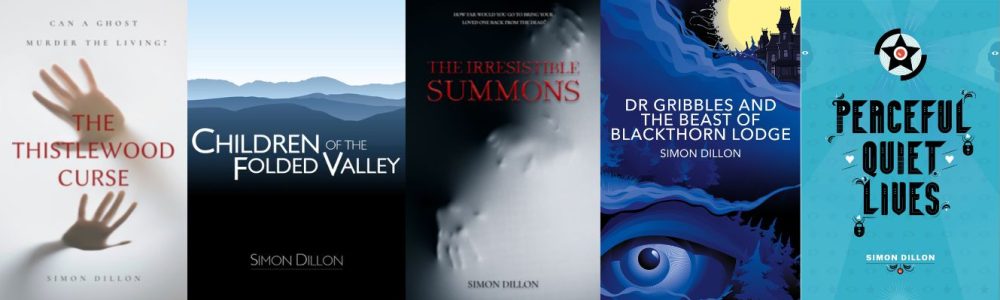
If I didn’t experience at least a bit of that, when writing The Irresistible Summons, Spectre of Springwell Forest, The Thistlewood Curse, and so forth, I wouldn’t be a very good writer. I believe an author should be thrilled by the telling of their story as they write it down. Every word should remind them that this is their kind of tale; the kind they love to read, share, and about which they love to enthuse. So yes, those novels did generate a little creeping dread as I penned them – especially when doing so late at night, when everyone else in the house was asleep and the shadows decided I need a bit of company.
If you’re curious (and brave enough) you can check out my scarier novels on Amazon here (in the UK) and here (in the US). They are also available on Smashwords here.




 Simon Dillon Books
You must be logged in to post a comment.