I recently had a couple of great five-star reviews for two very different novels: One for children’s adventure story Echo and the White Howl, and another for horror-thriller The Irresistible Summons. I always feel immensely encouraged by such reviews, as nothing makes me happier than knowing I’ve entertained the reader in the manner I intended.
Echo and the White Howl is a story about wolves in Alaska that I originally wrote for my youngest son. I was pleased to see the reviewer below picked up on the influence of Watership Down, one of my all-time favourite novels, though as he says, this is also very much its own beast.
“This is an exceptional story written by a brilliant author. My favourite book is Watership Down and whilst this has similar themes it is an original story on a slightly darker tone mixed with a bit of fantasy. Beautiful descriptions of the habitat of wolves and a wonderful adventure of family and revenge on an evil act. This is a must for any lover of Watership Down.” (MA Holburn, Amazon)
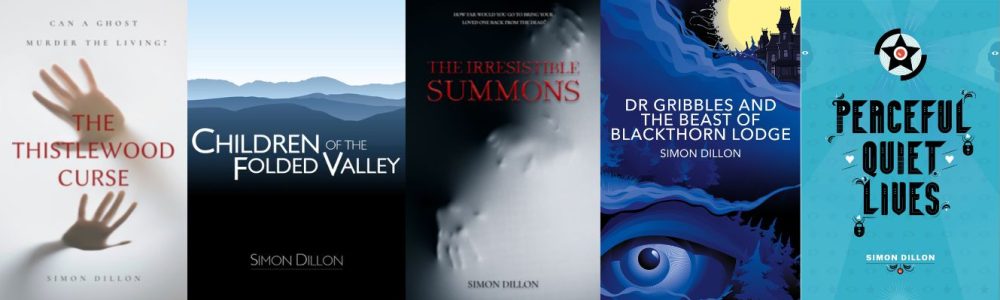
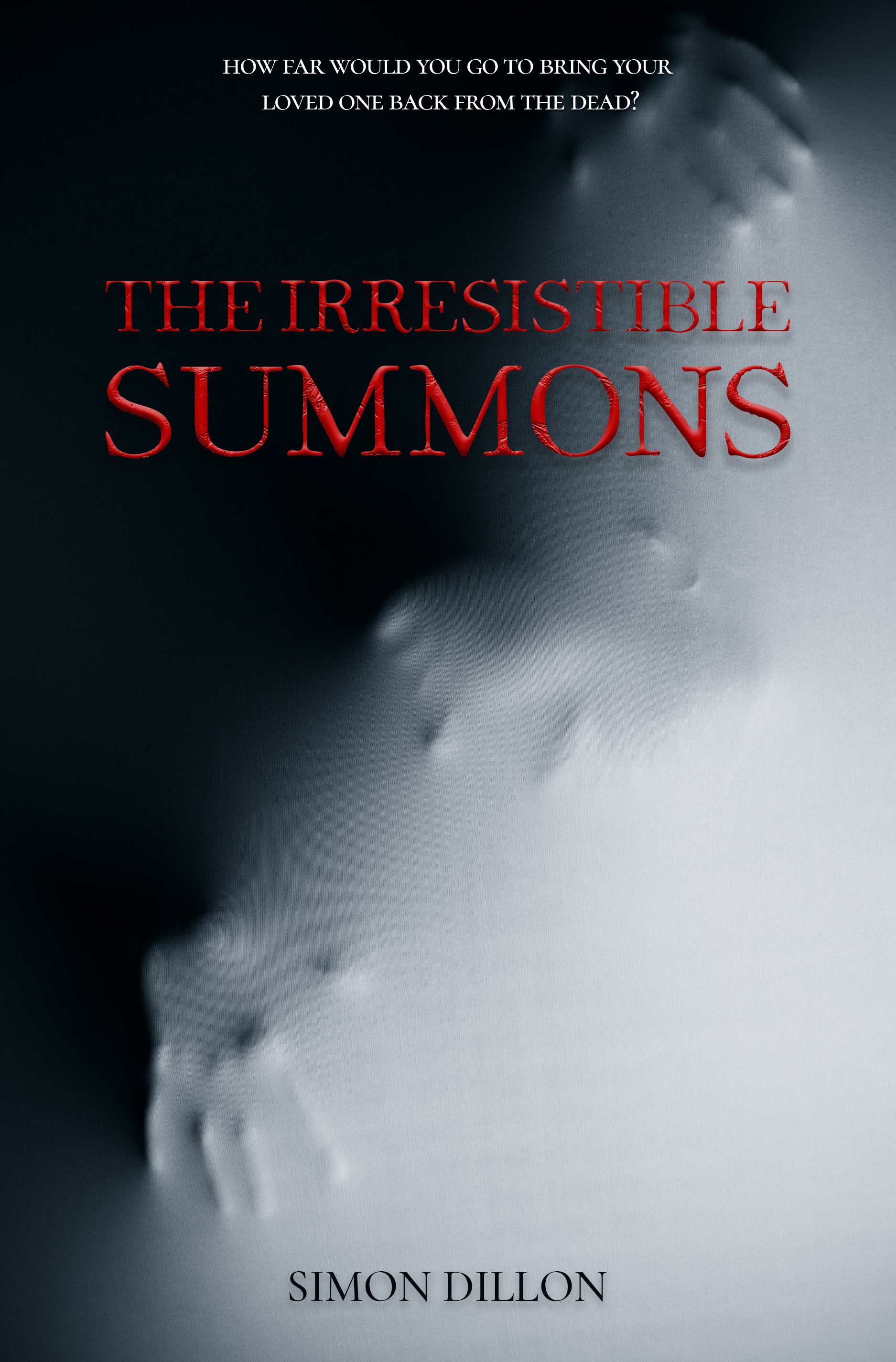
The Irresistible Summons is the scariest novel I’ve written, or so I’m told. I’m pleased it kept this reader on the edge of her seat.
“An extraordinarily imaginative tale, the supernatural infused with technology, love and hatred and an intense sense of dread and mystery. Thoroughly enjoyed it.” (AlisoninOz, Amazon)
You can pick up The Irresistible Summons and Echo and the White Howl from Amazon here (in the UK) and here (in the US) or here (on Smashwords). If you do read and enjoy my novels, please consider leaving a short review. Not only are they a great encouragement, but they encourage Amazon’s algorithms to show my work to more readers. That’s why reviews – even just a one-liner – really help independent authors like me. As for all who have left reviews, thank you very much. It is immensely appreciated.
In late 2017, I self-published my one and only animal fiction adventure novel, Echo and the White Howl. Set in the Alaskan wilderness, it’s a gripping revenge story packed with hunts, blizzards, and dangerous journeys, with a mysterious, supernatural edge. It also proved one of the most challenging projects of my writing career.
I decided to pen this novel after my youngest son begged me to write him a story about wolves. Although I initially resisted the notion, rather irritatingly, an excellent narrative occurred to me, and the voices in my head wouldn’t shut up about it. In the end, much to my son’s delight, I had no choice but to write the damn thing. In the process, I learned three important lessons:
Writing animal fiction is bloody difficult
Animal fiction is a fiend because it is tricky to tread the line between assigning relatable human attributes to animal characters whilst making sure their knowledge doesn’t go beyond what they would naturally know. A myriad of choices complicates this, from turns of phrase to the wolves’ knowledge of the world around them. For example, I had to weed out a lot of human expressions from the dialogue or create wolf equivalents. A wolf wouldn’t be unable to put its finger on the problem, for instance, as they have paws. It also gets awkward when describing human devices of which they have no knowledge (for example guns). In addition, when hearing about places beyond their natural habitat (eg cities, or the sea), again, they have to be seen to not fully comprehend such concepts.
Animal fiction is a technique, not a genre
Animal fiction can incorporate everything from comedy to satire, allegory, adventure, fantasy, romance, and more. In my case, Echo and the White Howl is a coming-of-age adventure tale aimed at anyone capable of reading it and up. The book combines atmospheric, dirt-and-snow-under-the-paws Alaskan wilderness realism with a few mystical elements. In keeping with the traditions of much animal fiction, humans lurk on the narrative periphery as an ever-present menace. Key inspirations include Watership Down, Bambi, and bizarrely, Twin Peaks.
Suspension of disbelief: Where to incorporate research, and where to ignore it
Again, this was a fiend. I undertook the usual deluge of research for writing this novel, but how much of it I should incorporate became a constant question. I have included elements of how cubs are raised, how a pack hunts, the challenges to become Alpha, and so on. However, science tells me wolves see in black and white. Needless to say, I ignored the latter point and opted for poetic licence, for much the same reason George Lucas opted for poetic licence when deciding we should hear those cool laser sounds and explosions in the Star Wars space battles, despite the fact that space is a vacuum, and we’d hear nothing were such battles to take place in reality.
Beyond all of this, I had a particularly difficult time coming up with a good title. The first draft was penned under the unimaginative moniker Wolf Story, but try as I might, I could not settle on a proper name. My excellent friend Yasmine Nuoraho, who designed the wonderful cover for the novel, trolled me with many unhelpful suggestions, including A Tale of Tails and Lupine Larks. Yet in the end, it was she who came up with Echo and the White Howl, which is nicely enigmatic.
All things considered, I don’t think I will ever attempt animal fiction again (although never say never), but I am immensely proud of Echo and the White Howl, and dare I say, I think it deserves a much bigger readership. A number of people have read some odd things into it (one person insisted it was a Brexit allegory) but whilst some of my familiar themes are present – megalomaniacal abuse of power for instance – I certainly didn’t write the novel with any clear message in mind. I just wanted it to be a first-rate adventure story.
Echo and the White Howl can be purchased from Amazon here (in the UK), and here (in the US).
Looking for the perfect Christmas present for that difficult relative? Why not give them a book this year? To be more specific, why not give them one of my books?
In this second of three articles, this post explores my children’s novels. Yes, I don’t just write gothic mystery horror thrillers. I have also dabbled in children’s adventures, mainly aimed at the Harry Potter/Alex Rider demographic. Most of these novels were written for my children, often at their request (Echo and the White Howl was penned for my youngest for instance, who wanted a story about wolves). But these stories aren’t just for children. They are for the young and young at heart, often tackling themes and ideas that are just as incisive for the adult reader.
Here’s is the blurb from the back of each novel:
Uncle Flynn
When timid eleven year old Max Bradley embarks on a hunt for buried treasure on Dartmoor with his mysterious Uncle Flynn, he discovers he is braver than he thought.
Together they decipher clues, find a hidden map and explore secret tunnels in their search.
But with both police and rival treasure hunters on their tail, Max begins to wonder if his uncle is all he seems…
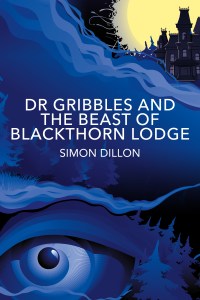
Curiosity lands Tim Rawling in a world of secrets, spies and a desperate race against time.
The haunted house, the monster and the mad scientist are only the beginning of a terrifying adventure…
Click here to order Dr Gribbles and the Beast of Blackthorn Lodge.
Echo and the White Howl
When a wolf pack discovers humans lurking near their territory, Echo senses dark times ahead.
Despite the warnings and omens, Aatag, the pack Alpha, refuses to flee… leading to a cruel turn of events that forces Echo into exile, and a quest for revenge that will change the pack forever.
George Hughes Trilogy (comprising George goes to Mars, George goes to Titan, George goes to Neptune)
From the back ofGeorge goes to Mars:
When George Hughes discovers he has inherited the planet Mars, he goes from poverty to becoming the richest boy on Earth overnight.
Accompanied by his new guardian, a mysterious secret agent, and a crew of astronauts, George voyages to Mars to sell land to celebrities wanting to build interplanetary homes.
But sabotage, assassination attempts and an alien threat plunge him into a deadly adventure.
My brain needs a break. Here’s a scary picture of me in brain meltdown mode.
Given the rather excessively productive year I have had so far (first drafts on two longer than usual novels, lots of editing on earlier, currently unreleased novels, and a couple of short stories), I have decided to take a short break from writing and from posting on this blog. However, I will be back in the first week of September, and I will still post film reviews of any films I see at the cinema.
In the meantime, if you’re a regular visitor to this blog, or are stumbling on it for the first time, why not buy or download one of my novels?
I write in a variety of genres, so here are five that might interest you:
Children of the Folded Valley – By far my most popular novel to date, this tale of a man looking back on his life growing up in a strange cult has over eighty mostly rave reviews on Amazon, and seems to have struck a chord with a lot of readers. It even seems to have got under the skin of people who didn’t like it (eg “Disturbing, distasteful and fascinating all at the same time” was one “negative” reader comment). I’ve also been told it’s my most “personal” novel to date, whatever the hell that means, although to be fair it is partly inspired by some of my own experiences in a cult during the early part of my life. Check it out here.
Uncle Flynn – A story about overcoming fear and the dangers of mollycoddling disguised as a treasure hunt adventure, this is my second most popular novel, and again, Amazon reviews are mostly raves. It is aimed at all ages, so don’t be put off by the “children’s book” label. For example, one reader said “In this day and age I sometimes find myself reading books like this unaware. I loved it and I’m nearly 69 years old. Uncle Flynn is a real treat.”
The Birds Began to Sing – A nail-biting psychological thriller about a wannabe writer entering a mysterious writing competition in a remote country house, this will satisfy anyone who loves a gripping, sinister narrative with a big twist ending. The reviews on Amazon are unanimous raves, with one reader commenting: “I kept guessing, thinking up various theories but never really sure which one would solve the mystery. As it turned out, none of my ideas were right!”
Echo and the White Howl – An animal fiction adventure about wolves in Alaska, mixing dirt-under-the-paw revenge story realism with a dash of the metaphysical. Tonally it is akin to something like Watership Down, and just as much aimed at adults as children. Here’s what one reviewer had to say: “The wolves bring to mind Jack London as well as George Orwell’s Animal Farm, but Dillon does it his own way, as always, with the spiritual/religious features that are common in his work.”
Love vs Honour – Teenage romantic drama isn’t a genre I typically I dabble in, but this novel is something of an outside curiosity compared with my usual work. It details a tale of star-crossed teenage lovers with a religious twist, as the protagonists try to appease their religious parents by pretending to convert to Islam and Christianity respectively. A tangled web of deception ensues, building to a much darker final act that some readers think is brilliant and some readers absolutely hate. Why not have a read here and decide for yourself?
Over the past several weeks, I have been promoting my latest novel, Echo and the White Howl. An animal fiction story set amongst a wolf pack in Alaska, this book is a gripping and thrilling adventure for all ages.
Here is a summary of essential information about the novel, as well as links to articles exploring its different aspects:
Blurb from the back of the book:
When a wolf pack discovers humans lurking near their territory, Echo senses dark times ahead.
Despite the warnings and omens, Aatag, the pack Alpha, refuses to flee… leading to a cruel turn of events that forces Echo into exile, and a quest for revenge that will change the pack forever.
Character introductions
Click here for introductions to some of the main characters.
I have been asked on a number of occasions how my latest novel Echo and the White Howl should be interpreted. Is it an historic allegory? A contemporary political allegory? A spiritual allegory? Someone suggested the story alluded to Stalin’s Russia and the way he created famines. Someone else even suggested the story might be about the European Union and Brexit.
Quite honestly, the primary motivation for writing the novel was simply to create a gift for my youngest son, who asked for an adventure story about wolves. If readers want to interpret the book in any other way, they are most welcome to, but certainly there is no intentional message of any kind in the story. Indeed, I take that approach with all my books. I believe that the more one tries to put a message in one’s writing, the more preachy it will sound.
What I do believe, as I have often stated on this blog, is that when one writes purely to tell a story and not deliver a message, what is important to the author will be inherent in the text, and thus be far more palatable and persuasive. So yes, it is possible, perhaps even inevitable, that some of my political and spiritual views are lurking beneath the surface of Echo and the White Howl. I shan’t get into what they might be, as I prefer to leave that to readers to interpret (inaccurately or otherwise). However, some of the themes present in my other works – abuse of power and corruption for example, not to mention the metaphysical elements – appear again here.
Echo and the White Howl is out now. Click here for your Kindle download or paperback copy.
Animal fiction is a notoriously difficult beast. I had never intended to write any, until last summer, when my youngest son begged me for a story about wolves. I initially said no, but then I had an idea that nagged and tickled, and the voices in my head would not be silenced until I had put them on paper.
Writing for my son proved a very good motivator, and despite my trepidation I pushed ahead with what eventually became Echo and the White Howl. It was not an easy novel to write for several reasons. For one thing, one has to make sure the reader suspends disbelief. That means walking the tightrope between assigning human attributes to animal characters to make them relatable, and yet at the same time making sure their knowledge doesn’t exceed their natural awareness. Wolves would have no understand of things like helicopters for instance (in the novel they are referred to as giant flying metal insects).
Turns of phrase can prove problematic. In the first draft, I often caught myself writing things like “Echo couldn’t put his finger on the problem” when he has paws, not fingers. On top of that, I had to decide which facts from my research should be incorporated into my story, and what should be left out. So for example, how a pack hunts, challenges to the Alpha and so forth are all woven into the narrative, whereas the fact that wolves supposedly only see in black and white was ignored. Poetic licence is important, and to have included the latter point would have been as foolish as insisting space battles in Star Wars feature no laser sound effects due to the vacuum of space.
Finally, I made a very conscious decision that this novel would not patronise children. I absolutely cannot bear children’s fiction which talks down to the reader. Whilst Echo and the White Howl is suitable for all ages, it does contain some frightening and upsetting moments. Nor does it skimp on blood and gore in both hunt and fight scenes. I honestly believe none of this material is gratuitous or out of place. Indeed, to have censored or left it out would have been fundamentally dishonest. In the main the novel is a thrilling adventure story with an ultimately reassuring outcome, but the fears, doubts, moments of despair and tragedies experienced by Echo and Saphira on their journey are not glossed over either. I believe this is in keeping with the traditions of the very best animal fiction, in the likes of Watership Down, The Jungle Book and Bambi.
Echo and the White Howl is out now. Click here for your Kindle download or paperback copy.
As with all my books, my latest, Echo and the White Howl, involved a considerable amount of research. I have not ever been to Alaska (alas), but nonetheless I had to find out a great deal in order to generate a convincing, atmospheric, dirt-under-the-paws level of realism for the novel.
For a start, I had to learn a great deal about wolf packs and their habits. Everything from how cubs are raised, to how lone wolves are sometimes adopted into other packs. Mating, digging dens, pack pecking order, territoriality and hunting were topics I studied extensively in books, online and in documentaries. Much of this provided useful information with which I could punctuate the narrative.
Regarding the issue of hunting, how a pack take down large and small prey proved particularly instructive. There are a number of hunts in the story at key points, some of which coincide with vital character development moments, so it was important to get these details right. For example, following a hunt, the pecking order in a pack determines the order in which the wolves feed, with the Alpha male and female first, and so on. Having studied this, I was able to generate drama around post hunt feasting in the very first chapter, with certain wolves resentful and envious of others, setting up conflicts to come.
I also researched a great deal about Alaska itself, especially the wilderness where these wolf packs reside. Everything from the kinds of trees to flora and fauna were looked into, although I tried not to overdo the references in the novel itself. After a certain point, landscape description just becomes tedious. Indeed, I had to trim it back in earlier drafts.
Another key element woven into the story are the seasons, including perpetual sunlight and perpetual darkness, depending on the time of year. Again, I was able to use this to my advantage in the story, as the amount of daylight proves significant in a key moment at the end of act one.
Other animals had to be researched as well, including Orca whales, eagles, bears and racoons. Originally all four species played a key role in the story, although in the end the Orca subplot was cut as I considered it too outlandish. In the final draft, these whales do appear briefly, but only in passing.
Finally, the most fascinating thing I learned in my research – which didn’t have a direct bearing on the novel – is just how unfairly reviled wolves have been throughout the centuries, and how they have been needlessly and cruelly hunted down by humans, when in fact they pose no significant threat to us. Where wolves have been deliberately reintroduced into the wild, such as in Yellowstone Park for instance – entirely ecosystems have radically recovered as the balance of nature has been restored in an extraordinary domino effect. Check out this short video here.
Echo and the White Howl is a thrilling animal adventure for all ages. Click here for your Kindle download or paperback copy.
Whilst I believe my latest novel Echo and the White Howl is an interesting and original work in its own right, I also think it is disingenuous to deny influences. Here then are seven other stories that informed Echo and the White Howl.
Watership Down (Richard Adams) – One of my favourite novels, and the most obvious influence. This tale of rabbits fleeing apocalyptic disaster and standing up against dictatorial oppression (both themes that also appear in my novel) has surprisingly dark, savage undertones, as well as being vivid, gripping and deeply moving. My novel doesn’t skimp on savagery either, as like Adams I don’t believe in patronising children. The notion of the rabbit god Frith is also echoed (see what I did there), with the wolf goddess Akna.
The Jungle Book (Rudyard Kipling) – Akela and the other wolves in Kipling’s iconic classic are so well-known and well-loved that I almost dismissed the notion of a wolf novel as futile before I’d even started. Akela’s presiding over the wolf council and his recitations of the law of the jungle are very clear influences on the character of Aatag, and how he runs his wolf pack.
The Wind in the Willows (Kenneth Grahame) – This classic of animal literature is an undoubted tonal influence on some of the lighter, more whimsical elements in my novel, especially during sequences where Echo tries to persuade an eagle and a bear to help him through trickery.
The Gruffalo (Julia Donaldson) – Nini the racoon is something of a comic relief character in my novel, but his amusing (and successful) attempts at talking his way out of being eaten are akin to that of the mouse in The Gruffalo.
Animal Farm (George Orwell) – Many animal fiction tales owe a debt to Animal Farm, and mine is no different. The tyrannical regime of the pigs proved a key inspiration for the tyrannical regime that appears in my novel. In Animal Farm the regime is meant as an allegory of Soviet Russia, and interestingly, some have read contemporary concerns (specifically Brexit) into “The Union” of my novel. I didn’t intend Echo and the White Howl to be a political allegory, but if people want to read that into it then obviously I cannot stop them.
Bambi (Film) – The “circle of life” narrative that underpins my favourite Walt Disney animated film was a big influence. My novel also features the traumatic death of a parent, as well as a forest fire in the climax.
Twin Peaks (TV series) – The idea of the villain being possessed by an ancient demonic force from the “Dark Realm” may feel like a side-step into outright fantasy or horror, but oddly enough the idea came from Twin Peaks, whereby the killer is possessed by a malevolent spirit from the “Black Lodge”. As my wife said in her (otherwise positive) assessment of Echo and the White Howl, “Not everyone is going to appreciate a left turn into weirdness”. Despite this, the Dark Realm elements simply add to the spiritual backdrop of the novel, along with the White Wolf of Akna, the Black Mountain, the Circle and so on. Besides, I believe mixing dirt-under-the-paw realism with the metaphysical creates a surprisingly potent combination.
Echo and the White Howl is a thrilling animal adventure for all ages, set amongst a pack of wolves in the Alaskan wilderness. Click here for your Kindle download or paperback copy.
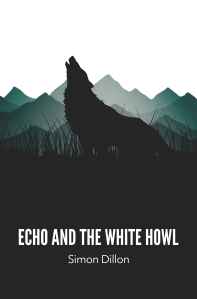
Here’s the cover for my new novel, Echo and the White Howl.
I greatly dislike the word “team”. It is the word my children dread to hear at school (“team project”) because it often means they will end up doing all the work whilst others sit and twiddle their thumbs. It is also hurled around endless miserable corporate settings, often as a stick to bash over the heads of employees, implying responsibility beyond what they are paid for (“You’re letting the team down”). Generally I only use the word in a sport related context, and prefer to use other terms elsewhere (“group”, “department”, “squadron” – anything but “team”).
However, I cannot deny that the Echo and the White Howl cover was the product of excellent “teamwork”. My wife Zara and my good friend Yasmine Nuoraho both had a hand in the design, as did I. There were a number of variations (including one with an orange sunset background) but in the end I opted for the colder, blue-grey version which tonally suits the mostly wintery setting.
Set amongst a wolf pack in the vast Alaskan wilderness, Echo and the White Howl is a thrilling animal fiction adventure for all ages.
Here is the blurb from the back of the book:
When a wolf pack discovers humans lurking near their territory, Echo senses dark times ahead.
Despite the warnings and omens, Aatag, the pack Alpha, refuses to flee… leading to a cruel turn of events that forces Echo into exile, and a quest for revenge that will change the pack forever.
Echo and the White Howl is out now, as a download or paperback from Amazon. Click here for your copy.


 Uncle Flynn
 Dr Gribbles and the Beast of Blackthorn Lodge
 Echo and the White Howl
 George Hughes Trilogy (comprising George goes to Mars, George goes to Titan, George goes to Neptune)
 Given the rather excessively productive year I have had so far (first drafts on two longer than usual novels, lots of editing on earlier, currently unreleased novels, and a couple of short stories), I have decided to take a short break from writing and from posting on this blog. However, I will be back in the first week of September, and I will still post film reviews of any films I see at the cinema.


 Simon Dillon Books
You must be logged in to post a comment.