Download The Birds Began to Sing FREE – for five days only

Love a gripping, page-turning psychological thriller? Download my novel The Birds Began to Sing absolutely FREE – for five days only!

Here is the blurb from the back of the novel:

When aspiring novelist Alice Darnell enters a competition to write the ending for an unfinished manuscript by late, world famous author Sasha Hawkins, it appears she might have her big break at last.

However, upon arrival at Sasha’s former home – the sinister Blackwood House – Alice is unsettled by peculiar competition rules, mysterious dreams and inexplicable ghostly visions. She begins to question her sanity as she is drawn into a terrifying web of deceit, revenge and murder.

Some review snippets:

“Mystery, drama, conspiracy theory, and some supernatural intrigue. A real page turner!” – Anonymous, Barnes and Noble.

“Well written, poetic in places, funny at times and with a plot that will keep you turning the pages…” – Al Gibson, Amazon.

“What a magical work of art! You’re really missing out if you don’t read this one.” – A Critical Reader, Amazon.

“Absolutely loved this. Properly chilling.” – Alice R Brewer, Amazon.

“This was really a great read and I loved the twist. Did not expect it at all.” – Jennifer, Amazon.

“A terrific read for lovers of suspense and mystery. Big thumbs up!” – Mickey, Amazon.

The Birds Began to Sing can be downloaded from Amazon Kindle FREE here – for five days only.

All my novels now available as paperbacks from Amazon

At long last, I have stopped procrastinating, deferring, delaying, dilly-dallying, putting off, hanging fire, dragging my feet, beating about the bush and taking a rain check (or a “precipitation verification” as I sometimes call it, since the expression, American in origin, uses the spelling “check” rather than “cheque”). At any rate, I have finally decided to get off my backside and do what I should have done long ago and, to finally come to the point, ensure all my novels are available in paperback from Amazon Create Space, complete with physical pages that you can actually turn.

With that deliberately silly paragraph out of the way, to be more succinct, all my novels are now available from Amazon in dead tree format. Simply click here, and you’ll find them all listed accordingly.

Life, Death, and Iceland: An interview with Zena Shapter

Award-winning author Zena Shapter has just had her new novel – a gripping, speculative fiction techno-thriller entitled Towards White – released by IFGW Publishing. Here’s the blurb from the back cover:

They know what’s going to happen to you… after you die.

Scientists in Iceland think they’ve figured out one of our greatest mysteries – where the electrical energy in our brains goes after we die. According to the laws of physics, one form of energy must always become another form. So the electrical energy in our brains and nervous system can’t simply disappear…

When ex-lawyer Becky Dales travels to Iceland to track down her missing brother, she doesn’t care about the groundbreaking discoveries, or the positive-thinking practiced by the Icelanders – she just wants her brother back. Having stumbled on something she thinks the Icelandic government wants covered up, Becky must piece together the answers fast… before she becomes a victim herself.

In this post I interview Zena, discussing the novel and all things writing, as well as her inspirations, metaphysical matters and more.

What inspired Towards White?

I grew up around elderly people, for whom death was never far away, and loved studying science at school, so knew all about the energy and nitrogen life cycles. As a teenager, I also enjoyed philosophical contemplations – wherever I could get them! So when I was about eighteen – home from University where I was reading English – I was up late one night philosophising with friends about life after death and I found myself layering our discussion with my scientific background. The conservation of energy theory states that one form of energy must always become another form of energy, energy cannot simply disappear. Our brains are powered by electricity, so I simply made the leap to wondering what happened to it after death. Our bodies go to the worms, what about our electricity? It can’t simply disappear, and it’s far too efficient an energy to simply dissipate, or entropy, as heat. I dwelled on the idea, pondered it, and extended it as far as I could. What if… what if that was the answer to one of man’s greatest mysteries: life after death?

Over the years I played with the idea but it wasn’t until I went to Iceland in 2001 that the story that would become Towards White took shape. I fell in love with the country’s austere beauty and inspiration simply poured into my brain from there. There were some delays along the way – moving to Australia, marriage, two children, a new career and finding the right publisher – but the story evolved so much it demanded to be told, and finally it’s here!

Is the protagonist Becky based on you in any way?

I try to put a little of myself into every story, not only because it helps make characters more authentic, but because I read to connect with others, their stories and challenges, and assume others do too. So when I’m writing, I like to offer readers the opportunity to spend time in another person’s shoes, and to do that I have to search through my own closet of shoes and find the right pair to offer up (BTW I don’t actually have a closet for shoes, my shoes are bundled up on wardrobe shelves!). Once I’ve found an experience I might be able to share, I imagine what it would be like to intensify that experience and go through it in extreme conditions, and once I know what those conditions might be, I build my character. During character development, I also think of friends and family who resemble my character in some way, and borrow bits of them to add into the mix. So there’s a bit of me in Becky Dales, there are bits from a few lawyer friends I know, but Becky’s also herself because none of us have ever been in her situation in Towards White – I’m sure we wouldn’t want to be either! We all fall apart sometimes, face the darkest of dark hours, question the essence of our being, then seek a way back to ‘normal’ life. Unfortunately for Becky, she faces having to do this during a crisis. Sometimes when it rains, it pours!

Becky has some strong views on those in the legal profession. Is that inspired by personal experience?

No comment (he he!).

Does Towards White hint at your personal philosophy of the afterlife, or are you simply speculating during the metaphysical aspects of the novel?

Since I like to write stories in first person from a single character’s perspective, I need to understand everything I can about that character before I write – where they come from, what they think and why they do the things they do, what they want to do in the future. This allows me to know them so well they start to take over the plot I’ve created for them and do things I hadn’t planned for them to do. I love it when that happens! This also means that, when I’m writing, I believe what they believe 100% – their personal philosophies become mine, I make discoveries with them, I wonder at life the same as they do. Their personal philosophies become mine. But when I switch to a new story, I leave those philosophies behind me and immerse myself in a new character.

Outside of that process I’m an agnostic atheist who speculates a lot!

Did any other personal experiences inform the novel?

My love of Iceland! There’s something magical about Iceland. Nothing can prepare you for the stark beauty of its geography – its lonely lava plains, steamy natural springs, volcanoes, glaciers, geysers, waterfalls and auroras. Once you’re exploring, you can’t help but develop a profound connection with the landscape. It’s also an incredibly friendly and open-minded place and, when I was there in 2001, this led me to think of it as a kind of utopia. I guess that’s why I then asked myself ‘what if’, added my life-after-death theories, and went from there.

Do the Heimspeki philosophy and the Sannlitro-Volva technology have any basis in fact?

Of course! Once I knew I wanted to write a story based on my scientific ideas set in Iceland, I thoroughly researched those ideas. For the scientific side of things, I went to libraries in the UK and over here in Sydney, read online and asked scientist friends, putting together a folder of research and ideas about energy. I researched all kinds of other relevant things too like gravity and electromagnetism, how colour works, magnetic field therapy, Reiki, astronomy, genes, artic phenomena, the auroras, the constitution and history of Iceland, and of course the brain and nervous system, including brain death and methods of execution. I also bought an Icelandic dictionary and got to know the language as best as I could, including famous cultural quotes and swearing. Many of these ideas have been ingrained in the story from the very first draft back in 2002, but I cut out a lot of the language as my writing technique developed because it didn’t bring anything to the story but ambiguity. Some of the research I cut too because it was too lengthy – but I still have it all somewhere! So there are tons of facts and figures behind the creation of both the Heimspeki philosophy and Sannlitro-Volva technology – that’s why they’re intriguing so many people!

Human corruption interfering with what could be a perfect system lies at the core of the questions raised by Towards White. Were a device akin to the Sannlitro-Volva come about in reality, to what extent should we be suspicious and distrustful of such a major scientific advance?

One of my favourite movie quotes of all time is by Dr Ian Malcolm in Jurassic Park: “Your scientists were so preoccupied with whether or not they could, they didn’t stop to think if they should.” We should always be sceptical and distrustful of major scientific advances.

How difficult was it to get from initial draft to final draft on Towards White?

Enormously. I finished my first draft in late 2003 though, at that time, hadn’t yet developed my writing voice. Between raising two kids as a full-time mum, developing a full-time creative support business and moving continents, twice, it took me another nine years to find my voice. In late 2012, an Australian agent signed Towards White after absolutely falling in love with it. I was so excited! Little did I know how downward the Australian publishing market would turn over the next few years. It came extremely close several times, but it wasn’t until mid-2016 that I actually sold it – and at that time I had a choice of two publishers at once, typical! Copy edits and proofreading happened mid-2017, publication late 2017. Finally, yay!
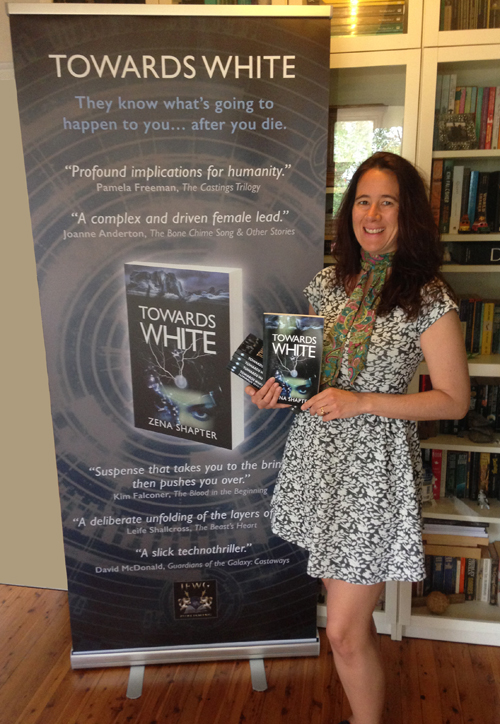
Zena Shapter Towards White Pull Up Banner

What is the best thing about being a writer?

The best thing about being a writer is the creativity. A blank page can be a difficult landscape to navigate, but when you fill it with delicious words you create something that didn’t exist before. That creative process gives me an enormous sense of achievement, no matter what I ultimately do with my words. I love it!

What is the worst thing about being a writer?

There isn’t a worst thing! There are plenty of challenges of course, including isolation, persevering through rejection, and diversifying your skills to support yourself financially. But those can be overcome. As long as you enjoy writing, which of course I do, and you’re doing something you enjoy, it’s never too much trouble to make it work somehow. Every job has its ups and downs.

Oh okay, more money would be nice. The worst thing about being a writer is that it’s a very low-paid job!!

To what extent do you agree with the statement “write what you know”?

When you first start writing, it’s easier to develop your writing technique if you do write what you know, which means writing from a perspective already familiar to you – that way you can focus on developing your writer’s voice. As you progress as a writer, however, you can branch out and write from different perspectives, as long as you make yourself familiar enough with that perspective that you can represent it accurately and sensitively. If you can do that, you don’t have to write only ‘what you know’.

Are you promiscuous or monogamous with your choice of genre?

Promiscuous. For me ‘story’ is paramount, over and above what shelf my book may be stocked on in a bookstore or library. I focus on character, the challenges they face and the changes they must make. After I’ve finished a story I look at genre and at finding an audience. Every well-told story has an audience. If you write specifically for that audience you may find yourself predicting their expectations, and writing something they’ve already read before. However if you write a story simply because it needs to be told, you’ve a greater chance of being original and offering readers something different or even unique. That said, I often have a primary genre in the back of my mind when I start a story, because the concept itself is likely to fall into one category or another.

Which writers inspire you?

I read widely and enjoy a huge range of writers. However, these writers definitely inspired me in some shape or form over the years:

  • Cormac McCarthy, “The Road”
  • Margaret Atwood, “The Handmaid’s Tale”
  • Laura Ingalls Wilder, “Little House on the Prairie” series
  • Malory, “Morte d’Arthur”
  • Daniel Defore, “Robinson Crusoe”
  • Mary Shelley, “Frankenstein”
  • H. G. Wells, “The War of the Worlds”
  • Salman Rushdie, “Haroun and the Sea of Stories”
  • Veronica Roth, “Divergent”
  • Suzanne Collins, “The Hunger Games”
  • Stephen King, “The Green Mile”
  • John Grisham, “The Firm”
  • Shakespeare, “Hamlet”
  • Mark Haddon, “The Curious Incident of the Dog in the Night-time”

How important is social media if you are a writer?

It can be useful as a resource for information and as a support group, especially if you work from home and need the interaction/encouragement. So far, however, it’s been my writing that’s helped me stand out in the crowd. Nothing is as important as having an incredible manuscript to offer publishers. Social media can also drain you of valuable time and, if you encounter any trolls, energy. So – writer beware!

What are your future writing plans?

My immediate plans involve editing a novel I’ve written, following a course I took earlier this year on ‘Writing Inclusive Fiction’. Beyond that, I’m planning writing world domination of course!

What advice would you give to any writer searching for mainstream publication?

Be prepared for a long-haul journey. Publishing is a slow business. It can take months and months for mainstream editors to read your work, take it to acquisitions, negotiate a contract, and then you have to join a queue of authors whose books are already scheduled for print. It also takes time to perfect your writing style and voice. So the key is not to get downhearted or frustrated. Set yourself realistic goals but be tenacious. Push onwards and upwards, constantly. To keep motivated, be sure to enjoy the highlights as they happen too – it’s so easy to always focus on what you’re yet to do rather than acknowledge what you’ve already achieved.

Towards White is out now. Copies can be ordered here.
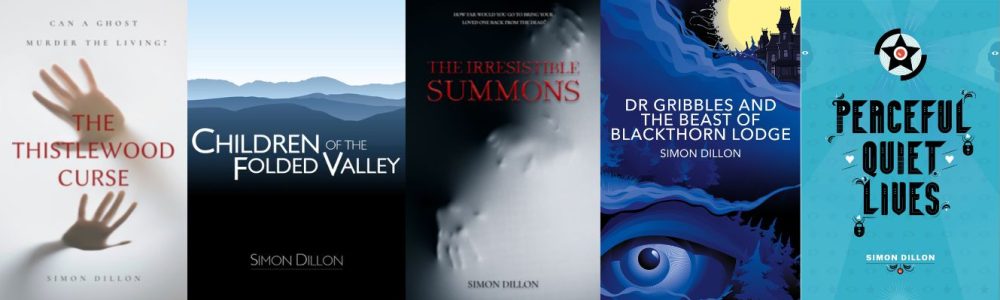
Inspiration: Children of the Folded Valley

Concluding my series on inspiration and influences for my novels, here’s a look at the stories that informed my most successful and “personal” book to date, Children of the Folded Valley.

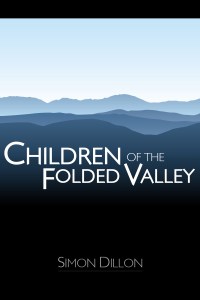
Folded Valley cover

A coming of age memoir set against a “light” science fiction backdrop, Children of the Folded Valley is about a man recalling his childhood and adolescence amid an unusual religious cult. The novel draws on some elements of personal experience, but here are seven key texts that were also influential.

The Remains of the Day (Kazou Ishiguro) – Children of the Folded Valley has a similar flashback structure to Ishiguro’s masterpiece, with the protagonist also taking a journey from Oxfordshire to the West Country during his reminiscences. Obviously The Remains of the Day has very different subject matter, but the melancholy theme of wasted lives is definitely an undercurrent in my own novel.

Never Let Me Go (Kazou Ishiguro) – Ishiguro again, and actually a novel I am less keen on because for me dystopian narratives really need to culminate in an act of rebellion (successfully or otherwise). Although brilliantly written, this one is determined to be “realistic”, with the characters resigned to their fate, at the expense of dramatic satisfaction. However, it remains a key influence for this reason: I love the way the science fiction element remains very much in the background, unrevealed until it absolutely has to be, and even then very obliquely.

The Handmaid’s Tale (Margaret Atwood) – As with Never Let Me Go, the science fiction elements are kept cleverly in the background (hence my term “light” science fiction), because they are less important than the bone-chilling themes of religious dystopia. The hideous treatment of women in this appalling future was also influential to a certain degree, though to be honest I must sadly admit I didn’t have to look too far into my own experience of real life religious organisations to find inspiration on that front.

1984 (George Orwell) – Well, obviously. I mean, anyone writing a dystopian novel has to acknowledge the granddaddy of them all. Orwell’s scathing, brilliant condemnation of totalitarianism is a clear influence, even though his novel focusses more on political dictatorship and mine on religious dictatorship. Like Shakespeare and Dickens, Orwell despised “the mob” (in this case, a political mob manipulated by the state). In my novel, the brainwashed “mob”, followers of cult leader Benjamin Smiley, are equally insidious at times, even though they too are victims. The “bleeding” scene in Children of the Folded Valley is also influenced a little by “Room 101”.

The Wizard of Oz (L Frank Baum) – The wizard being revealed as a fraud is an important moment in the novel (and in the film), although the effect is largely comical. In Children of the Folded Valley, when Smiley is revealed for what he is, the effect is devastating. However, there remains a touch of the Wizard of Oz in his character, despite Smiley’s malevolence.

Great Expectations (Charles Dickens) – Just as 1984 is the ultimate dystopian novel, Great Expectations is the ultimate coming of age story and I borrowed from it extensively. There are definitely elements of Estella and Pip in the relationship between James and Miranda, though again I know the backgrounds are very different. It’s also worth giving an honourable mention to The Kite Runner here, as there were tonal elements that were an inspiration, particularly in the novel’s latter stages.

Lost (TV series) – Yes, I know this ultimately led to an exasperating and disappointing finale, but along the way the story of “the Others” proved very influential, in the way they operated much like a cult. Benjamin Smiley is not deliberately named after Ben Linus, but it is an amusing coincidence.

You can download or buy print copies of Children of the Folded Valley from Amazon here.

Inspiration: Uncle Flynn

Continuing my series on inspiration and influences for my books, here’s a look at texts that informed my debut novel, Uncle Flynn.

uncle-flynn_cover

A thrilling treasure hunt inspired by local history and walks on Dartmoor with my oldest son, Uncle Flynn is a good old-fashioned adventure story for young and old alike, with a surprising twist in the tale. It delves into themes of overcoming fear and the dangers of mollycoddling, but the heart of the story concerns the restoration of a relationship between father and son. Here are five key influential texts:

Five on a Treasure Island (Enid Blyton) – Not my favourite Famous Five novel (that would be Five go to Smuggler’s Top) but certainly the biggest influence on Uncle Flynn in that it features a map, treasure and villainous rival treasure hunters. Like all good treasure hunt stories, the real prize is not the gold but something greater – in this case, lonely George gaining lifelong friends in her cousins. In the case of Uncle Flynn, the afore-mentioned restored relationship between Max and his father is the real prize.

Treasure Island (Robert Louis Stevenson) – I could hardly exclude this. As well as obvious treasure hunt iconography (maps, gold, etc), there are elements of Long John Silver in the darker side of Uncle Flynn. My book doesn’t have pirates though.

Swallows and Amazons (Arthur Ransome) – Another obvious touchstone, and a classic of children having adventures out of doors. The inspiration here is more tonal, though other Ransome novels contain elements that perhaps proved a more direct influence on the plot (for example Peter Duck and Pigeon Post, which are both treasure hunt stories).

The Goonies (Film) – Childhood nostalgia plays a big part in my affection for this film, a treasure hunt adventure packed with secret tunnels, maps, boobie traps, villainous treasure hunters and so forth. Obviously there are also treacherous secret tunnels and treasure chambers in Uncle Flynn, so the influence is obvious.

Mary Poppins (PL Travers) – To be fair, the film provided much of the inspiration here, since the character arc of Mr Banks isn’t really present in the novels. Uncle Flynn shares a certain amount in common with Mary Poppins, in that he enters the story at a point when Max really needs him. They go on great adventures, like Mary Poppins with the Banks children, so in that sense both the books and the film are an influence. But it is the film that features the restoration of the relationship between Jane and Michael and their parents. Just as Mary Poppins leaves “when the wind changes” so Flynn leaves once Max’s relationship with his father is restored.

You can download or buy print copies of Uncle Flynn from Amazon here.

Plot Twists versus Unexpected Plot Turns

I have noticed some people confuse plot twists with unexpected plot turns. Here I shall attempt my own definitions of each, to explain the difference.

Earlier this year, I was most amused by a “bad” review of my novel Love vs Honour on Goodreads. The reviewer took great exception to the third act, stating the following:

“No…just No….
I hate such endings..
Wtf….
When the story got interesting then the author has to shock us?
No…
That’s bad..”

Obviously the reader is entitled to their opinion, and I am pleased that my writing got under her skin, but I maintain (and this is supported by many others who have read the novel) that the third act of Love vs Honour is not a pointless exercise in shock tactics but an outcome that was hinted at throughout – indeed the very first chapter clearly telegraphs where this is all going to end up.

LvsHonour 1600 x 2400

That said my intention in writing that novel was to create an unexpected plot turn, despite the hints that had been dropped. The third act should still feel like a shock, even though in hindsight it ought to seem inevitable. This was not a twist, but a new and unexpected narrative direction. However, an unexpected plot turn does not mean earlier events are viewed in a different light. In Love vs Honour, the first two acts are not open to drastic reinterpretation as a result of the third act.

By contrast a plot twist, particularly a final act plot twist, turns the entire story on its head, providing a rush of insight that causes the reader to see all events and characters in completely new terms. Said twists must be cleverly woven into the narrative in such a way that they come out of left field, and yet like unexpected plot turns, also seem inevitable in hindsight, causing the reader to wonder how on earth they didn’t see it coming.

In a number of my novels – including Uncle Flynn, The Birds Began to Sing and most recently The Thistlewood Curse – there are big, final act twists which mean the entire story has to be reassessed in light of the new information. How well these big twists work is of course up to readers to decide, but for better or worse, the events in those finales do mean the entire plots of those books are turned on their heads, hopefully in an entertaining and enjoyable way.

To conclude, a good example of the difference between the above narrative devices occurs in Alfred Hitchcock’s film Psycho. The notorious shower stabbing is an unexpected plot turn, whereas the finale in the cellar (when the nature of Norman’s “mother” is revealed) is a plot twist.

Here are some other examples of both from books and movies (I will tip-toe around spoilers):

Harry Potter and the Philosopher’s Stone – The man with two faces finale is a big plot twist.

One Day – The bike accident late in the novel is an unexpected plot turn.

The Sixth Sense – Bruce Willis’s final discovery about himself is a justly famous plot twist.

His Dark Materials: The Amber Spyglass – The upshot of the romance between Will and Lyra, as a result of the difficult choice they are forced to make, is an unexpected plot turn.

Planet of the Apes – Charlton Heston’s final discovery on the beach is a plot twist.

Great Expectations – The demise of Miss Havisham is an unexpected plot turn.

The Empire Strikes Back – Darth Vader’s big revelation is a plot twist, one that turns the entire story of not just that film but also the previous film completely upside down.

Million Dollar Baby – What happens to Hilary Swank’s character following the sucker-punch is an unexpected plot turn.

Les Diaboliques – The nail-biting bath finale is a plot twist.

Dead Poets Society – What happens to Neil after he performs in A Midsummer Night’s Dream is an unexpected plot turn.

Tinker Tailor Soldier Spy – The identity of the mole in MI6 is a big twist.

Sherlock Holmes: A Scandal in Bohemia – Irene Adler’s escape is an unexpected (and unconventional) plot turn.

Murder on the Orient Express – The finale is one of the most famous whodunit resolutions of all time, and one of the biggest twists.

Kind Hearts and Coronets – The delicious irony of why the protagonist finally gets arrested is a particularly amusing unexpected plot turn in this sublime black comedy.

I could go on and on, but hopefully that clarifies my definition.

Download Uncle Flynn FREE – for five days only!

For five days only, my debut novel Uncle Flynn is available to download FREE from Amazon Kindle.

Uncle Flynn was received very positively. On the surface it is a properly old-fashioned treasure hunt adventure, but it contains underlying themes about overcoming fear and the dangers of mollycoddling. The book is dedicated to my eldest son, and was largely inspired by our many excursions over Dartmoor, as well as a bit of local history.

Here is the blurb from the back of Uncle Flynn:

When timid eleven year old Max Bradley embarks on a hunt for buried treasure on Dartmoor with his mysterious Uncle Flynn, he discovers he is braver than he thought.

Together they decipher clues, find a hidden map and explore secret tunnels in their search. But with both police and rival treasure hunters on their tail, Max begins to wonder if his uncle is all he seems…

Here are a few reviews from various readers:

“Harking back to the wonderful adventure stories of Arthur Ransome, Uncle Flynn is a welcome return to the excitement of outdoor exploits in wild surroundings. Excitement, tension and peril combine in a well-written tale where The Goonies meets Swallows and Amazons. The evocative descriptions of treasure seeking on Dartmoor will have you longing to visit and explore for yourselves. Action-packed puzzle-solving pleasure for children and adults alike, with a neat twist in the tale to keep you guessing.”

Mrs Alice R Brewer, Amazon.co.uk

“A treasure for all ages. Kids and teenagers would love this fast-paced adventure story. Most adults would also find it a light and enjoyable read.”

B Fraley, Amazon.com

“Don’t pass this one by. I have been burning through the free NOOKbooks and this is the absolute BEST. Doesn’t matter what type of fiction you like to read, I can imagine this would capture just about anyone’s attention – and heart.”

willreadanything, Barnes and Noble.

“Could not put the book down, so enjoyed the journey. Recommended it to my 12 year old grandson who now wants me to be his book reading adviser. Loved by three generations.”

Brinney, Barnes and Noble.

“What a wonderful book for young readers and anyone else who loves a book with a great twist on an amazing story of courage over fear.”

Beansie47, Barnes and Noble.

“I’m an 83 year old woman. Your book was a joy to me. I felt I was having all the adventures myself at this ripe old age. Your book was like a cold drink of water on a hot day. Thank you.”

Joan McLaughlin, commenting on the Uncle Flynn blog.

“I downloaded the book for my boys to read, and thought I’d just read the first few lines… Needless to say I read to the end! Well written and most enjoyable – great adventure with life lessons woven into the story.”

Cecile Weyers, commenting on the Uncle Flynn blog.

Uncle Flynn is available to download FREE here. Print copies are also available (not free) here.

Managing Metaphors

Sometimes metaphors in novels can seem crass and unwieldy. Other times they can be sublime. But what is the difference between good and bad use?

Folded Valley cover

My general rule of thumb is that deliberate metaphors should only be included if they are also a vital part of the narrative. For example, in my novel Uncle Flynn, when Max is stalked by the panther, it is an essential ongoing element of the story, without which the plot would fall apart. But the panther is also a metaphor for Max’s fears, and his responses to the panther illustrate his progress in this respect.

In Children of the Folded Valley, the trains form an equally essential part of the story. Without them the plot would simply cease to exist. And yet, the trains take on an increasingly metaphorical role as the novel progresses; lost childhood, the passing of time, the end of an era and so on.

There are a number of excellent metaphors in JK Rowling’s Harry Potter series that adhere to my above principle. For example, in Harry Potter and the Prisoner of Azkaban, Dementors are essential to the plot, but are also a metaphor for depression. In the same novel, the hippogriff Buckbeak, unjustly sentenced to death, is a metaphor for another character who has also suffered a miscarriage of justice. Again, Buckbeak is pivotal in the climax. In the final novel, Harry Potter and the Deathly Hallows, one character’s silver doe patronus symbolises their ongoing love for a deceased character – a very poignant metaphor. Patronuses are, of course, an ongoing and vital part of the series.

There are exceptions to the above rule from time to time, but generally I get irritated when a metaphor takes me out of the story and draws attention to itself when the plot could exist perfectly well without it. When that happens, I feel as though the author is deliberately popping up in the middle of the narrative to announce how clever they are. I have had many an eye-roll for this reason, often when reading critically acclaimed high-brow literature.

Download the entire George Hughes trilogy FREE – for five days only!

The George Hughes trilogy is a thrilling, action-packed space tale set just over a hundred years in the future. Each story is a stand-alone adventure, but I recommend reading the novels in order nonetheless, as they do follow on from one another.

All three can be downloaded FREE from Amazon Kindle during the next five days.

Also, I must emphasise, these books are not just for children. Adult readers have found plenty to enjoy too (especially those who have picked up on some of the subtexts).

Here is the blurb from the back of George goes to Mars:

When George Hughes discovers he has inherited the planet Mars, he goes from poverty to becoming the richest boy on Earth overnight.

Accompanied by his new guardian, a mysterious secret agent and a crew of astronauts, George voyages to Mars to sell land to celebrities wanting to build interplanetary holiday homes. But sabotage, assassination attempts and the possibility of an alien threat plunge him into a deadly adventure…

Here is the blurb from the back of George goes to Titan:

The thrilling sequel to George goes to Mars…

A year on from his adventures on Mars, George Hughes faces an even deadlier peril as he travels to Titan on an urgent rescue mission. The mysterious Giles returns to help him, but assassins are once again on his tail, and a new, far greater alien menace lurks in the shadows waiting to strike.

Here is the blurb from the back of George goes to Neptune:

In this spectacular sequel to George goes to Mars and George goes to Titan, George Hughes faces his most dangerous adventure yet.

Following the Titanian invasion, a deadly and very personal threat forces George to undertake a voyage to a top secret Martian research base on Neptune.

On this remote outpost, he uncovers a diabolical plot. But George is too late to prevent the catastrophe.

A catastrophe that will change his life forever…

Here are a couple of reviews from adults:

“A thoroughly enjoyable read” – Mark, Amazon.

“Reading like a cross between one of Edgar Rice Burroughs’ pulpy Mars adventures and a Robert Heinlein ‘juvenile’, this improbable yarn (just how many “saved in the nick of time” coincidences can one novel contain?) about a rags-to-riches-to-hero boy named George was nonetheless page-turningly entertaining. Perfect rainy day/sick day reading.” – Elizabeth Olson, Goodreads.

And here some thoughts from the target audience (at least I assume so, given the tone of their reviews):

“This was totally amazing! Involves space ships, aliens and more! A totally exciting adventure you’ll love!” – Anonymous, Barnes and Noble.

“Pure awesomeness! Packed with suspense and adventure, as well as LOTS of action!” – Anonymous, Barnes and Noble.

“Best book ever!” – Anonymous, Barnes and Noble.

The George Hughes trilogy can be downloaded FREE here

Print copies (not free, alas) can be ordered here (book 1), here (book 2) and here (book 3).


The Limitations of Allegory

lotr

JRR Tolkien famously wrote about his dislike of allegory in the foreword to The Lord of the Rings. Here is what he had to say:

“I cordially dislike allegory in all its manifestations, and always have done so since grew old and wary enough to detect its presence. I much prefer history – true or feigned – with its varied applicability to the thought and experience of readers. I think that many confuse applicability with allegory, but the one resides in the freedom of the reader, and the other in the purposed domination of the author.”

I don’t have quite the same issue with allegory that Tolkien had, since I think part of his problem came with the insistence of readers that The Lord of the Rings was an allegory of World War II (amongst other things). I maintain that it is intellectually lazy to read allegory into any literary work unless it is the stated purpose of the author. For example, CS Lewis intended The Lion, the Witch and the Wardrobe to be an allegory about Christianity. George Orwell intended Animal Farm as an allegory of Soviet Russia. However, The Lord of the Rings was never intended as an allegory of anything.

Conversely, it is true that Tolkien’s experiences – particularly of encroaching industrialisation destroying the countryside, as well as World Wars I and II – informed the writing of The Lord of the Rings. His Catholicism was also a key factor, and Tolkien admitted as such in later letters, claiming that in retrospect he could see how these life experiences had influenced his work, regardless of the fact that he never intended it as an allegory.

Therefore, his remark about applicability to my mind makes perfect sense.

In my own writing, I have not written any deliberate allegories. But I know readers have made all manner of metaphorical applications, sometimes confusing them as allegory. For example, George goes to Mars has been read as a pro-feminist, anti-Islamic fundamentalist allegory. I certainly didn’t have that in mind when I wrote it. I simply wanted to write a thrilling science fiction adventure story for children and young-at-heart adults. Yet it is true that my own views are often inherent in my work, and can be detected to a greater or lesser extent. Equally they can sometimes be misconstrued, and that begs the question as to whether or not I have failed as an author. The bottom line is readers will interpret George goes to Mars (or any of my novels) any way they please, perhaps in ways I might even disapprove of.

I have almost finished an animal fiction adventure novel about wolves in Alaska, which I may well decide to fast track for release later this year. Reading back over my first draft, I suspect some may well read political allegories into it. But again, I must emphasise this is not my direct intention, and therefore it is not an allegory, however much readers may wish to label it as such. I do not wish to reduce my work to a single message or lesson, claiming it as allegory, since that would be reductive. Rather, I would prefer the reader to decide what to make of the story, and allow for multiple interpretations.