Writing Major Plot Twists

Photo by Girl with red hat on Unsplash

NOTE: The following is a revised version of an article originally published on Medium, where I’ve published a number of writing advice pieces.

Warning: Contains spoilers for Planet of the Apes, One Day, Dead Poets Society, Rebecca, The Hound of the Baskervilles, Harry Potter and the Chamber of Secrets, 24 series 2, Death on the Nile, and The Sixth Sense.

Big story twists can be brilliant or dreadful, depending on the skill of the writer. Many a budding screenwriter or novelist would love to pull off a gasp-inducing twist of The Sixth Sense proportions, but doing so in a manner that feels organic, plausible, and above all inevitable is extremely difficult. However, it is not impossible.

Successful big twists can be intellectually thrilling and emotionally exhilarating; The Murder of Roger Ackroyd, The Usual Suspects, and Memento are examples of the former, Rebecca, Jane Eyre, and The Empire Strikes Back the latter. Some are a combination: Snape’s true allegiance in Harry Potter and the Deathly Hallows for instance. The big reveals at the end of Les Diaboliques, Planet of the Apes, and The Sixth Sense generate tremendous cerebral and emotional pleasure, whilst the latter even operates on a spiritual level.

Conversely, a bad plot twist feels bolted on, gratuitous, and irritating. How many times have you encountered a film or novel with a promising plot, only to be sideswiped by a random, contrived plot twist that seems to have gate-crashed from another story? Ambushing an audience with ill-conceived, implausible, shock tactic twists only serve to undermine intellectual or emotional engagement. The big twist ending cannot seem tacked-on as an afterthought. It must be an essential final component.

Twist versus Unexpected Plot Turn

To avoid confusion, it is important to define a plot twist. I do not mean an unexpected plot turn, which is slightly different. In an unexpected plot turn, the story may veer off in a new and unforeseen direction, but it does not mean earlier events are viewed in a different light. A plot twist is a reversal; a revelation that turns the entire story on its head, provoking a rush of insight and causing the audience to see the entire narrative from a completely new angle. The tragic death near the end of One Day, the suicide at the climax of act two in Dead Poets Society, or the aftermath of the sucker-punch received by Hilary Swank’s character in Million Dollar Baby are examples of unexpected plot turns rather than twists.

Most great, narrative-defining twists occur towards or at the end because that’s the natural place for them. Withholding the most essential facts from the audience for as long as possible creates the immensely satisfying thrill of delayed gratification. However, there are rare occasions when revealing the major twist earlier adds depth to the work. The Crying Game and Reservoir Dogs are both good examples.

The major bombshell central to the mystery in Hitchcock’s Vertigo occurs at one hour and fifteen minutes in. This surprised me the first time I saw it, but every subsequent viewing has underlined why screenwriters Alec Coppel and Samuel A. Taylor made this unconventional choice. Audience knowledge regarding Kim Novak’s character creates a sense of impending dread and despair, as we watch James Stewart’s character spiral into ever increasing obsession over the remaining forty-five minutes. How will he react when he finds out the truth?

Know your ending

I know this won’t appeal to “pantser” writers, but if your ambition is to craft a story with a major twist ending, simply seeing where a character takes you will almost certainly lead to far more agonised rewriting than if you work from a well-planned outline. I always prefer to start with an ending that completely blows me away, then work backwards, discovering how the characters ended up at that point. As I’ve already noted, twists of plot-defining magnitude typically occur in the latter stages, so with this kind of story, it really pays to plan.

It is also worth asking, does my story need a big twist ending? It might not. However, as an aside, every story should at least feature crisis in the climax. If the final act of a heist thriller features everything going precisely to plan during the heist, how boring would that be?

The most obvious skill in writing a major plot twist is the ability to conceal it from the audience. In some genres, such as the murder mystery, the author must summon an arsenal of misdirection weaponry, because the reader is already on the alert to expect the unexpected. Here are some examples of tactics that can be deployed in whodunit type narratives.

Red Herrings

The use of red herrings — seemingly important plot points that prove irrelevant — is an obvious genre trope, but they should be deployed sparingly. Too many will lead to frustration and confusion in the reader. However, slipping one in now and again can work wonders for plot misdirection.

Conan Doyle’s Sherlock Holmes stories provide a masterclass in red herrings. In The Hound of the Baskervilles, Holmes himself turns out to be one, as he is latterly identified as the mysterious figure Watson observed on the moors. That same novel includes many other false trails, including a subplot involving an escaped convict.

In Harry Potter and the Chamber of Secrets, JK Rowling deploys multiple red herrings concerning the identity of the heir of Slytherin. Everyone from Hagrid to Draco Malfoy is suspected. At one point, Rowling even cast a suspicious eye at Percy Weasley (when he is seen reading about “Prefects that gained power”). There is also a monstrous red herring in the form of giant spider Aragog.

Incidentally, red herrings aren’t necessarily confined to detective fiction. Romantic stories can contain emotional red herrings. These take the form of misunderstandings, or secondary characters attempting to win the affections of our protagonist in their quest for true love. There are often plenty of red herring dalliances before the reveal of who the protagonist ends up with. Jane Austen’s novels, such as Pride & Prejudice and Sense and Sensibility, indulge in such romantic red herrings, as do latter romantic comedies following the Austen template, like Bridget Jones’s Diary.

Multiple Suspects

When writing any story featuring a mysterious, perhaps murderous unidentified figure manipulating events behind the scenes, I incorporate at least three suspect characters into the narrative. The first is the individual to whom all evidence points, and they are suspected by characters or investigators in the story. Since the audience invariably considers themselves smarter than the protagonist, it is vital to feed them a second character, not suspected by anyone in the plot, over whom clouds of suspicions can gradually form. There can be more than one of these second suspects, as required. The final suspect is the genuine culprit or manipulator, who is considered by both reader and protagonist to be above suspicion. Yet when unmasked, the solution must appear obvious and make complete narrative sense.

Agatha Christie’s Death on the Nile features a particularly clever example of this technique, with multiple suspects, all of whom have means, motive, and opportunity for the murder. Yet the two characters with cast-iron alibies, who are emphatically above suspicion, prove to be the killers. What’s more, their scheme is convincing, plausible, and fiendishly clever.

In TV series 24, agent Jack Bauer suspects young Muslim Reza of being involved in a terrorist plot. Reza protests, and we believe him. But we’re not so sure about his shifty father-in-law to be, who has secretly worked for the CIA and clearly has some dark secrets. Yet the real snake in the grass turns out to be Reza’s seemingly sweet and innocent wife-to-be, Marie. She was completely above suspicion, yet she has been brainwashed into murderous fundamentalism.

Hiding in plain sight

The final misdirection device, and one of the most effective, is the hiding-in-plain-sight technique. The Sixth Sense is a case in point. Everything you need to figure out the big twist is contained within the opening scene, which in retrospect ought to be obvious. Yet the audience doesn’t see it coming. Why? Clever screenwriting sleight of hand, from M Night Shyamalan. The subsequent scenes with Bruce Willis’s character Malcolm interacting with his estranged wife Anna, and with his young patient Cole, appear to be straightforward. Yet the final reveal points to the elephant in the room, so to speak, in every one of those sequences. It was there, the entire time, yet we failed to spot it.

The Murder of Roger Ackroyd is another example of hiding in plain sight. It features a phenomenally cunning twist that works best on the page rather than in onscreen adaptations, for reasons that will be clear to anyone that has read it. Whenever I encounter snobby dismissals of Agatha Christie, I point to that novel as one of the finest examples of hiding in plain sight misdirection ever written.

Daphne Du Maurier’s gothic mystery Rebecca features my all-time favorite hiding in plain sight twist. The young, nameless protagonist marries widower Maxim de Winter in a whirlwind romance, but once back at ancestral family home Manderley, finds herself endlessly and unfavorably compared to Maxim’s first wife Rebecca. She is torn apart over the belief that Maxim adored Rebecca, whose wit, intelligence, sophistication, and beauty is remarked upon by all around her. Sinister housekeeper Danvers seems particularly determined to torment the new Mrs de Winter, and she does so with devilish cruelty.

Yet eventually, a dramatic turn of events forces Maxim to confess his true feelings regarding Rebecca to his new bride: “I hated her.” Those three words reverberate in the reader’s mind, as a shocking rush of insight. Maxim’s subsequent explanation, concerning how their marriage had been a sham, forces the reader to re-evaluate everything they thought they knew about Maxim up to that point. Every time a memory of Rebecca was triggered, he wasn’t upset because he had loved her. He was upset because he had hated her. More importantly, he had been indirectly responsible for her death, and had made it look like an accident.

Inevitability

There is one other major factor in creating a twist ending that genuinely wrong-foots the audience: It must seem inevitable. If the audience instantly imagines an alternative scenario, or a better plot twist, the writer has failed. The reader or viewer needs to experience the big twist in such a way that it not only makes complete sense, but that the plot could not have unfolded any other way.

In the original 1968 Planet of the Apes film, Charlton Heston’s character Taylor is an astronaut on a mission to explore the far reaches of the universe. After years in suspended animation, his spaceship crashes on a strange world where apes seemingly evolved from men. With ape the master and mankind their mute slaves, Taylor spends the entire film trying to validate his existence as intelligent being rather than savage. In the process he upsets the religious, theocratic apes, who don’t believe in evolution, but stubbornly cling to their religious texts which warn man is dangerous and must be suppressed. They also want to suppress recent archaeological evidence of a society of intelligent men predating apes.

Taylor exposes this conspiracy, and leaves the apes feeling rather pleased with himself. But then he has to confront the appalling truth when he discovers the ruins of the Statue of Liberty, revealing the planet to have been Earth all along. Taylor pounds the sand in despair, cursing the men who pushed the button of (presumably) nuclear annihilation that turned evolution upside down. It’s an astonishingly dramatic, powerful reveal, which answers all the questions of the film in a rush of insight, through a single devastating image. Impossible to see coming, but also, in retrospect, inevitable.

Conclusion

With good planning, and by factoring in some or all of the above disciplines, in my experience it is possible to write a convincing, thrilling, unexpected twist ending. I have crafted a few in some of my own novels, which I believe fulfill the criteria of being organic, plausible, and inevitable. I hope the above advice is useful to anyone with similar ambition.

New Short Story: Trigger Warning

Photo by Brendan Stephens on Unsplash

My latest short story, Trigger Warning, is now being serialised in Fictions on Medium, and also on Substack, if you are subscriber. Here’s a “friend link” to the first part on Medium, so you can get past the paywall and enjoy a free sample of this four part satirical tale.

Trigger Warning concerns a future where a small but growing minority of people are being offended to death when reading contentious novels. The protagonist, a novelist who unrepentantly writes controversial material, finds their persective challenged when they become romantically involved with someone whose close relative died reading one of the author’s books.

If you enjoy what you read so far, why not subscribe to me on Substack? In addition to full access to my film review archive, you also get access to all the other articles I syndicate from Medium (film analysis, top tens, classic cinema retrospectives, etc) plus many short stories. It’s well worth the $5 per month, I think, so why not at least give it a free trial? Subsequent instalments of Trigger Warning will appear each Friday over the coming weeks.

Alternatively, for Medium subscribers, the story will also be revealed in full over the next three weeks. I hope you enjoy Trigger Warning, wherever you read it.

New Short Stories Directory

If you click “Short Stories” on the menu, you’ll now find a handy directory of all my published short stories and novellas to date, and where you can read them. These are mostly on Medium, with some syndicated to Substack (more will gradually follow), and a few are exclusives to anthologies available on ebook or in paperback. I plan to add to this list as and when new short stories are published. In the future, I may revise the order or categorise them better, but at this point I rather like how they’re presented.

I enjoy writing short stories and novellas, because they provide a chance to let rip with some of my narrative ideas that don’t warrant fleshing out to novel length. Typically, the short stories are between 10,000 and 15,000 words each, and the novellas are between 15,000 and 25,000 words. I hope you dip in and enjoy what’s there, either on Medium, Substack, or by picking up one of my anthologies, which are themed by genre.

There are a lot of stories (plus others waiting in the wings that I’ve yet to publish), so where to start? Well, here are half a dozen I’m particularly pleased with: For a spine-chilling horror tale involving a ghost ship, check out Vindicta. Or perhaps you fancy a bit of romantic fantasy, in which case try Papercut. For something with a bit of satirical bite, Call the Number on Your Screen involves a televangelist being blackmailed. For sci-fi dystopia, Sweet Dreams concerns a conspiracy involving nanotech nightmare suppressing technology for children. And if you want something outside of traditional genre fiction, why not read Aftermath, about a young woman returning to her estranged mother after leaving a cult. One story quite personal to me is In-Between, a supernatural satire about a recently deceased man harassed by ghostly political campaigners whilst attempting to haunt his family.

For links and other stories, click here to see the full list.

A Christmas Present Suggestion: Death Nest

Image created by author in Canva.

Seldom-seen relatives one only catches up with at Christmas can be difficult to buy presents for. However, most people love a nail-biting, page-turning mystery thriller. To that end, I humbly suggest my recently released novel Death Nest.

I’ve written about this novel a little on Medium, principally in this Orson Welles-ish faux-interview prank designed to intrigue readers (I interview one of the supporting characters). I’ve also written a lot about it here, for example in this piece, which is probably as close as I’m ever going to get to a baring-my-soul, personal essay-type article. In it, I discuss the real-life fears and traumas that metaphorically and emotionally informed the novel.

But if that makes it all sound heavy and depressing, don’t be put off! Death Nest is first and foremost a gripping thriller with a touch of romance, a smidgen of coming-of-age drama, and the odd moment of supernaturally tinged horror. There are also a few funny bits, and that’s important in any novel if you ask me, purely to provide contrast.

Here’s the blurb from the back of the book to give you an idea of the plot:

From the author of Spectre of Springwell Forest and The Irresistible Summons

A nail-biting new mystery.

After his young son Ben writes a disturbing story about murdering a boy in a forest, widower Nick Unwin is alarmed by eerie parallels between his son’s behaviour and that of his younger brother Jason, prior to his inexplicable disappearance twenty years previously. This tragic past returns to haunt Nick when he sees an image of his long-lost brother in a newly released film.

Fearing history will repeat itself, Nick decides to investigate, along with Tanith, an old flame from his early teenage years, with dark secrets of her own connected to Jason’s disappearance. But as they delve deeper into the labyrinthine mysteries of their past, long-buried memories resurface. Nick is forced to face the terrible fear that has plagued him for decades: Was he responsible for the death of his brother?

A riveting coming-of-age thriller exploring traumatic sibling relationships, parental fears, and the misleading nature of memory, Death Nest is Simon Dillon’s most gripping novel yet.

If you want to try before you buy, the first three chapters of Death Nest are available to read on Medium in Fictions. Here’s chapter one.

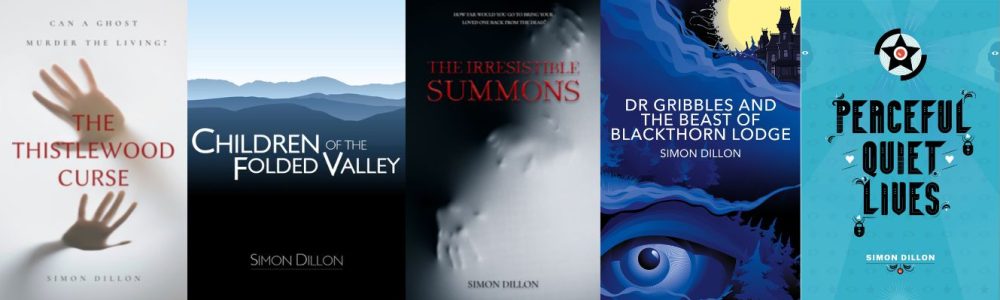
Of course, Death Nest isn’t the only novel I have available for potential Christmas presents. I’ve also written other mystery horror thrillers, children’s adventure stories, dystopian sci-fi tales, and one or two other things. For a full list of my published novels, click here.

Death Nest is available in paperback or on Kindle from Amazon here (in the US) and here (in the UK). It is also available via Smashwords and its various outlets (click here).

Read My Short Stories on Substack!

As you are no doubt aware, all my film reviews have now moved to Substack or Medium. I syndicate them to both sites, with Medium available only to those with a Medium account. However, those with a Substack account can access my film reviews for FREE – for four weeks, before they disappear behind a paywall.

This FREE option isn’t the only thing I’m up to on Substack. I’m also creating a mirror of my Medium account, which means for just $5 per month, you also have access to short stories, including horror stories like Crockern’s Curse or Once in a Lifetime, poignant dramas including Aftermath, satirical fantasy such as In-Between, satirical thrillers like Call the Number on Your Screen, and many others as I release them. For example, my dark fairy tale Window of the Soul will be serialised there over the next eight weeks, and new subscription-only material is added constantly (for one thing, I’m gradually transferring my entire Medium back catalogue, as well as releasing new stuff).

Your monthly subscription also gets you access to all the film essays, top tens, and other cinema analysis I write on Medium, along with access to the full film review archive, which doesn’t disappear after four weeks behind a paywall (unlike the FREE option). There’s also a try-before-you-buy option, so why not take a free trial of Dillon Empire on Substack? Click here and sign up today, as they say in commercial speak.

Thank you to everyone who has supported my writing by signing up so far.

(Dillon Empire image created by author in Canva.)

New Short Story: Crockern’s Curse

Image by Rizal Deathrasher from Pixabay

In October, I published a new short story. Crockern’s Curse concerns a young couple investigating a childhood mystery on Dartmoor are menaced by supernatural forces linked to local folklore. A spine-freezing tale of supernatural horror, this proved very popular with readers of the Fictions publication on Medium (where it was published). It’s in five parts, but there are links to every subsequent part at the end of each instalment.

Check out the first part on Medium here. Alternatively, if you are a subscriber to Dillon Empire on Substack, check out all five parts there, starting with part one here (again, there are links at the end of each segment to the next part). I’ll explain more about what I’m up to on Substack soon, but the short verison is you can get all my film reviews there for free (they disappear behind a paywall after four weeks), or else take up the paid option of $5 per month and in addition to unlimited access to the film review archive, enjoy all my other articles syndicated from Medium, including top tens, classic film analysis, and of course, short stories.

Enjoy!

Death Nest: Summary of Recent Articles

My new mystery thriller novel Death Nest is out now. I’ve been writing a lot about it recently, from many different angles. Here’s a summary of what I’ve been discussing, with links to the articles in question. First though, here’s a brief idea of what the novel is about.

A widower fears his young son is cursed when he shows disturbing behaviour akin to that of his younger brother, before he vanished without a trace twenty years previously. Gnawing dread that history will repeat itself is inherent throughout this modern gothic mystery novel. It’s also a coming-of-age romance with hints of the supernatural, exploring traumatic sibling relationships, parental worries, and the misleading nature of memory. 

After his young son Ben writes a disturbing story about murdering a boy in a forest, widower Nick Unwin is alarmed by eerie parallels between his son’s behaviour and that of Nick’s younger brother Jason, prior to his inexplicable disappearance twenty years previously. This tragic past returns to haunt Nick when he sees an image of his long-lost brother in a newly released film.

Fearing a repeat of history, Nick decides to investigate, along with Tanith, an old flame from his early teenage years, with dark secrets of her own connected to Jason’s disappearance. But as they delve deeper into the labyrinthine mysteries of their past, long-buried memories resurface. Nick is forced to face the terrible fear that has plagued him for decades: Was he responsible for the death of his brother?

The following articles explore different aspects of the novel and the making of it. I have worded them carefully to avoid plot spoilers.

Death Nest: Reflections on Writing My Most Personal Novel

This story is quite personal for me, as it has been informed (in broad metaphorical terms) by the sectioning of my youngest brother following drug abuse, as well as my own fears about the future of my autistic youngest son. The article above was slightly written through gritted teeth, as I’ve revealed a lot more of my personal life than I’m normally accustomed to, but I hope this provides some valuable insights.

Death Nest: Chapter 1 Excerpt

According to readers so far, this is an opening that immediately grips the reader. As an author that’s all very encouraging to hear.

Death Nest: Chapter 7 Excerpt

A second clip, this time from a flashback chapter, introducing a key supporting character.

Death Nest: Settings, Research, Revisions

Various locations in southwest England, as well as my home city of Oxford, were chosen as a setting. This article also touches on other research aspects, and some of the ways in which the novel was rewritten.

Death Nest: Inspiration and Influences

Here I discuss the initial idea for the novel, and how it evolved, including an abandoning of almost all the original premise, and the switching of the protagonist’s gender from female to male (my horror-thriller novel protagonists are usually female). I also mention other novels and a few films that informed the story.

Death Nest: Initial Reviews

The five-star raves are starting to trickle in! Check out some reader feedback here.

Death Nest is in paperback or on Kindle from Amazon (click here for the UK, and here for the US). It’s also available from Smashwords and its various outlets.

(All images designed by author in Canva.)

Death Nest: Initial Reviews

Image created by author in Canva.

The first reviews for my latest novel, mystery thriller Death Nest, are starting to trickle in. I’m thrilled to tell you they are five-star raves! I’m extremely pleased readers are finding this book as gripping and entertaining as I had hoped. My fears that the story would prove too painfully personal (for reasons discussed here) seem to have been unfounded. I’m glad.

Let’s take a look at what people are saying.

“Once I started reading this, I couldn’t put it down. The mystique of the storyline drew me in and held my attention until the very end.” – Joseph M Zobel, Amazon.

“I couldn’t put it down because the twists and turns kept me on my toes. Dillon’s deep dives into characters, narrative, mystery, and intrigue kept me totally engaged. There were no lulls… I was sorry when it ended.” – Annabelle Colbert, Amazon.

“The perfect pre-Halloween read. A wonderful combination of dark and supernatural forces with moral dilemmas in life that we can all relate to, and a thread of romance that runs right through the story… Thoroughly enjoyable (if deeply disturbing at times) and hard to put down from start to finish.” – Saltram, Amazon.

The above reviews can be read in full here.

If you’ve read and enjoyed Death Nest, please do add a review to Amazon or Goodreads (or ideally both). It doesn’t have to be long or eloquent. A one-liner saying you enjoyed it is fine. I seek reviews not to massage my ego (though obviously good reviews are encouraging) but because they are absolutely vital for independent writers like yours truly. Reviews mean the algorithms show my books to more people who potentially buy them. As such, reviews literally put food on my table, so a huge thank you to all of you who take the time to write them. It is so, so appreciated.

If you’ve not read Death Nest, here’s the blurb from the back of the book to whet your appetite.

From the author of Spectre of Springwell Forest and The Irresistible Summons

A nail-biting new mystery.

After his young son Ben writes a disturbing story about murdering a boy in a forest, widower Nick Unwin is alarmed by eerie parallels between his son’s behaviour and that of his younger brother Jason, prior to his inexplicable disappearance twenty years previously. This tragic past returns to haunt Nick when he sees an image of his long-lost brother in a newly released film.

Fearing history will repeat itself, Nick decides to investigate, along with Tanith, an old flame from his early teenage years, with dark secrets of her own connected to Jason’s disappearance. But as they delve deeper into the labyrinthine mysteries of their past, long buried memories resurface. Nick is forced to face the terrible fear that has plagued him for decades: Was he responsible for the death of his brother?

A riveting coming-of-age thriller exploring traumatic sibling relationships, parental fears, and the misleading nature of memory, Death Nest is Simon Dillon’s most gripping novel yet.

Death Nest is available in paperback or on Kindle from Amazon (click here for the UK, and here for the US). It’s also available from Smashwords and its various outlets.

Death Nest: Settings, Research, Revisions

Created by author in Canva.

My latest novel, the mystery thriller Death Nest, has recently been released. Lately, I’ve been exploring different aspects of this novel, which as well as dealing in page-turning suspense also features coming-of-age elements, a touch of romance, and the odd horror moment (especially in the latter stages). It’s also possibly my most “personal” novel to date (as I’ve discussed elsewhere), with a variety of influences and inspirations informing the book.

Here, I want to share a few insights into the settings, research, and revisions that went into the creation of the novel. Beginning with the settings, I should point out that the town of Corthpothan in the novel is fictional, but slightly based on the real Cornish village Porthcothan. I visited this lovely area on the north Cornwall coast a few years ago with the family, at the height of summer. 

Porthcothan beach. Photo by Zara Dillon.

If you drive past, it looks deceptively uninteresting, but if you walk the short distance along the sand of the small inlet next to the village, it widens out into a vast sandy beach. The sea has phenomenal waves, so it is great for surfers. The area is bordered by a spectacular rugged coastline that boasts caves and gorgeous rock pools. Some of the latter are great for children to swim in (if one is concerned about the ferociousness of the sea waves and strong currents).

We had a fantastic time here, but at the same time, the details of the area were carefully logged away in my mind, knowing they might one day make their way into a novel. As for other settings that wound up appearing in the novel, these include the lovely Bagley Woods on Boars Hill, Oxford. In fact, the opening movement of the novel features a variety of Oxford locations, including the King’s Arms pub; a real place, which used to be a regular watering hole of mine. The story also includes scenes in the Magdalen Street cinema (now sadly closed), and Port Meadow, which is another fabulous place to go for walks if you ever visit Oxford, especially if you’re a keen birdwatcher.

Beyond that, the sinister Darkfire Forest is inspired by a few different woodland areas in and around where I live in Devon. Of course, eerie, possibly haunted forests have cropped up before in my novels Spectre of Springwell Forest, but what takes place in Death Nest is a little different. Here’s a photograph I took a while ago that sets the tone for the Darkfire Forest.

Photo by author.

Much of my research for this novel came about from simply checking details about places I already knew, making sure I either rendered them accurately, or deliberately changed them (as was the case with the name Porthcothan). The novel also dealt with certain subjects with which I am already greatly familiar (film production, for instance). However, some more in-depth research took place into dark subjects like human trafficking and brainwashing. I also had to research pagan folklore quite a bit, which is where I discovered and adopted the name Damara for the ancient spirit that may (or may not) influence events in the story. But I also made up a great deal too.

The initial draft had a lot more overtly supernatural stuff included. I cut or greatly reduced much of this, deciding a greater ambiguity over such incidents was preferable. There are still plenty of spooky edges in the final text, and one can read the supernatural into the events. But at the same time, there are enough doubts and questions to leave such matters up to the reader, rather than forcing them into a particular perspective.

Death Nest is available in paperback or on Kindle from Amazon (click here for the UK, and here for the US). It’s also available from Smashwords and its various outlets.

Death Nest: Chapter 7 Excerpt

Here’s another taster of my latest mystery thriller novel, Death Nest. This excerpt is taken from chapter 7; a flashback chapter in which the protagonist, Nick, meets the enigmatic Tanith, in his early teens. The excerpt begins as Nick is looking after his younger brother Jason, playing a game with him.

Created by author in Canva.

For the best part of an hour, we rushed along the stream, following the dusty footpath away from the village green to the south, running a little way uphill, parallel to farmland and clusters of tall hedges and spinneys. Along the way, Jason and I selected our usual weapons of choice from the various sticks that lay around, all the better to shoot the marauding malevolent aliens on the strange planet where we had crash landed. I threw myself more vigorously than usual into the pew-pew of shooting, and we would often take cover together behind rocks, trees, and bushes, looking ahead into the distance and blasting alien threats from afar. Sometimes we would attack. Other times we would be on the run. For Jason, it was exhilarating and fun. I enjoyed it too.

  Ultimately, our game petered out, but we decided to keep walking. I knew eventually we’d reach a small cluster of cottages on our left that lay on the southern border of the Darkfire Forest. The stream continued south to its source somewhere in the woods, skewing right with the building site of Wally’s Wonderland in the distance, further up the hill. I decided this was where we would halt and head home for lunch.

  More than ever, reality seemed heightened. The stillness, sweaty heat, glimmering sunshine dancing through branches, bouncing off the stream… It all fused together, slowing time down into a kind of meandering trance. Jason and I had enjoyed a boisterous time together, but now we ambled along the stream path in silence, as the cottages at the foot of Darkfire Forest came into view. They lay on the opposite side of the path, their thatched roofs and well-tended vegetable gardens gradually revealed as the path wound to the right. Absorbed in the hazy tranquillity, I halted.

  That’s when I first heard the singing.

  The high, clear, beautiful voice of a girl rang out across the stream.

  At first, I couldn’t see her, but her song carried through the still air like a magic spell. I tried to locate the source of the music. My eyes wandered across the water, through a patch of reed and tussock, to the foot of a great oak tree. A young teenage girl emerged from behind the trunk, still singing. She wore a bright summer dress and held a marigold. I couldn’t see her face properly, as her long auburn hair hid her features. Almost ritualistically, she took the marigold to the edge of the stream and began to pluck at the petals, throwing them into the water one at a time. I watched in fascination, listening to catch the words of her song.

It’s over again, no longer together.

But dry your tears, they’re not forever.

Another comes, to take the rein.

The cycle begins again.

Earth, air, water, flame.

The cycle begins again.

  We watched for a while, before Jason got bored, wandered to a nearby willow tree, and started to climb. I remained transfixed, staring at the girl beneath the oak tree, plucking the petals and throwing them into the stream. After about a minute, she turned and caught my eye. Bright blue eyes shone across the water, captivating me in their gaze. For the briefest of seconds, she appeared startled, but the flicker of surprise passed from her face almost immediately. She smiled, as though she were expecting me. A strange dizziness came upon me, and I stumbled where I stood.

  The girl resumed her singing, continuing until she had finished plucking the petals. She discarded the stalk with the final note, staring across the water towards me. I remained arrested in the dreamlike stillness, sensing something had taken place between us, though I didn’t know what.

  ‘I’m Tanith,’ the girl said.

  ‘Nick,’ I replied. I indicated my brother, who was busy climbing the willow tree. ‘That’s Jason.’

  Tanith’s eyes made a brief dart in Jason’s direction, before snapping back to me.

  ‘How old are you?’

  ‘Fourteen. How old are you?’

  ‘Fifteen. Come over here a moment.’

  ‘Why?’

  ‘I want to ask you something, but I want to whisper.’

  Too intrigued to refuse, I made my way down the bank to a rocky place in the stream. The crossing was easy enough, but I took more care than usual, not wanting to trip and fall in the water, thus embarrassing myself in front of Tanith.

  Whilst climbing the bank on the other side, I again became acutely aware of the bubbling stream, still air, hazy heat, distant birdsong… It all blended like a peculiar enchantment. I couldn’t take my eyes off Tanith and wondered at how she drew me in like a fish on a hook. Suddenly self-conscious, I turned away, staring determinedly at the grass, the reeds, and back across to Jason, busy having fun in the willow tree.

  ‘Look at me,’ Tanith said.

  Her tone was commanding, but beguiling. She appraised me, and I felt uncomfortable, as though I were standing before her naked.

  Presently, she nodded. ‘Scruffy, a bit smelly, but you’ve got kind eyes. I think you’re safe.’

  ‘Safe?’

  ‘I can tell straight away if people are safe. It’s a gift. My grandma taught me how to do it. Look into a person’s eyes and see inside their soul.’

  Tanith was certainly beautiful, but all this weirdness started to annoy me. ‘Look, what did you drag me across here for?’

  ‘I wanted to ask you a question.’

  ‘What question?’

  Tanith leaned closer. My heart began to speed up, and once again I felt dizzy. For one thrilling, terrifying second, I thought she was going to kiss me. But then she placed her mouth close to my ear and whispered.

Death nest, Simon dillon, 2023.

Want know what Tanith whispered to Nick? Check out Death Nest, which is out now in paperback or on Kindle from Amazon (click here for the UK, and here for the US). It’s also available from Smashwords and their various outlets.