“A futuristic book about a post-civil war America. The east is ultra-liberal and the west is ultra-conservative. What I loved about this book is the detailed thought Mr. Dillon put in about what an extreme society would look like. In my personal life, I live mainly on one side of the aisle. The description of the other side’s extreme made sense to me. The description of the extreme side of my ideals was shocking. It made me understand what the other side of the aisle is so afraid of. Quite an eye-opener. I’d like to believe the proverbial “slippery slope” will never end in the extremes described in this book. And hope this book is a warning to us all of what could happen if we continue to widen the gap and refuse to compromise.” – Heather K, Amazon.
“Dystopian sci-fi with a high level of haunting creepiness that begets humans in some situations. Interesting character development and interactions.” – Aimee Gramblin, Goodreads.
“An extraordinarily imaginative tale, the supernatural infused with technology, love and hatred and an intense sense of dread and mystery. Thoroughly enjoyed it. I recommend you check out more of Simon’s extensive body of work both here and on Medium.” – Alison, Amazon.
“Simon Dillon has done it again with this gripping story full of intrigue and mystery. Characters full of emotions that a reader can invest in.” – AM Cummins, Goodreads.
If you enjoy my novels, please do leave reviews on Amazon, Goodreads, or wherever you picked them up. They are an encouragement to me, but much more importantly, they mean the algorithms show my work to more potential readers, which is a great support to me as an independent writer. Reviews literally help me put food on the table, so a huge thank you to everyone who shows their appreciation in this way. Even a one-liner helps (as you can see from the above), so they don’t have to be long.
I know I’ve not written a great deal of book/writing related articles here over the last month, but I expect that to change soon. I’ve been busy on a number of other fronts, including writing a new short story which I hope to announce here soon. Watch this space.
All titles are available from Amazon here (in the UK) and here (in the US). Some of the above titles are also available from Smashwords.
I don’t want to say too much about the plot at this stage, but here are a few titbits. As previously stated, it concerns a young journalist, who investigates a local mystery with links to her past in the fictional town of Hobbford. There are variations on a few typically gothic locations, including a large spooky house and a sinister forest. In the background of the narrative is an archaeological dig taking place on the site of a now-closed children’s home, following a major abuse scandal. The protagonist’s mysterious estranged uncle is also a key character. He runs an expensive mental health clinic for rich clients.
As for the title, it refers to Hobbford folklore. On a nearby hill, is the chalk outline of a giant figure, somewhat akin to the real-life Cerne Abbas Giant in Dorset (see below). In my story, local legend states this giant was sent by a witch to take revenge, after the witch in question was persecuted. The giant was slain, and the body supposedly buried inside the hill. How does this have a bearing on the plot? I wouldn’t dream of spoiling the surprise.
Credit: Wikipedia Commons. Nigel Mykura / Cerne Abbas Giant / CC BY-SA 2.0
What else can I tell you about the book? It took about three months to complete the first draft (working from a thoroughly researched and plotted outline I prepared last year), and in the process, the story became rather darker than I originally intended. Although the essentials of the plot didn’t change, I realised whilst writing that the subject matter and tone veered more towards the horror end of my oeuvre than I originally thought. I’d expected this to read as more a thriller, like The Birds Began to Sing. But it ended up closer in tone to Spectre of Springwell Forest, though to my mind not quite as frightening. Perhaps The Thistlewood Curse is my closest point of comparison, as that one also sits at the mid-point between horror and thriller.
Thematically, this story deals with hidden secrets, as with all good gothic mysteries. More specifically, it concerns what happens when lies are told and perpetuated, and how these lies act as a kind of black hole, sucking in others when they chose to keep silent out of fear and intimidation, rather than bringing the truth into the light. I didn’t set out to write anything particularly profound, but looking back over the first draft, I can see more, in retrospect, what must have been lurking in my subconscious whilst writing this: Lies and cover-ups, however well-intended, are never a good thing.
I will now be following my standard procedure of sitting on the novel for a while, before redrafting with fresh eyes anywhere between six months to a year from now. At that point, I will start the process of showing the manuscript to beta readers, and then think about publication possibilities. I’m excited about this novel and look forward to sharing it with you in due course.
This post is a bit of a cheat, because it is little more than me updating you by saying I’ll soon be updating you. Updating you on what, you may ask? The novel I’ve almost finished writing. I mentioned this novel in my New Year’s Day post. It’s another gripping gothic mystery thriller with spooky, possibly supernatural undertones. I suspect it will be right up your street if you enjoyed my earlier novels such as The Birds Began to Sing,Phantom Audition, and so forth.
I typically spend the winter months writing novels. It distracts me from feeling depressed about the dismal, dark, dank weather, and gives me something to do in hibernation. Getting to a first draft by March (or thereabouts) also makes me feel as though I’ve achieved something significant early in the year. Of course, sometimes I go on to write additional novels. My most productive year to date was 2017, where I managed to pen Spectre of Springwell Forest, Echo and the White Howl, and a third, as-yet unpublished novel entitled A Statement of Disbelief.
Three points about the new novel: 1) No, I’m not going to tell you anything about the plot. At least, not yet. I will simply repeat what I said in my New Year post: “It is set in a fictional south-west England town and features a young journalist who gets drawn into a local mystery with links to her past.” 2) Progress wise, I’m on chapter 19, having written around 75,000 words. 3) I reckon I’ll have a first draft finished by the end of this month, with an estimated word count of around 85,000 – 90,000 words.
I had the idea for this novel in the middle of writing another early last year. The research, outlining, character profiles, and so forth were prepared during the summer and autumn, and I started writing the novel in earnest in January. Do I have a title yet? No, but I will by the time the first draft is finished. The experience of writing this novel has been smooth on the whole, though not without the occasional interruption from other voices in my head, demanding I start on the next story idea. And the next, and the next… Those voices are terribly unreasonable, though they can occasionally be cowed into temporary submission by telling them to form an orderly queue and shut up.
My recently released book Infestation: A Horror Anthology features my Infestation novella – a six-chapter sci-fi horror tale – along with five other short stories. In my final entry in this series examining each story in the collection, here’s a closer look at White Horse, which like Influencer is exclusive to this volume.
Raven is a snarky, ambitious young camera operator/editor working for a production company specialising in documentaries that usually debunk the supernatural. Whilst on a location scout/research excursion with her producer, they meet a woman claiming her house is haunted. Although initially thinking her an opportunist after television fame, Raven comes to believe there might be something to her claims. Also, the woman’s face is unsettlingly familiar…
White Horse is a prequel to my gothic mystery horror novel The Irresistible Summons, in which Raven is a supporting character. Here she is the protagonist, working alongside a different producer, investigating a sinister and apparently supernatural mystery with a link to Raven’s childhood. I should add that no prior knowledge of The Irresistible Summons is required to read White Horse. It is entirely standalone, though it does hint at what is to come for Raven in the dying embers of the story.
Like the other stories in this collection, White Horse is a variation on the running theme of guilt, in this case involving a moral dilemma in Raven’s past. Where did the idea come from? Fellow author and friend Claus Holm had been pestering me for years to write a spinoff from The Irresistible Summons featuring Raven, and eventually I had an idea I considered worthy of development. White Horse delves more into Raven’s background and motivations, and is, I believe, a fine companion piece to the novel. I’m rather pleased with it, and I hope you like it too.
Incidentally, the title refers to the Uffington White Horse, an extraordinary piece of minimalist Bronze Age art in which a large chalk horse is rendered on a hillside. There are several White Horse hills in the UK, but the Uffington White Horse is the most famous. The story takes place near said hill, and aside from the geographic setting, there are (fictional) occult elements linked to the hill that prove relevant to the narrative.
Infestation: A Horror Anthology is available on Kindle and paperback from Amazon here (in the UK) and here (in the US). It can also be ordered via Smashwords here.
A new anthology containing some of my horror short stories has just been released.
Infestation: A Horror Anthology primarily contains my science fiction horror novella Infestation; recently serialised in the Fictions publication on Medium. The collection also includes two entirely new short stories exclusive to this volume, as well as other previously published tales.
Infestation is set in the near future. No one knows where the giant spider nests came from, but nations are adjusting to the challenge of living alongside dangerous oversized arachnids.
A mercenary desperate for money to purchase medical treatments that can save his wife is hired by an influential businessman. His objective: Infiltrate a spider nest on a mission of vengeance.
Alongside the Infestationnovella, this volume also features the following short stories.
White Horse – Raven, a supporting character from my gothic mystery novel The Irresistible Summons, gets her own spinoff here, in a new, previously unpublished story. This is a standalone spooky mystery, with no prior knowledge of the novel required.
Influencer – Another new, previously unpublished tale. This one has a slightly satirical edge, and concerns a social media influencer who takes bending the truth a little too far.
Regression – An English teacher is haunted by a terrible secret from his past. Previously published on Medium.
Spinner – A graphic designer in an abusive relationship investigates a malevolent supernatural force in her basement. Previously published on Medium.
Once in a Lifetime – After inexplicably awakening inside a different home with a different wife, a man experiences an existential crisis, as new memories replace old. Previously published by Dragon Soul Press, as part of their All Dark Places horror anthology.
For those of you that don’t have a Medium subscription, this is an ideal opportunity for you to see some of my horror stories that have been published on that site. I’ve also released this partly in response to those who wanted to get my work as an ebook or in print. The anthology clocks in at around 77,000 words, so is good value.
I’ve selected the stories around the theme of guilt, and will discuss that a little further, as well as provide more information on each story, in upcoming articles. In the meantime, I hope you enjoy this collection.
Infestation: A Horror Anthology is available on Kindle and paperback from Amazon here (in the UK) and here (in the US). It can also be ordered via Smashwords here.
Many of my novels draw on history for their narratives, particularly the local history of where I live, in southwest England. Here are three examples of more fascinating historic footnotes that I appropriated, and massaged a little, for inclusion in my stories. The first two are from novels presently available, and the last one is from a manuscript I am holding on to for the time being.
The Dissolving of Buckfast Abbey (referenced in Uncle Flynn)
The facts: Henry VIII went about dissolving many Catholic monasteries during his reign. One of these was Buckfast Abbey, in the village of Buckfastleigh, on the southern borders of Dartmoor, which is a short distance east of where I live. The Abbey was dissolved by Sir William Petre, who in 1539, under instructions from the King, seized considerable amounts of gold which were subsequently taken to the Tower of London. William Petre later retired to the south-west. The Abbey was restored in the 1800s.
My fiction: In Uncle Flynn, the protagonist, eleven-year-old Max, and his mysterious adventurer uncle (who apparently has the police on his tail), uncover clues to hidden treasure written by a monk at the time of the dissolution. He supposedly took a vast amount of the Abbey’s gold, along with priceless Catholic library manuscripts, and buried them in a secret location on Dartmoor. This local legend is supported by William Petre’s supposed obsession with trying to locate this treasure that slipped through his fingers during the dissolution. It also explains why he chose to retire in the southwest.
Slaves of Lundy Island (referenced in The Thistlewood Curse)
The facts: Lundy Island is a tiny island on the Bristol coast, about three miles long and half a mile wide. It is sparsely populated, with limited local amenities, including a church, the Marisco Tavern, and a small airstrip where helicopters can land. Lundy Castle has since been divided into holiday homes. Electricity is only available at certain times of day, and there is no mobile phone signal (though there is a radio in the tavern).
Lundy has a rich and fascinating history, but one episode informed The Thistlewood Curse more than any other. Thomas Benson was an MP for Barnstaple when he owned Lundy in the 18th century. He also traded from the North Devon port of Bideford after inheriting a family fortune. His vessels transported tobacco, but he also kept a slave workforce on Lundy procured from convicts he was supposed to transport to America. After getting involved in smuggling, Benson’s misdeeds were discovered but managed to escape justice by fleeing abroad.
My fiction: Thomas Benson becomes Henry Thistlewood in my novel. As per real life, he secretly holds convicts intended for transportation to Virginia and uses them as slaves on the island. However, I devised the background for a ghost story: One slave, Jeremiah Adams, is executed with medieval barbarity after allegedly raping Thistlewood’s wife Cora. Whilst enduring death agonies, Adams curses the Thistlewood family line, swearing he will return to wipe them out.
In the present day, Henry Thistlewood’s descendant, Charles Thistlewood, son of Lord Alfred Thistlewood, mysteriously drops dead, having suffered an inexplicable heart attack. His wife Sally is an old friend of protagonist Detective Laura Buchan. Despite the doctor claiming Charles’s death is an open and shut case of tragic heart attack, Sally suspects foul play and asks Laura to come and secretly investigate, during Charles’s funeral. Laura brings along another childhood friend of theirs, paranormal investigator Lawrence Crane, who uses astral projection to try and discover the truth.
I won’t say anything more about the plot as I wouldn’t want to spoil it, but I will add that in my novel Lundy Castle is still occupied by the Thistlewoods, not divided into holiday homes.
Oliver Cromwell’s Head (referenced in The Balliol Conspiracy)
The facts: During the English Civil War, Balliol College in Oxford had its silver taken by the Roundheads and melted down for Oliver Cromwell’s New Model Army. After Cromwell’s death, when the monarchy returned, Charles II had Cromwell’s body dug up, put on trial, hanged, drawn, and quartered. His head was placed on a spike in London as a warning against anyone who’d seek to overthrow the monarchy again. Here’s where the facts get bizarre: Oliver Cromwell’s head was stolen, preserved, and changed hands multiple times (at one point it was hidden stuffed up a chimney), before supposedly being buried in Sidney Sussex College, Cambridge. Exactly where is unknown.
My fiction: My as-yet-unpublished novel The Balliol Conspiracy involves the above facts, though I tweak them by pretending Cromwell’s head was buried in Oxford. I won’t say any more about the plot, as the novel is strictly under wraps, suffice to say it’s a treasure hunt adventure for grown-ups, with a spy thriller element and a romantic element. I’ve not penned anything else quite like this, and it took quite some effort to rein in my gothic horror sensibilities whilst writing, to keep the narrative to PG levels. But I was determined that, for once, I’d write a novel that my mother could enjoy.
Uncle Flynn is available from Amazon here (in the UK) and here (in the US).
The Thistlewood Curse is available from Amazon here (in the UK), here (in the US), and here (from Smashwords).
The Balliol Conspiracy will be released at some point in the future. Watch this space.
My youngest child asked me an interesting question today: Do I get scared writing my horror novels? I feel like the answer ought to be no, since I’ve already plotted out the narrative and know exactly what’s going to happen. I’m aware of all character arcs and know where everyone ends up, alive, dead, or worse. Yet despite this, in all honestly, the answer is yes.
It is often assumed that horror fans (and writers) are hardened, desensitised individuals, but this silly stereotype simply isn’t true. Stephen King apparently has to sleep with the light on. I have much sympathy and have previously expounded on this subject at greater length. Writing horror – which in my case subgenre-wise is a blend of gothic mystery, supernatural thriller, and ghost story – definitely makes the hairs on the back of my neck stand to attention at times.
My point is that visceral emotional response ought to be the result of any fiction writing. A novel should be immersive in that way, generating an appropriate reaction in the reader. In the case of horror, I want them to feel suspense, thrills, fear; a burning desire to get to the bottom of the supernatural mystery, underscored by an awareness that once they learn the truth, they might wish they hadn’t. Horror fiction should be bracing and invigorating, rewarding the nerve of the reader with the masochistic catharsis inherent in the greats of the genre.
If I didn’t experience at least a bit of that, when writing The Irresistible Summons, Spectre of Springwell Forest, The Thistlewood Curse, and so forth, I wouldn’t be a very good writer. I believe an author should be thrilled by the telling of their story as they write it down. Every word should remind them that this is their kind of tale; the kind they love to read, share, and about which they love to enthuse. So yes, those novels did generate a little creeping dread as I penned them – especially when doing so late at night, when everyone else in the house was asleep and the shadows decided I need a bit of company.
If you’re curious (and brave enough) you can check out my scarier novels on Amazon here (in the UK) and here (in the US). They are also available on Smashwords here.
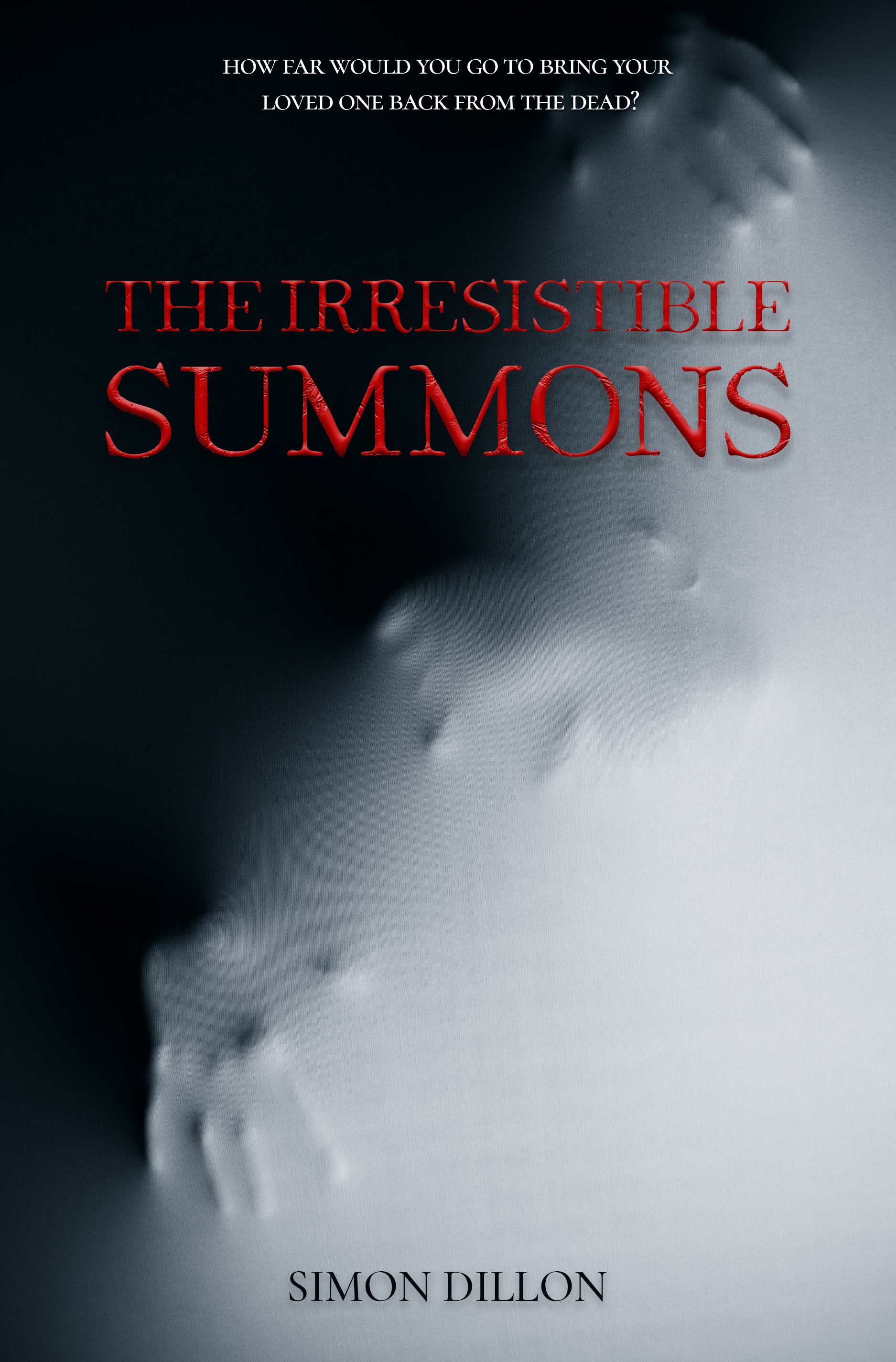
For the next six weeks, I’m making my gothic mystery novel The Irresistible SummonsFREE to download at Smashwords, to promote my novels in outlets other than Amazon.
Here’s an introduction to whet your appetite.
In a brief prologue, teenager Naomi Levinson laments the death of her boyfriend, Toby Lane. Toby and his entire family perished in a mysterious house fire, which Naomi comes to believe may have been started deliberately.
Several years later, Naomi is now an accomplished television producer making documentaries debunking the supernatural. When a shoot interviewing a possibly possessed killer in prison goes terribly wrong, the production company Naomi works for faces a lawsuit and possible closure.
Offered what could be her last job, Naomi is initially reluctant to take on filming a promotional video for computer game company Persephone. She considers the task beneath her talents. However, after production gets underway at the Persephone office block on London’s Canary Wharf, strange things begin to happen.
One member of staff inexplicably disappears. Ghosts are sighted, one of whom appears to be Toby. This re-opens old emotional wounds for Naomi, bringing back bittersweet memories of her strictly religious messianic Jewish parents, who disapproved of her secret teenage romance.
As Naomi continues to investigate, she begins to believe she might have stumbled onto a genuine haunting, one with disturbing links to her past, and possibly her future.
A horrifying conspiracy is gradually revealed. Cutting edge technology and ancient evil meet, leading to the discovery of a shocking and terrifying secret – one that could change the nature of life and death as we know it.
The Irresistible Summons can be downloaded FREE from Smashwords here. It also continues to be available for purchase at Amazon. Enjoy!
With the exception of a couple of short stories, last year I took an extended break from fiction writing after finishing the first draft of a novel tentatively titled The White Nest. This story proved every bit as “personal” as Children of the Folded Valley. In fact, given the level of raw nerve jabbing involved, it’s safe to say I did something of a “Truman Capote”. What I mean by that is Capote was scarred to such a degree after writing his masterpiece In Cold Blood that he never finished another novel.
I am not comparing myself to such a literary giant, nor did I do anything as drastic as attend executions for my art, as he did, but the painful truth is that writing The White Nest affected me in ways I’m still coming to terms with. For some time, I wondered if my “voices” would ever return. I wrote a bit about that experience in this article on Medium. Thankfully I can report that the voices are back.
This year so far, I have written the first novel in a planned trilogy of fantasy stories that exist in the same Universe as my as-yet unpublished dark fairy tale novel The Faerie Gate. However, despite being pleased that I’ve managed to write another novel, I’m not yet convinced the quality is high enough to warrant being shared with the world. I feared the same for The White Nest, but having finally braved another look at the manuscript, I am pleased to report that is not the case.
The White Nest (I’m keeping the real title secret for now) is another gothic mystery, at least in part. It is also a coming-of-age story, a romance, a conspiracy thriller, and obviously it contains some strong horror elements. It deals in themes of complicated sibling relationships, parental fears, and false guilt. Reading it back, I can see why the process of writing it had such an effect on me, due to some of the painful personal experiences on which I am drawing. That said, I think readers will simply enjoy it as a vivid, gripping, page-turning mystery, which was always my primary intention. I think it might contain the best first act I’ve ever written. I can’t say if the ending is up to the same standard, as I’ve yet to reread it, but so far the signs are promising.
In terms of plot, The White Nest represents something of a departure from my previous gothic mysteries, in that the protagonist is male. I’m keeping the specifics under wraps for now, but I can tell you the story contains a full checklist of my favourite gothic tropes, including a sleepy south-west England village, haunted forest, eerie mansion, secret tunnels, dubious secret experimental facilities, occult secret societies, ghosts, demons, curses, mysterious disappearances, childhood memories buried by trauma, rug-pulling twist ending… you name it. You could even call this novel Now That’s What I Call A Simon Dillon Gothic Mystery if you really wanted to, as it is something of a compilation of my preoccupations, genre wise.
Here are some photographs of locations that inspired settings for certain sequences in The White Nest. The novel is predominantly set in Cornwall, but much of the landscape is based on the rugged North Devon coast. However, the first part of the novel is set in Oxford. One key scene takes place in Port Meadow.
Once I finish a second draft of The White Nest, I am moving on to a new gothic mystery, one that’s been gestating in my mind for some time. It is getting to the point where it is an itch I have to scratch, and I’m looking forward to developing it. In the meantime, I may well release a volume of short stories in the future, as I’ve now got quite a nice pile of these, and it would be nice to have them all together in one place. As ever, watch this space.
Here’s the first part of the first chapter of my recently re-released gothic mystery novel Phantom Audition:
What Mia noticed most was the silence.
She kept expecting to hear Steven’s voice, or the insistent thud of his feet, as he rehearsed his lines, pacing up and down. She expected to hear him on the phone to his agent, publicist, or to a director.
In the mornings, she no longer heard his absurd singing in the shower. His seat at the breakfast table stood empty. Mia would avert her eyes, unable to bear staring at the space he should occupy. He should be sipping his tea, scrolling through his phone, crunching his cereal… Silence chewed the room instead, like wind and rain gnawing an eroding landscape.
At nights, Mia would awaken and roll over, hoping to warm herself on his body. But Steven wasn’t there, and he wasn’t coming back. He had been replaced with the same terrible silence that screamed, clawed, and tore at her mind whenever she entered the rooms that still had his smell. The memory of her husband had stained the entire house.
Mia had always thought the mansion ludicrously big for the pair of them, but now more than ever she felt the size of the place. A curious unease lingered, as though the carpets, furniture, paintings, and ornaments had turned against her. She felt like a stranger in her own home, imagining everything around her glared in frowning disapproval. Perhaps her presence was a desecration.
One Monday morning a month after the funeral, the unpleasant sensation of feeling watched by the house became too much, and Mia yelled out into the silence.
‘It’s my bloody home too!’
The house responded without mercy, making every tiny tick of the clock an intolerable cacophony. Mia put her hands over her ears. She knew her behaviour was absurd, but the curious mixture of anger and fear that stirred within her had taken her by surprise. Sadness at Steven’s passing was to be expected, but she had not expected to feel so defensive or fearful. Perhaps bewilderment at the events leading up to his suicide by drug overdose still had her on edge.
Even though she still wore her dressing gown, Mia continued to sit in the morning room, on an ornate Elizabethan chair that matched other antique furniture in the room from the same period. Occupying this chair felt like a strangely defiant act, as though she were challenging the house itself. Steven’s ancestors glared down at her from portraits on the wall. His home was now hers, and sooner or later, the ancestors would just have to accept it.
‘It’s my bloody home,’ Mia muttered. ‘Deal with it.’
‘A-hem!’
Mia leapt out of the chair and spun towards the doorway. A middle-aged woman in a maid’s uniform stood there, her face unsmiling and severe.
‘Liza… Good God, you made me jump!’
‘Ma’am,’ said Liza. ‘I apologise for startling you. I know I’m a little early.’
‘Yes, yes, of course… Is it Monday already?’
Liza didn’t reply. Her eyes bored into Mia.
‘Of course it’s Monday.’
Mia looked down, avoiding Liza’s glare. Eventually the maid spoke again.
‘I can come back to this room later if you like, ma’am.’
‘No, no, that’s fine. I’ll get out of your way. I need to have a shower really.’
Mia scurried out of the morning room and headed back up the main staircase to the west wing. She locked herself in her bathroom, feeling very foolish. Her heart beat a little faster as she tried to get a grip on herself, staring into the mirror.
‘It’s my bloody home. Mine.’
But it didn’t feel like her home. Liza Richards, a hired cleaner who came in on most days, had been employed by the Yardley family for years, and her demeanour was more like that of a proud, old-school housekeeper. That Mia had leapt out of the Elizabethan chair when challenged by Liza, as though she were some disobedient child, underscored to Mia yet again that she felt threatened by Elm House, the ancestral home of her late husband, the renowned actor Steven Yardley.
Renowned actor.
Renowned.
Perhaps that was the problem. Steven had been renowned in many ways. Rich family. Successful acting career. What was she in comparison? Mia recalled the whispers when they had married three years previously, that she was little more than a gold-digging, hack bit-part actress. Such rumours never bothered her whilst Steven had been alive, for they were utterly false. She and Steven had loved one another with an enviable passion. Their marriage had been one made for the right reasons. What did it matter what anyone else thought?
However, since Steven’s death, after inheriting everything, it had been impossible not to feel this resentment amid icy stares at the funeral, and at the reading of the will.
‘My bloody home…’
Tears streamed down Mia’s face as she stared into the mirror. She felt utterly pathetic. A part of her wanted to return downstairs to the morning room. She wanted to place herself in that Elizabethan chair with her arms folded, reading the paper, and glaring at Liza as she went about her cleaning duties. But she felt so utterly defeated. Her stomach twisted, and she felt sick. She slumped to the floor, bent double, sobbing.
‘Steven… Steven…’
She allowed herself a moment to cry. But after a couple of minutes of anguish, Mia took a deep breath, wiped her face, and stood up again. She couldn’t allow Liza to see her like this. She had to be strong.
Mia took a shower then headed to her bedroom to get dressed. For a moment, she toyed with the idea of lurking upstairs until Liza had finished, but part of her despised such a cowardly notion. Why should she want to avoid Liza? She was an employee. Besides, the gardener was due to arrive soon, and she had to give him instructions.
Mia returned downstairs to the kitchen. She made herself a cup of tea and sat at the kitchen table for a few minutes. Still the silence taunted, but Mia ignored it.
Outside, the mid-February drizzle threatened to become a downpour. Staring out of the window towards the driveway, her eyes came to rest on a large horse chestnut tree amid the extensive gardens. The branches were stark and bare right now, but Mia recalled Steven’s fondness for that particular tree, and the significance it had held for him throughout his entire life. Mia briefly closed her eyes, remembering a summer’s day when they had sat beneath the horse chestnut tree in the warm afternoon sun, with the lingering scent of freshly cut grass and white roses. She could still taste the honey on her lips and his. She recalled the wasp sting that had rudely interrupted their passionate kiss. Placing her hand to her arm, she rubbed the place where the wasp had struck. Was it her imagination or was there still a scar?
For more, pick up your copy of Phantom Audition in paperback or ebook here (in the UK), and here (in the US). Or you can click here, to download the book from Smashwords.
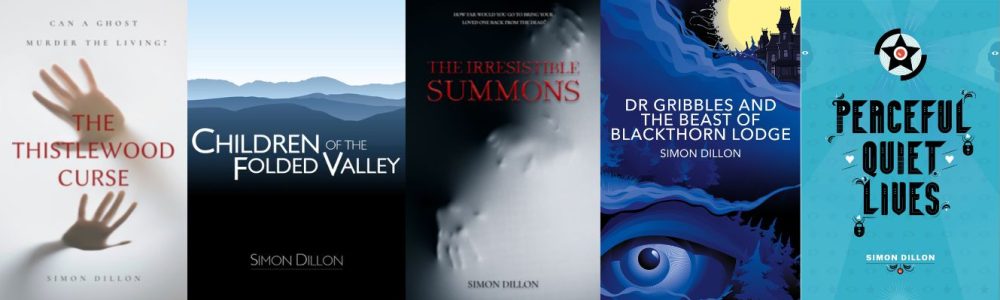
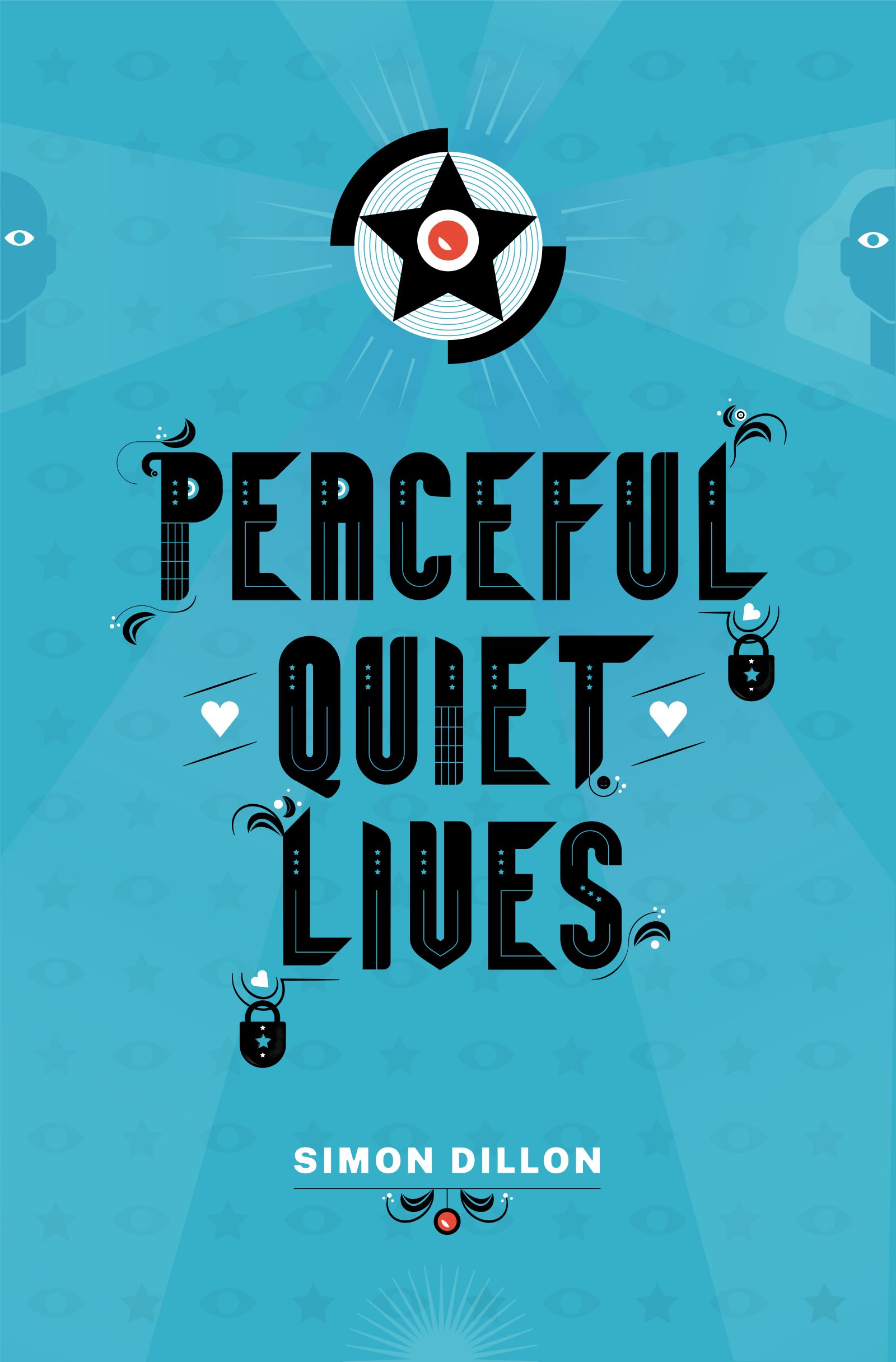




 Simon Dillon Books
You must be logged in to post a comment.