
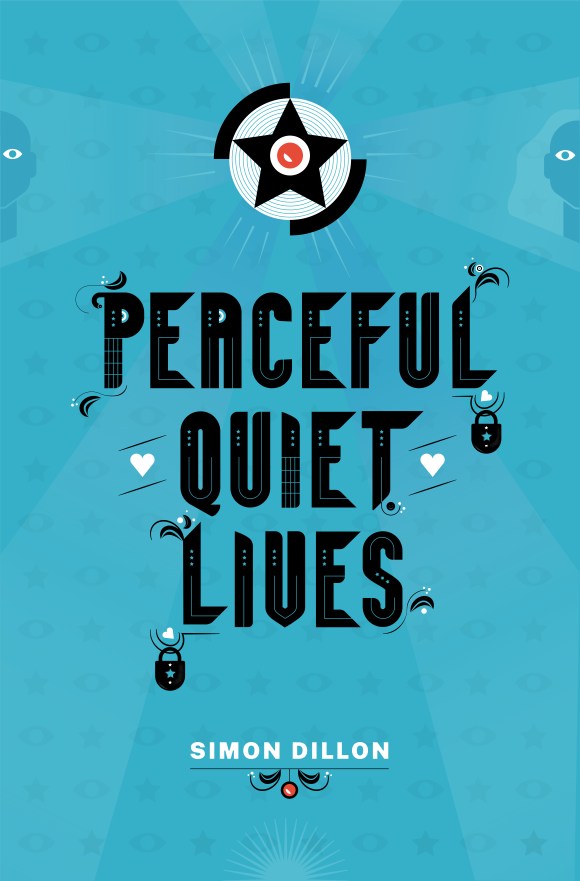
My latest novel, Peaceful Quiet Lives, is informed by a number of classic novels, whilst also being very much its own unique story. Here are five texts that were influential in some way.

Nineteen Eighty-Four (George Orwell) – Orwell’s masterpiece casts a long shadow over all modern dystopian fiction, and to not acknowledge it would be disingenuous. The Winston and Julia romance informs some of what Sam and Eve experience, as does their suffering at the hands of the authorities. However, the central relationship has a very different purpose and outcome in my novel. There are also parallels between the censorship of Nineteen Eight-Four (including “newspeak”) and the censorship rules in both nations in my novel, which operate at opposite political extremes. However, once again, the kind of censorship is very different.

The Handmaid’s Tale (Margaret Atwood) – The religious oppression of the Gilead regime to a degree did inform the oppression of women in the NPAR (New Puritan American Republic), in my novel. However, there are vitally important differences. For one thing, there is no population crisis, and women are not forced into marriages for breeding purposes in the NPAR. However, women are strictly controlled in terms of the lives they can lead, the careers they can pursue, and so forth. Furthermore, marriages have to authorised by religious authorities.

A Clockwork Orange (Anthony Burgess) – The brainwashing of young Alex to “cure” him of his wicked ways did in some way influence the torment Eve suffers at the hands of interrogators in the DEAR (Democratically Enlightened American Republic), in my novel. However, unlike Alex, Eve is a far less contentious subject, nor is the reader invited to feel torn or backed into a corner over her treatment. I expect and indeed hope that unambiguous sympathy is the reader’s response in her case.

Fahrenheit 451 (Ray Bradbury) – A state where all books are banned is the horrifying premise of Bradbury’s most notorious novel (the title refers to the temperature at which paper burns). Not all books are banned in the two nations of my novel, but many are. Sometimes the same novel is banned in both states, but for entirely different reasons. For example, a novel banned for sexual content in the NPAR could also be banned for perceived sexism in the DEAR.

The Trial (Franz Kafka) – Like the protagonist of Kafka’s novel, Sam finds himself chewed up by the inexplicable and unfair machinery of legal processes in both the NPAR and the DEAR. The prosecutions he faces are nonsensical, but are intended as a satire of the fears often expressed by extremists on both ends of the left/right political spectrum. In particular, the trial in the latter part of the second section of the novel reaches an absurdity of hair-clutching proportions, but I shan’t explain how, for fear of spoilers.
Peaceful Quiet Lives was also informed, to a lesser degree, by Gulliver’s Travels, Brave New World, The Hunger Games, and even satirical BBC classic comedy series Yes Minister. Here’s the blurb from the back of the book to whet your appetite:
Two Nations Under God. Can their love survive in either nation?
Life, love, liberty, and the pursuit of happiness are a distant dream for Sam and Eve. Their forbidden love falls foul of laws in both nations born from the ashes of the Second American Civil War.
A satire of political and religious fears, Peaceful Quiet Lives is a thought-provoking and powerful dystopian future shock.
Peaceful Quiet Lives is available as a download or paperback from Amazon. Order your copy here (in the UK) or here (in the US). It is also available at Smashwords here.




 Simon Dillon Books
You must be logged in to post a comment.