Best read in the run-up to Christmas: Spectre of Springwell Forest

Gripping gothic horror mysteries are best read at this time of year, when leaves are falling, and nights are drawing in. As it gets colder in the approach to Christmas, nothing beats snuggling up in front of the fireplace with a mug of tea, and a sinister, nail-biting ghost story.

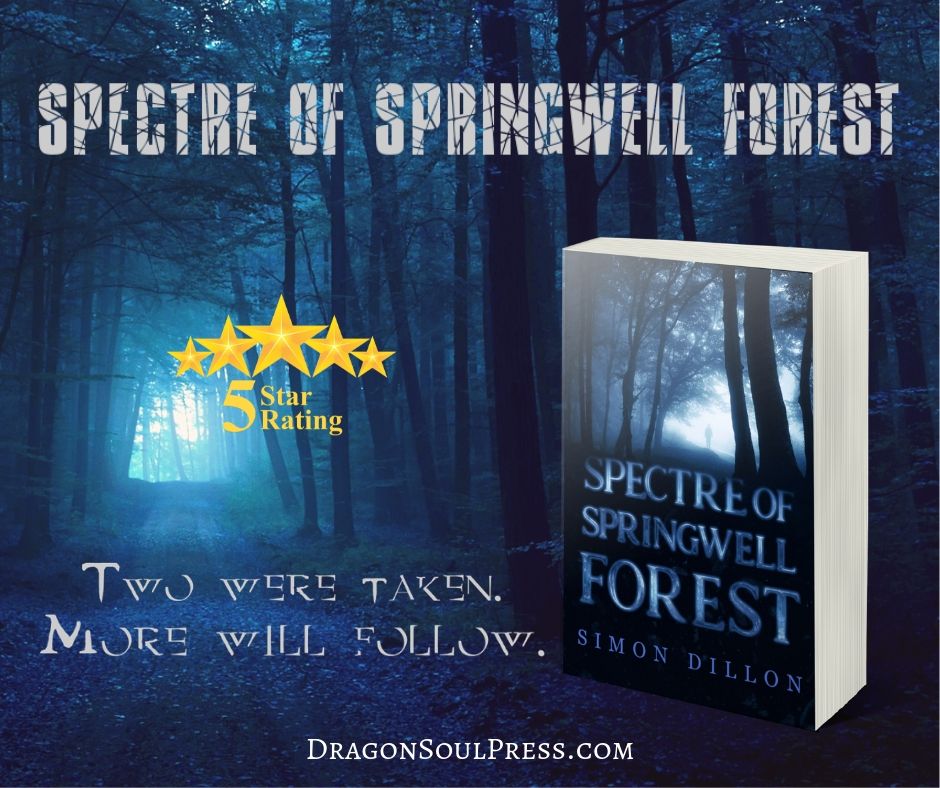
Concluding this two-part series, I pick the second of my published novels best read in the run-up to Christmas: Spectre of Springwell Forest.

The novel opens in Exeter, 2010. Lily Parker learns that her daughter Olivia is to move to the village of Springwell, near Plymouth. To the surprise of her husband Andy, this sends Lily into terrified despair. She tells him that Olivia must not move to Springwell, under any circumstances. Andy wants to know why, and Lily tells him what happened to her many decades previously, in 1979, warning him that she has a horrifying secret that she had previously hoped to take with her to the grave.

In 1979, Lily and her then six-year-old daughter Olivia, along with her first husband Tom Henderson, move to the sleepy village of Springwell. Here they meet a tight- lipped community of secretive villagers who seem to have something to hide. Lily then discovers a painting of an abandoned railway tunnel in her attic, by a local artist, Alison Merrifield. Lily is strangely drawn to the painting, particularly the dark maw of the tunnel, and ends up hanging the picture in her hallway.

After meeting her neighbour and other mothers dropping their children at the local primary school, Lily is surprised to learn they all have similar paintings in their homes, all of them painted by Alison Merrifield, all of them showing the same abandoned railway tunnel. The other mothers dismiss this as something of a village in-joke, and when Lily visits Alison in her local craft shop, Alison herself insists she cannot understand why the paintings of the abandoned tunnel are so popular. But Lily senses she is being lied to.

Shortly afterwards, when Lily and Olivia go for a walk in the local forest, they come across a fenced off area in the heart of the woods where the barbed wire has been mysteriously torn apart. Investigating further inside the fenced off section, they discover the very same abandoned railway tunnel of the painting and enter the tunnel. A disturbing incident follows (which I won’t spoil).

After this incident, Lily starts to make out a mysterious figure in the painting of the railway tunnel. As time passes, the eerie figure becomes more and more clearly defined, but Lily is disturbed to discover no-one can see it but her. Worse still, as the sinister figure is revealed, Olivia starts to behave in an increasingly alarming manner.

Intrigued? Here’s what a few Amazon reviewers had to say:

“As a horror fanatic, it takes a lot to scare me in writing. Very few books manage to do it, but Simon Dillon’s Spectre of Springwell Forest gave me nightmares! After reading this book, you will never look at a painting of a tunnel the same way again… I can’t recommend the book enough, if you want something well-written, believable, and scary for a cold, dark night.”

“You cannot shake off the feeling that something is constantly watching you… But the biggest pull for the book is the climactic revelation. Here, the author deserves full points.”

“A darkly intense and intriguing horror story full of mystery, Spectre of Springwell Forest will have you on the edge of your seat. My jaw literally dropped in shock. Enter Springwell Forest if you dare, but be prepared for the consequences.”

“A wonderful horror/thriller. Creeping sense of unease starts almost immediately. Even before you know what is to come, you are shouting at Lily to leave well alone. Dillon writes excellently and believably as a 1st person female protagonist. The story is tightly written with little preamble, which has a pleasingly sudden way of throwing you into this strange and disturbing village.”

“Spine-chilling, terrifying, absolutely gripping. A fantastic read.”

Spectre of Springwell Forest is available in paperback or on Kindle from Amazon here (in the UK) and here (in the US).

Best read in the run-up to Christmas: The Birds Began to Sing

Let’s face it: gripping gothic mysteries are best read at this time of year, when leaves are falling and nights are drawing in. As it gets colder in the approach to Christmas, nothing beats snuggling up in front of the fireplace with a mug of tea, and a sinister, spooky thriller.

In the first of a two-part series, I pick two of my published novels that are best read in the run-up to Christmas, beginning with The Birds Began to Sing. It concerns Alice Darnell, a struggling, not-yet published author, who has suffered the usual setbacks faced by wannabe authors, namely rejection from agents and publishers. Yes, I know this already sounds self-indulgent, but bear with me.

Alice is ambitious, but she isn’t an insufferable narcissist. Significant past trauma, including drug addiction, has left her with psychological scars, an occasional tendency to slip into delusion, as well as a peculiar bird phobia. A couple of incidents in the opening act – one involving an apparent stalking on the London underground, and a misunderstanding during a work performance review – underline her potentially fragile psyche.

When Alice finally acquires a literary agent, he enters her into a mysterious writing competition at Blackwood House on Dartmoor. Alice has been chosen, along with other candidates, to write the final act of an unfinished manuscript, penned by the late, great Sasha Hawkins; a bestselling author of popular thrillers, who died at a tragically young age, in a car crash. Blackwood House is the ancestral family home of Sasha Hawkins, and her former publishers have persuaded her family to host the competition.

The winner of the competition will have their ending selected for publication, as well as their own novel. However, a number of peculiar rules must be strictly observed. Competitors have to stay at Blackwood House for two weeks, where they must write the ending cut off from all contact with the outside world. Intrigued and somewhat bemused, Alice agrees to join in, excited at the potential opportunity.

However, once she arrives at Blackwood House, and the competition gets underway, strange things starts to happen. Alice is unsure who to trust, as she is drawn into a labyrinth of deceit, revenge, and perhaps even murder. But the biggest secret of all is more shocking than Alice could have possibly imagined.

The Birds Began to Sing draws inspiration from mystery classics such as Daphne Du Maurier’s Rebecca, to Agatha Christie whodunnits, specifically Sleeping Murder, and also the gothic literature of the Bronte sisters, particularly Jane Eyre. There’s even a bit of Michael Crichton or Dan Brown style conspiracy thriller in the mix, and a dash of Arthur Conan Doyle, most obviously The Hound of the Baskervilles. But The Birds Began to Sing is also a unique and nail-biting thriller in its own right.

Intrigued? Here’s what a few Amazon reviewers had to say:

“I loved this! Absolutely awesome read clever plot and ruddy brilliant twist! If you love a good mystery and a bit of a thriller this is for you!”

“An excellent psychological thriller… kept me turning pages right to the end.”

“A maze of spooky encounters… Full of exciting twists and turns.”

“A memorable lead character, mystery, suspense, eerie settings, a couple of genuine surprises, all sprinkled in with a healthy dose of wit.”

“A terrific read for lovers of suspense and mystery.”

“A great read and I loved the twist. Did not expect it at all.”

I should add that the bulk of the narrative (from act two onward) is set during the run-up to Christmas.

The Birds Began to Sing is available in paperback or on Kindle from Amazon here (in the UK) and here (in the US).

Coming Soon, Later, and Perhaps Never: October 2020 Update

A couple of years ago, I posted an article with the same title, expounding on exactly where I was at with my novels, in their varying states of disrepair. Here’s a full update, sort-of divided by genre. Bear in mind one of these will be released very soon, almost certainly before the end of the year.

Fantasy

Ravenseed – This Dark Ages set fantasy novel is now on its third draft, having received largely positive feedback from various sources. It’s a brooding, melancholy tale of knights, sorcerers, and enchantment, simmering with love, lust, betrayal, and revenge. Alongside the Dark Ages story is a parallel framing story set in the present.

The Faerie Gate – My long-delayed, horror-story-for-children is now on its fourth draft. Originally written in 2015, it’s definitely the scariest novel I’ve written that is primarily aimed at children, and it really pushes the envelope in that respect. But this dark fairy tale is also a very compassionate story, about a young adolescent coming to terms with the separation of her parents. I’m also planning an epic sequel which may end up being more than one sequel, set in the same universe. The sequel(s) might be aimed at a more “young adult” readership. I’ll know more once I start writing this next year.

The Deviant Prophet – Another dark fairy tale, but this time for adults. Fantasy and reality clash in a disturbing tale of religious oppression, amid a vivid and surreal world parallel to our own. The initial inspiration for this came from a close friend’s extraordinary dreams. I finished a third draft earlier this year.

Goldeweed – This is an epic, three volume fantasy saga I have been shaping on and off for almost eighteen years. Set in a vast imagined realm on many different planes of reality, it details three love stories that play out against an apocalyptic backdrop at the end of an era. Currently longer than War and Peace, it’s a tale I have rewritten and tinkered with for some time, and I’m still not entirely happy with it.

Gothic Mystery Thriller/Horror

The White Nest – This novel is something of a culmination for me; a summing up of all the tropes, themes, and ideas I have explored in earlier gothic mystery novels. But although there is an element of Now-That’s-What-I-Call-a-Simon-Dillon-Gothic-Mystery about this novel, it is also radically different in two ways. Firstly, it features a male protagonist. Secondly, it is the most intensely personal novel I’ve written since Children of the Folded Valley. Yes, I know all writing is “personal”, but this one really jabbed raw nerves in an ultimately cathartic way, tapping into traumatic fears regarding siblings, parental fears, false guilt, and more. It is also something of a coming of age novel, despite the genre trappings. One more point: The White Nest refers to something sinister in the story, but it’s only a placeholder title. I’m keeping the real title secret for now.

Wormcutter – From something I wrote in 2020, to something I wrote in 2007 (from an idea I had researched on and off since 1996), this detective thriller/horror hybrid begins as an apparently open and shut murder investigation, then escalates into a humdinger of a conspiracy, involving the Freemasons and much more… until it ends up in the most disturbing territory I have ever explored in a novel (definitely 18 certificate stuff). Currently on its fourth draft, and due for another polish.

Miscellaneous

The Balliol Conspiracy – This somewhat old-fashioned, Hitchcockian romantic spy thriller is a conspiracy story of a different kind (much more PG territory, unlike Wormcutter), and proved a real change of pace for me when I wrote it. A strong, suspenseful central mystery results in an historic, fact-based treasure hunt, leading to a new lease of life for the bereaved protagonist. I don’t want to say too much more, except that yes, it does involve Balliol College in Oxford (see above picture). I also wanted to write a grown-up book that, for once, my mother would be able to read without having nightmares. Currently on its second draft, its actually grown on me quite a bit since I first wrote it, and my wife thinks I should attempt more stories of this kind. But I suspect it is a one-off. We’ll see.

Peaceful Quiet Lives – This dystopian tale imagines a bleak American future, satirising the worst fears of both sides in the so-called culture wars. At the same time, it is also a love story, featuring protagonists who fall foul of political extremists of all persuasions. This novel is currently on its fourth draft, and represents a real oddity for me, as it is quite unlike anything I’ve ever written. Like Children of the Folded Valley and The White Nest, it is also a highly “personal” novel.

A Statement of Disbelief – Another satirical novel, this time set in the dubious world of Christian television fundraising. It’s only had one draft, but quite honestly, I’m not sure it will ever see the light of day. However, I will confess it was great fun to write.

Short Stories – It’s also worth mentioning that I’ve written quite a collection of short stories, mostly horror and science fiction (including one of novella length). I may publish a volume of these at some point.

To reiterate, one of the above will almost certainly be released before the end of the year. Can you guess which one? Watch this space for an imminent announcement.

Phantom Audition: Why I wanted to mess with your head

When submitting my manuscript for Phantom Audition, I told my editor at Dragon Soul Press that this one wasn’t as scary as my previous gothic mysteries. However, her response was, to paraphrase, “maybe less scary, but it messed with my head a lot more”. I was pleased with that reaction, because with this novel, I absolutely wanted to mess with the reader’s head. Unlike the comparatively clear-cut plot twists in The Irresistible Summons or Spectre of Springwell Forest, I felt Phantom Audition became less satisfying the more I tried to spell out answers. Therefore, despite considering several different endings, I ultimately stuck with what I had written in my original outline, which allows for a wide range of interpretation.

Some of my favourite novels (and also films) have a vital ingredient missing: the reader (or viewer). What they bring to the story essentially completes it, although that may make the story different for every reader. The protagonist in Phantom Audition, Mia Yardley, is a small-time actress recently widowed from much more famous actor Steven Yardley, who committed suicide in mysterious circumstances. Her subsequent investigations into his death, wherein she discovers he only took acting roles on advice from a psychic medium, lead her not only deep into a sinister mystery, but also deeper into herself. However, in a sense, the novel is also meant to delve deeper into the reader, and what they bring to the text.

To achieve this, I added a hefty dose of the A-word: ambiguity. However, ambiguity is a dangerous tool that needs to be deployed sparingly, and only in the right context. For example, an Agatha Christie whodunnit would not benefit from an ambiguous ending where Hercule Poirot or Miss Marple never discover the killer. I tested an early draft of Phantom Audition on my wife, who isn’t a big fan of ambiguous endings. To my surprise and delight, she thought the ambiguity in Phantom Audition worked well because to her mind, by the time you get to the ending, the answer to the original mystery is essentially irrelevant, as it has been superceded by deeper questions.

This view is reflected in many of the rave reviews I’ve received. Here are a sample:

“A novel that stole my sleep for two nights. I know I’ll be thinking about so many of the characters, twists and turns, and emotions I came across on this reading adventure… I can’t say that I’ve ever read anything remotely similar to this plot. Originality, being captivating to the reader, and giving me moments of goosebumps and multiple frightened starts, earned all 5 stars.” – Kelli Pizarro, Goodreads.

“I love this story with all of its puzzles and strong emotion. Mia is a complex main character lost in grief after her husband’s death. She is searching not only for answers, but also to be able to own her own skin again. She feels lost in her husband’s shadow, and is determined to come into her own… One of the best mysteries I have read in a long time.” – Rowan Thalia, Amazon.

“Grief does strange things to the mind. Mia mourns the loss of her husband Steven, a renowned actor whose drug-overdose death is out of character for him. But not out of character for the role he’s most recently undertaken. Could it be that the chillingly realistic embodiment Steven gave, an Oscar-worthy portrayal of a famous artist, was so realistic because he received help from beyond the grave? Mia wants answers. But each answer only raises new questions… Some questions are, as she was warned, better left unanswered… A compelling read with an unexpected conclusion. It left me wanting to re-read it right away.” – Sara, Goodreads.

“An extremely well-written mystery thriller novel that kept you guessing at what was going on. After the death of her husband young Mia is left alone and feeling that nothing is truly as it seems. Was her husband’s death an accident or was it something more sinister? The search for answers is haunting and might even come close to being deadly.” – Arien/Sloan, Goodreads.

“Simon Dillon has done it again with this intriguing mystery. You will find yourself caught up in this page turner trying to figure out if the mysterious death of Steven was a murder or a suicide. I had no idea how it was going to end, and I like a mystery that isn’t easily figured out early on in the novel. An excellent read!” – PD Dennison, Goodreads.

“A beautifully written thriller about grief and how it affects the mind.” – Jennifer J, Goodreads.

“A thrilling supernatural mystery that will have you guessing until the very end. Filled with page-turning suspense, jaw-dropping visuals, and spine-tingling events, Phantom Audition grips you from start to finish… I also loved the last chapter, the epilogue of sorts. It was beautifully written, with wonderful detail, and left me thinking.” – RA Rivera, Amazon.

“An excellent thriller that leaves you questioning everything.” – Amazon reader.

Intrigued as to what you might bring to Phantom Audition? Pick up a copy here (in the UK) or here (in the US). It is also available in other regional Amazon sites. To further whet your appetite, here’s a little trailer my publisher put together for the novel.

The Irresistible Summons: My scariest novel?

“Naomi believes she wants to see what is on the other side, but doesn’t realise it’s the other side that wants to see what is inside of her…” – Aaron Channel, Warhol Publishing Reviews.

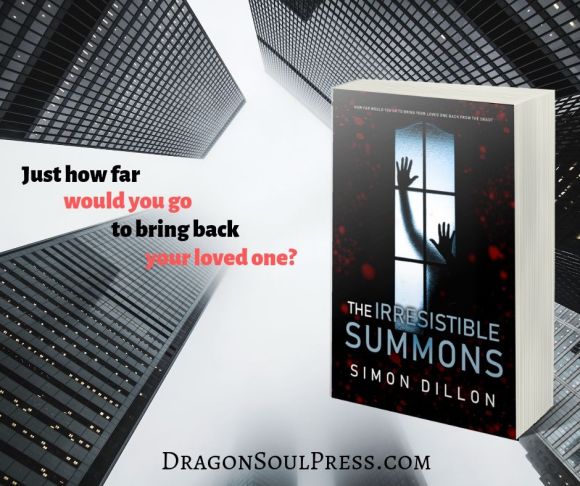
Feedback for my supernatural horror/thriller novel The Irresistible Summons has 1) been consistently great, and 2) consistently told me it is the scariest, most disturbing novel I have released. I am surprised, as I personally think Spectre of Springwell Forest is a lot more unsettling. However, reviews suggest otherwise. Here are a sample from around the internet, including a couple from fellow authors Claus Holm and Galina Trefil.

“A wonderful mix of old-fashioned ghost story, religious horror, drama, and a dash of sci-fi. We follow a young woman who, after suffering a devastating loss as a teenager, grew up to become a film producer making documentaries debunking supernatural stories. After an incredibly scary event, she’s re-assigned to a new project – a haunted high-rise in central London. But it’s not just ghosts that haunts the building… Simon Dillon has a wonderful way of describing environments. The Dartmoor landscape, Central London, and the scary underground tunnels of abandoned tube stations are described in such detail that I could almost see them, and at the same time he does very well with action scenes. There are some very cinematic fight scenes, but most importantly, the book is genuinely scary. I loved Naomi, the main character, but I was even more enamoured with Raven, the wonderful cameraperson on her team. I pray she gets a spin-off in her own book, because she was one of the highlights. I can’t recommend this book highly enough – if you’re into horror and spooky stories, you should definitely pick this one up.” – Claus Holm, Goodreads.

“Dillon’s talent for somehow making already-creepy settings, (abandoned tube stations, tunnels, moonlit moors,) even creepier, dirtier, more decrepit, and claustrophobic presents itself proudly in this poignant story of innocent, young love gone a very gory wrong. Demons, ghosts, witches, high-powered businessmen… this book has almost every possible form of monster, (not to mention some gnarly mutilations) to make the hair prickle on the back of the audience’s neck. The only question is, of all the multiple baddies to choose from, which one will ultimately wind up being the biggest threat, and will they be formidable enough to take down Dillon’s badass, axe-wielding heroine? Evil may be powerful, but it’s in for one hell of a fight.” – Galina Trefil, Amazon.

“Regarding horror aspects, the book starts surprisingly slow, sprinkling in a few particularly unsettling scenes here and there, but not pushing the macabre envelope overly. Then… boom! Suddenly, the pace picks up, and picks up fast. Dillon incorporates some of the classic elements that catapulted films like The Exorcist and Rosemary’s Baby into horror history, but he does so with a series of modern, technological twists. With surprising ease, when the complete set-up of the plot finally reveals itself, Dillon’s take on these beloved scream queen tropes turns them into something wholly original.” – Aaron Channel, Warhol Publishing Reviews.

“Fabulous creepiness and building feelings of discomfort reaching a delightful peak.” – Daniel, Amazon.

“Legitimately terrifying read, with the great elements to make a scary story.” – Amazon reader.

Curious? Here’s the blurb from the back of the novel:

Television producer Naomi Levinson makes documentaries debunking the supernatural.

When asked to film a promotional video for computer game company Persephone, she considers the task beneath her talents. But as production gets underway at the Persephone office block on London’s Canary Wharf, a mysterious disappearance, ghostly sightings, and lingering tragedy from Naomi’s past lead her to believe she might have stumbled into a genuine haunting.

As Naomi continues to investigate, past and present collide in a horrifying conspiracy. Cutting edge technology and ancient evil meet, leading to the discovery of a shocking and terrifying secret that could change the nature of life and death as we know it.

How far would you go to bring the one you love back from the dead?

Still curious? Pick up your copy of The Irresistible Summons here (in the UK) and here (in the US).

Spectre of Springwell Forest: Recent Reviews

I’m thrilled to see reviews for my ghostly gothic horror mystery novel Spectre of Springwell Forest continue to pour in. Here are a sample.

Increasingly famous horror maestro Neil D’Silva (who I recently interviewed on this blog) had this to say (full review on Amazon):

“I recently had the pleasure of reading Simon Dillon’s Spectre of Springwell Forest, my first from his oeuvre. And I must say, I was quite taken by it… A horror fan like me was impressed by this creepy feeling that the scenes slowly unravelled… You cannot shake off the feeling that something is constantly watching you. The author’s choice to use first-person narrative only helps to boost this feeling… But the biggest pull for the book is the climactic revelation. Here, the author deserves full points. Though there is a good deal of foreshadowing, few might anticipate how the story turns.”

Next up, another fellow author, the excellent Claus Holm (who I also recently interviewed on this blog), had this to say (full review on Amazon):

“As a horror fanatic, it takes a lot to scare me in writing. Very few books manage to do it, but Simon Dillon’s Spectre of Springwell Forest gave me nightmares! That’s saying something! After reading this book, you will never look at a painting of a tunnel the same way again… I can’t recommend the book enough, if you want something well-written, believable, and scary for a cold, dark night.”

Pretty exciting stuff, and wonderful to get the endorsement of such talented writers. Elsewhere, I’ve had a few other recent Amazon five-star raves for Spectre of Springwell Forest, including this one from Alice in Germany, which I rather like. It’s another of those “I don’t like horror but…” variants, which always amuse me a little.

“For someone who doesn’t normally read horror novels, I positively relished reading Spectre of Springwell Forest, which admittedly alarmed me a bit. I couldn’t put it down. It’s a gripping page turner to the very end. I enjoyed the eerie, gothic atmosphere; the first-person narration and how that leaves us guessing as to how reliable the main character really is in her narration. Is she imaging things? Is it really happening? Or is it something else altogether? I enjoy that kind of storytelling, not least because it’s very well-written. And that painting …eek! I will never be able to look at gloomy landscape paintings again without inadvertently checking whether it has that certain something in it…” (Alice, Amazon)

I’ll end with this snippet of another Amazon five-star review that reflects the slow-burn nature of the novel’s central mystery:

“I didn’t expect the twist at the end till it was upon me and I had no escape route!” (Ciaran, Amazon)

Intrigued? Pick up your copy of Spectre of Springwell Forest here (in the UK) and here (in the US).

I’ve Got a Trope and I’m Not Afraid to Use It

PHANTOM AUDITIONGenre fiction writers are often accused of writing “formulaic” stories. It may surprise you to know I plead guilty as charged. My children’s adventure novels contain many well-worn tropes. My gothic mystery/horror thrillers likewise. Why? Because the reader expects them, and would be disappointed if I didn’t deliver.

simon-dillon-irresistible-summons-full-resIt is vital, especially in genre fiction, to give the reader what they want but not the way they expect it. Genre writers understand this. Agatha Christie’s novels and crime fiction in general is hugely formulaic, but also fiendishly difficult to write well. Like most genre fiction, they are an easy target for literary snobs.

In short, I have a trope (several in fact), and I’m not afraid to use them. However, I aim to use them in interesting and original ways. Here are ten tropes used in my quintet of gothic mystery horror/thrillers.

tumblr_p8fwjgL6LI1sxnnxgo1_400Imperilled heroine – All these books feature a tenacious, insatiably curious, likeable but flawed heroine, who is dealing with some kind of trauma either in the recent or distant past.

Big central mystery – Spooky paintings, sinister writing competitions, inexplicable sudden deaths, apparent messages from ghosts, and murderous cover-ups all feature in these narratives.

Haunted locations – Creepy forests, castles, mansions, or office blocks, are key locations in these stories.

5Supernatural elements – Ghosts, demons, witchcraft, astral projection… These are often (but not always) explored.

Hidden labyrinths – Again, these novels frequently include mysterious and sinister secret passages, caves, mazes, closed off wings in mansions, and – in one case – abandoned tube train tunnels.

Cults and/or secret societies – I seem to come back to this trope time and time again. Obscure religious movements and/or clandestine organisations pulling strings behind the scenes are an important part in many of my narratives. Often said organisations are revealed in secret rooms at the heart of the afore-mentioned labyrinths.

TheAshTreeIllustrationByGeorgeChastain565Villain/antagonist with similar goals to the protagonist – I am fascinated by stories where protagonist and antagonist essentially want the same thing. Of my gothic mysteries, The Irresistible Summons explores this with particular potency.

Melodramatic overdrive – With gothic horror, I have no shame in dialling up the melodrama when called for, with all the blood, thunder, and passion evident in the greats of the genre.

Religious Oppression – My protagonists sometimes have a religiously abusive past, or else the issue is relevant in the present. This isn’t so much a trope, as a theme I find myself exploring again and again, along with abuse of power. I expect this is a result of my background, upbringing, and personal experience of such things. I suppose this is no bad thing, as many famous authors wrote their greatest works around the same theme. For instance, Charles Dickens, whose father was imprisoned for debt, wrote again and again about lost families and fathers. In my case, I seem to write again and again about oppressive religious environments. This is true of The Irresistible Summons and The Thistlewood Curse, but outside of my gothic mysteries, I explore these themes in novels including Love vs Honour, and particularly Children of the Folded Valley (by far my most “personal” novel to date).

CultBig twist ending – This needs no explanation. I love a good twist ending, but only when it comes off as both inevitable and unexpected. It’s no good pulling out the rug from under the reader without laying the necessary groundwork, or it won’t feel satisfying. I don’t always do this (I’ve always maintained there’s a big difference between a twist ending, and an unexpected plot turn) but twist endings can be great fun to write, when they are appropriate.

Check out my published works here. If you want to try before you buy, to see if you care for my writing style, by all means take a look at a couple of short stories I’ve made FREE to download here.

Opening lines of my novels: Do you want to read on?

“Never open a book with weather” is advice often given to novelists. I’m not sure where to attribute said quote, although it is the first of Elmore Leonard’s ten tips for writers. I’m not sure how seriously to take it either. I can name a few classic novels that open with weather (Jane Eyre, for instance).

At any rate, I thought I’d give you the opportunity to judge some of my novels by their opening lines as well as their covers (it’s a myth that people don’t judge books by their covers – they absolutely do, when choosing what to read).

Glancing back over these, I like some, and slightly cringe at others. For instance, I think the opening to Children of the Folded Valley – still by far my most popular novel – is a tiny bit literary fiction try-hard, and I’d probably opt for something more immediately gripping these days. Still, it establishes the melancholy tone, as protagonist James Harper looks back on his childhood growing up amid a mysterious cult.

Folded Valley cover“We spend our adult lives trying to regain what we lost in childhood.

I do not claim to be unique in that respect. Whilst it might be argued that I lost more than some, we all, I think, chase after what we once had or never had. What we lost cannot be replaced, but we chase after it nonetheless.

Some think of what they lost with romantic rose-tinted spectacles, whilst others are more pragmatic. Some deny it, others get angry about it, others still accept it and seek help from friends, family, lovers, therapists, priests, gurus or anyone else who will listen. But I cannot do that. I can never tell my friends, my colleagues, my wife or my children what happened to me in the Folded Valley.”

Children of the Folded Valley is available here (in the UK) and here (in the US).

Onto something a bit more instantly gripping, here is the opening of The Thistlewood Curse. The reader is thrown headfirst into an investigation that has ended badly, which establishes the two main characters DS Laura Buchan, and paranormal consultant Lawrence Crane.

THE THISTLEWOOD CURSE Cover (JPG Print version)“In spite of the peculiar circumstances surrounding the death of Jacob Price, Detective Sergeant Laura Buchan had all but convinced herself there was no foul play. That he died as the result of a bizarre accident had become the accepted version of events for her and most of her colleagues. Only the senior investigating officer, Detective Inspector Ethan Roland, had any further inkling that Price’s demise was in any way suspicious.

Laura kept pinching the bridge of her nose in a nervous reflex. The questioning of her lifelong friend and occasional colleague Lawrence Crane should have been mere formality; an interview that would establish beyond all doubt that he had no involvement in Price’s death. But Roland kept treating him like a criminal. No doubt he considered his actions thoroughness, but Laura thought he was just being rude. Through the two-way mirror Laura watched as Roland continued to question Crane in the interview room.

‘Are you glad he’s dead?’”

The Thistlewood Curse is available here (in the UK) and here (in the US).

Phantom Audition concerns a grieving actress whose actor husband committed suicide in mysterious circumstances. This opening goes for the emotional jugular, establishing the novel’s themes of grief and what it can do to the mind.

PHANTOM AUDITION“What Mia noticed most was the silence.

She kept expecting to hear Steven’s voice, or the insistent thud of his feet, as he rehearsed his lines, pacing up and down. She expected to hear him on the phone to his agent, publicist, or to a director.

In the mornings, she no longer heard his absurd singing in the shower. His seat at the breakfast table stood empty. Mia would avert her eyes, unable to bear staring at the space he should occupy. He should be sipping his tea, scrolling through his phone, crunching his cereal… Silence chewed the room instead, like wind and rain gnawing an eroding landscape.

At nights, Mia would awaken and roll over, hoping to warm herself on his body. But Steven wasn’t there, and he wasn’t coming back. He had been replaced with the same terrible silence that screamed, clawed, and tore at her mind whenever she entered the rooms that still had his smell. The memory of her husband had stained the entire house.”

Phantom Audition is available here (in the UK) and here (in the US).

Onto some of my novels aimed at younger readers (and the young at heart). Here is the opening of Uncle Flynn. This treasure hunt adventure mystery concerns eleven-year old Max. His crippling panic attacks are established in the opening chapter, ahead of the introduction of his mysterious uncle, and the main narrative. Themes of overcoming fear and the dangers of mollycoddling ensue, and Max’s character arc develops in ways that are hinted at in this opening segment.

Uncle Flynn_Cover_600px“Max Bradley didn’t like to climb trees.

It wasn’t that he didn’t want to climb trees. He longed to do as his friends did and climb high into the branches of the great horse chestnut that stood at the foot of Gavin Bainbridge’s large garden. But every time he tried, he became dizzy after ascending just a few feet, and the idea of climbing higher frightened him. This was a continual frustration, since all eleven-year old boys could usually climb trees.

Max, Gavin, and Gavin’s cousins Jenny, Paul, Mark, and Katie had been playing a game of football, but Mark had kicked the ball into the upper branches of the tree. No amount of hurling sticks or stones had dislodged it, and the only way to retrieve the ball was for someone to climb up and get it.

Ordinarily, Gavin would have nipped up and retrieved it, but he was in one of his awkward, showing-off moods. He knew of Max’s fear of climbing and began to tease him.

‘Why don’t you go up and get the ball?’”

Uncle Flynn is available here (in the UK) and here (in the US).

Dr Gribbles and the Beast of Blackthorn Lodge is another action-packed children’s adventure story which well and truly throws the reader in at the deep end. Chapter one alone features a haunted house, a monster, and mad scientist.DrGibbles_1600x2400_front cover
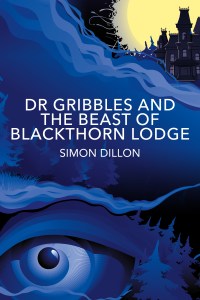
“Being trapped inside a haunted house was turning out to be every bit as terrifying as Tim had feared. He sat on the moth-eaten hallway carpet leaning against the crumbling plaster walls, putting his hands over his ears to shut out the horrible muffled roars.

Tim desperately tried to think of a way out, but his options were limited. The front door was blocked shut, as was the back door. That left the downstairs windows, but they were boarded up; as were most of the upstairs windows, except the small bathroom window on the top floor. But getting to it would mean climbing the dusty wooden staircase and it didn’t look particularly stable…”

Dr Gribbles and the Beast of Blackthorn Lodge is available here (in the UK) and here (in the US).

Finally, here’s the opening of Echo and the White Howl. My youngest son begged me for a story about wolves, so I wrote this novel about a wolf pack in Alaska. It’s a vivid, thrilling tale of betrayal, exile, and vengeance, with a touch of the supernatural. I am particularly pleased with this one, even though writing animal fiction is way out of my “comfort zone” (if you’ll forgive my use of an obscenity) and is something I’ll almost certainly never attempt again. We join protagonist Echo and the rest of his pack during an elk hunt, establishing the bleak, unforgiving landscapes, and the main characters.
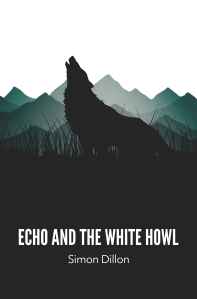
“The pack stalked the bull elk in the forest. Having successfully separated the beast from his herd, the wolves finally closed in for the kill.

Echo crouched in the snow behind a rock, a short distance above the elk, on a steep slope. He anticipated the imminent pounding thrill that would course through his veins when the attack signal came. He could practically smell the blood on the icy air. Every sense in his body tingled, and he longed to sink his teeth into the succulent flesh. But still he waited. Aatag, the Alpha and his father, would make his move soon.

The elk had spotted Aatag, some twenty yards away, lurking next to a large pine tree. Aatag no longer hid himself but stared down his prey, attempting to both intimidate and distract the elk from the danger at either side. To the right, Echo and his brothers Malakai and Puyak, both of whom lurked behind trees, waited high on the slope. To the left, Echo’s mother Kiana remained concealed in the undergrowth with Copper, Aatag’s fiercely dutiful second-in-command, as well as sly and clever Imalik.

Presently Puyak broke his cover and trotted across to Echo. Irritated at his brother’s impatience, Echo cocked his head, indicating for him to get back under cover. But Puyak disregarded this and eventually shuffled up next to Echo.

‘This is getting boring,’ said Puyak. ‘Why can’t we just attack?’”

Echo and the White Howl is available here (in the UK) and here (in the US).
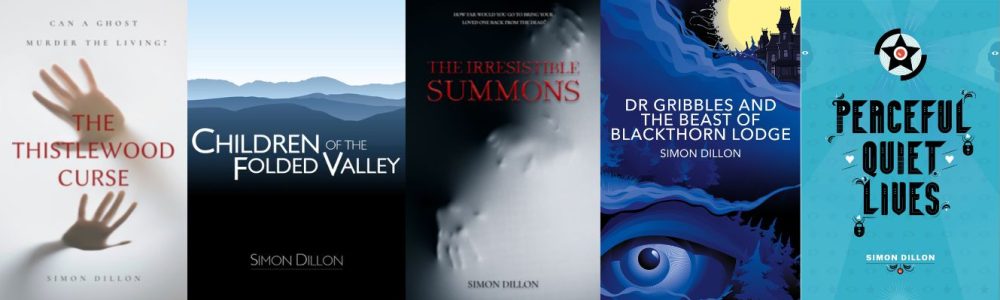
Gothic Mystery Podcast Interviews

The release of my last three gothic mystery novels – Spectre of Springwell Forest, The Irresistible Summons, and Phantom Audition – were each accompanied by a podcast interview with yours truly, conducted by the excellent Samantha Stephen – my co-host on The Tangent Tree podcast.

Throughout the three interviews, Samantha grills me on a variety of subjects in her inimitable manner, on everything from influences and twist endings, to why I have a thing for tenacious imperilled heroines creeping around haunted houses, spooky labyrinths, and other don’t-go-there places.

They aren’t too long, so why not head over to the Dragon Soul Press website and have a listen here.

My Top Five Most Reviewed Novels

Every so often, I write an email, social media post, or blog urging my wonderful readers to please, please, please, take a minute to leave a review of my novels (or short stories) if they enjoy them.

Why do I ask this? Online reviews are absolutely essential to writers, especially little-known authors like yours truly who either self-publish, or more recently publish through a small indie publisher. We don’t crave reviews because we are insecure and require constant affirmation; we crave them because the more there are, the more algorithms show our work to more people. Reviews are an author’s lifeblood, and in many cases help us (indirectly) put food on the table.

Reviews don’t need to be long or eloquent. “I enjoyed it” is absolutely fine. If you can add that on Amazon and/or Goodreads, you will have been an immense help. Thank you very much to everyone who has left reviews. It is hugely appreciated.

With that rather begging (but continually necessary) appeal out of the way, here are my top five most reviewed novels (current combined totals taken from both Amazon and Goodreads). Most of these are four or five star reviews; which is nice, obviously.

PHANTOM AUDITION5. Phantom Audition (20 reviews) – My personal favourite of the novels on this list. A gripping and sinister psychological gothic mystery, it concerns a bereaved actress, who lived in the shadow of her much more famous actor husband, prior to his death. A series of unsettling discoveries lead her to believe her husband may have rather buried himself in his final role. Did it have a bearing on his apparent suicide? Was it murder? Could he even have been influenced by vengeful supernatural forces? Phantom Audition is a page-turner that messes with the mind of the reader as much as it’s imperilled heroine.

SSF cover4. Spectre of Springwell Forest (21 reviews) – A full-blooded gothic ghost story, guaranteed to send shivers down the spine. Easily the scariest novel on this list, Spectre of Springwell Forest concerns a young woman called Lily who moves to a sleepy village near Dartmoor, with her husband and young daughter. Lily discovers a sinister painting in her attic that shows the mouth of a mysterious abandoned railway tunnel in a forest. She is unsettled to discover other villagers have paintings (by a local artist) of the same image in their homes, though they remain tight-lipped as to why. Later, after discovering the real abandoned railway tunnel in a local forest, a mysterious spectral figure appears in the paintings that only Lily can see. The figure gradually becomes visible at the mouth of the tunnel, then slowly emerges, getting closer and closer as time passes. At the same time, Lily’s daughter begins to exhibit strange and disturbing behaviour. Intrigued? Read it if you dare…

The Birds Began to Sing_1600x2400_Front Cover3. The Birds Began to Sing (27 reviews) – Another gothic thriller, this one features a huge twist ending. The story largely takes place in a sinister country mansion that once belonged to the late, great author Sasha Hawkins. Several wannabe authors arrive at the mansion to take part in a mysterious writing competition, to pen the finale to an unpublished Hawkins manuscript. Among these is Alice Darnell, who is hoping this will finally lead to her big break. However, peculiar competition rules, enigmatic dreams, and ghostly apparitions lead her to question her sanity, as she is drawn into a tangled web of deceit, revenge, and murder.

uncle-flynn_cover2. Uncle Flynn (75 reviews) – The first novel I published is an old-fashioned treasure hunt story aimed at the young and young at heart. It concerns an anxious boy called Max who is plagued by fears and panic attacks. He is visited by his archaeologist uncle, and together they set about uncovering the truth behind local legends of buried treasure on Dartmoor, with roots going back to the time of Henry VIII’s sacking of Catholic monasteries. With rival villainous treasure hunters on their tail, can they get to the treasure first? More unsettlingly, why are the police also after Max’s uncle? Dedicated to my eldest son, this novel is first and foremost intended as a gripping and mysterious adventure, but it also features themes of overcoming fear and the dangers of mollycoddling – especially in the twist ending (yes, I do enjoy writing a good twist ending).

Folded Valley cover1. Children of the Folded Valley (259 reviews) – Still my most popular novel by a huge margin, this tale of a man looking back on his life growing up amid a mysterious cult clearly struck a chord among readers. It’s a mysterious and melancholy dystopian tale, with themes of religious oppression, loss of innocence, disillusionment, coming of age, rebellion, uprising, and the haunting power of traumatic memory.

Very loosely informed by some of my own childhood experiences, perhaps it is my most “personal” novel to date. Having said that, all writing is personal to some degree, so regardless of how many raw nerves I decided to jab with this book, I can’t attribute its (relative) popularity to that alone. I also like to think my writing has improved a lot since I penned Children of the Folded Valley as there are one or two sections I’d definitely approach differently if I wrote it today.

I completed the first draft in 2011; a fact I constantly point to, in order to dismiss those who view the novel as a cathartic response to the sudden death of my father in 2012. In fact, my father helped shape the final version. I spoke over the phone with him after he read the initial draft, and he made one particular suggestion that he felt would tip the story from “good” to “great”. Hugely excited at his idea, I thanked him profusely, and told him I would definitely adopt it. He seemed very pleased.

That was the last time I ever spoke to him.

Children of the Folded Valley is dedicated to both my parents.