Coming Soon: New Dystopian Sci-Fi Anthology

Image by Gerd Altmann from Pixabay

Over the past few weeks, I’ve been polishing short stories and novellas to include in a planned new anthology release. Akin to my earlier collection, Infestation: A Horror Anthology, this one won’t be horror but dystopian science fiction. The anthology will be entitled Love and Other Punishments, after one of the stories, previously published on Medium.

The volume is about 80,000 words long. Over half (around 50,000 words) will be new, exclusive material, consisting of two novellas and a short story never seen before. The remaining short stories and novellas have previously been available to Medium subscribers.

Most of these novellas or short stories explore one aspect of futuristic technology, but otherwise takes place in relatable settings a short way into the future. The stories aren’t bogged down in scientific theory but are much more about the potential repercussions of these speculations on humans. Some of them are akin to potential technologies presently being discussed in places like the World Economic Forum.

Here are the titles, plus a little about each story.

The Thought Improvement Plan (exclusive to this volume) – In a world where brain monitoring implants are standard employment practice, a man and woman conduct a secret workplace romance against company policy, finding devious ways to fool their thought supervisor by providing false brain metrics.

Driverless (exclusive to this volume) – When terrorists hack the Driverless Vehicle Network, threatening to crash cars unless their demands are met by the British government, a civil servant begins to suspect there may have been an inside job.

The Traffic Warden (previously available on Medium) – A curious IT technician discovers the truth about traffic wardens in this surreal, sinister, darkly comic conspiracy thriller.

Bleed With Me (exclusive to this volume) – In a world where ghost sightings are found to be “quantum contamination” or “memory bleeds” that can be easily disposed of via scientific means, a quantum contamination cleaner becomes secretly obsessed with the unsolved murder of a young woman whose memory bleeds occupy his home.

Sweet Dreams (previously available on Medium) – A journalist investigates a tech company manufacturing nightmare suppressing nanotech for children. “Sweet Dreams” refers to the technology involved, which the journalist comes to believe may be linked to an increase in suicidal tendencies among young people. Her investigations uncover conspiracies, cover-ups, and eventually murder.

Apocalypse 1983 (previously available on Medium) – In a parallel universe, a Soviet Air Force officer holds the fate of the world in his hands.

Love and Other Punishments (previously available on Medium) – In a fascistic future London, a widowed salesman begins to suspect he has repressed memories when he encounters a mysterious woman.

I shall be announcing a publication date and revealing a cover image very soon. Watch this space.

Sweet Dreams: All Parts Out Now

Credit: Pixabay

Medium publication Fictions have recently serialised my new short story Sweet Dreams. A science fiction thriller set in the near future, it concerns a journalist investigating a tech company that manufactures nightmare suppressing nanotech for children. “Sweet Dreams” refers to the technology involved, which Ali, the journalist, comes to believe may be linked to an increase in suicidal tendencies among young people. Her investigations uncover conspiracies, cover-ups, and eventually murder.

Themes of playing God and the dangers of mollycoddling are inherent in the subject matter, but quite honestly it isn’t meant to be terribly deep. My main motivation in writing was to create a gripping tech-murder mystery. I’ve had lots of great feedback on Medium so far, and I hope you enjoy it. All five parts are now available for your reading pleasure.

Part One

Part Two

Part Three

Part Four

Part Five

Peaceful Quiet Lives: Summary of Recent Articles

Here’s a one-stop-shop with links to all you need to know about my latest novel, dystopian romantic satire Peaceful Quiet Lives.

What’s it about? Here’s the blurb from the back of the book:

Two Nations Under God. Can their love survive in either nation?

Life, love, liberty, and the pursuit of happiness are a distant dream for Sam and Eve. Their forbidden love falls foul of laws in both nations born from the ashes of the Second American Civil War.

A satire of political and religious fears, Peaceful Quiet Lives is a thought-provoking and powerful dystopian future shock.

Intrigued? Want to know more? Check out these articles:

The First 400 Words

“The morality inspectors are late.”

Read the opening paragraphs to whet your appetite.

Themes

“The central idea – regarding opposite extreme authoritarian states being two sides of the same militant coin – I thought would make an intriguing backdrop for a doomed romance. But I also wanted the novel to be a satire of the worst fears of both sides in the US culture wars.”

I outline my intentions for the novel, whilst making clear it isn’t a political statement.

Influences and Inspirations

“Orwell’s masterpiece casts a long shadow over all modern dystopian fiction, and to not acknowledge it would be disingenuous.”

The literature that informed Peaceful Quiet Lives.

The Cover

“Given that the subject matter is outside my usual gothic horror or children’s adventure oeuvre, it really needed to stand out.”

Designing the cover, through various alternative images, before settling on the final version.

A Second Excerpt

“You will be expected here, at the Department of Tolerance, to begin your Enlightenment Conditioning classes tomorrow morning at nine o’clock sharp.”

An extract from the second half of the novel.

Setting, Research, and Revisions

“At first, I feared the ideas for my novel would be too ridiculous even for a satire, but real life was always three steps ahead of me.”

An insight into the development of the novel, including deleted chapters, and research into extreme political movements.

Love and Other Punishments

A short story companion piece to Peaceful Quiet Lives, published in Illumination (a publication on Medium).

How Will You React?

“I’ve had people tell me it’s gripping, romantic, satirical, darkly funny, deadly serious, disturbing, offensive, timely, too-soon, desperately sad, and an important warning.”

An overview of reviews and reactions so far.

Peaceful Quiet Lives is available as a download or paperback from Amazon. Order your copy here (in the UK), or here (in the US). You can also order from Smashwords here.

Peaceful Quiet Lives: How Will You React?

My most recent novel, dystopian romantic satire Peaceful Quiet Lives, has attracted a wider and more varied response than any of my previous works. It has provoked a lot of wildly different reactions and jabbed a few raw nerves. I’ve had people tell me it’s gripping, romantic, satirical, darkly funny, deadly serious, disturbing, offensive, timely, too-soon, desperately sad, and an important warning.

One thing all the responses have in common: They are all hugely positive. So far, reviews have been exclusively five-star raves. I must confess, I sensed I was on to something whilst writing the novel, and speculated to that effect at the time. I’m always reluctant to trust such instincts, as there is always the danger of being deluded. However, it seems on this occasion, my instinct might have been correct.

Here are a sample of recent reviews, on Amazon and Goodreads:

“It’s been a long time since any novel has touched me on such an emotional level: shock initially, then horror, and ultimately sadness; the last few pages were read through tears. A futuristic, thought-provoking book in the first instance that hits you with the realisation at a certain point that most of what Dillon describes is here already. Absolutely gripping.” (Amazon reader.)

“A must-read. I am a slow reader, but I read this book in a few days because I could not put it down. If you only read one book in 2021, I’d recommend it be this one. An exciting yet frustrating love story set in America (but not as we know it) a few decades from now. Buy it – buy it now!” (EmmaGee, Amazon.)

“Interesting (and scary) look at the extreme ends of two societies we see vying for power and attention in our world today. I am not sure why the second half of this book surprised me but throughout the whole story I found my confirmation bias challenged – exactly, I am sure, what the author intended.” (JA Nice, Amazon.)

“Future Fact or Fiction? Gripping, thought-provoking stuff in the light of current events. It may punch you in the stomach.” (Amazon Reader.)

“Relentlessly bleak… This is not for the faint hearted but certainly kept me gripped.” (Amazon Reader.)

“Who doesn’t love a great love story? This is a great book… an easy read with a captivating plot. It also caused me to think a lot about the political landscape in the US right now and brought up a lot of emotions. When I reached the end of the book, I didn’t want it to end. I highly recommend it!” (Amazon reader.)

“Thought provoking, disturbing, and at times hilarious. Several laugh out loud moments… I dare you to read it!” (Steve Beegoo, Goodreads.)

“So engrossing that I literally missed my stop on the train, because I was busy reading. I highly recommend it.” (Claus Holm, author Tempus Investigations.)

Intrigued? Why not pick up a copy yourself, and see how you react? Here’s the blurb from the back of the book to further whet your appetite:

Two Nations Under God. Can their love survive in either nation?

Life, love, liberty, and the pursuit of happiness are a distant dream for Sam and Eve. Their forbidden love falls foul of laws in both nations born from the ashes of the Second American Civil War.

A satire of political and religious fears, Peaceful Quiet Lives is a thought-provoking and powerful dystopian future shock.

Peaceful Quiet Lives is available as a download or paperback from Amazon. Order your copy here (in the UK), or here (in the US). You can also order from Smashwords here.

Peaceful Quiet Lives: Setting, Research, and Revisions

My latest novel, Peaceful Quiet Lives, involved just as much research as usual, though this time into many unexpected areas.

Given the authoritarian political states in the novel, a certain amount of investigation into those with extreme views was inevitable. I looked at a lot of the more cult-like leaders on the US evangelical right-wing, as well as extremists on the left, and their groups and organisations. I also read up on so-called “incel” groups and those who believe they can have loving relationships with an android. At first, I feared the ideas for my novel would be too ridiculous even for a satire, but real life was always three steps ahead of me.

After researching several US cities and states, I took the decision to not name any real city or geographic location in the novel, other than to talk in vague terms about east and west (with California and the west coast having fallen into the sea, following the “big one” earthquake). Apart from anything else, I didn’t like to assign particular social, political, or religious ideologies to any one city, so it seemed best, on balance, to have the cities in the novel remain nameless. It’s also worth mentioning that several parts of the novel deal with news media organisations, for which I drew on my own television experience. This was more for the personalities and their attitudes than the technical side, though I should stress no characters are directly based on real people.

The plot came to me fully formed in early 2018, in a strange “download”. At first, I expected my protagonist Sam to be American, but then I realised I needed an “outsider” perspective for this story, so made him an English refugee (in the novel, an unspecified “Catastrophe” has rendered the UK and Europe uninhabitable). As I wrote the story, little changed from the original outline in terms of characters and events, but I did ruthlessly prune everything I considered “preachy”, I hope successfully. Peaceful Quiet Lives is not intended to be a political statement of any kind, and I wanted the events to speak for themselves, without editorialising.

I also cut a number of lengthy sequences, especially in part two. A chapter where Sam and Eve attend an illegal gathering was removed, largely because it felt superfluous in light of the Halloween party they attend earlier. This gathering involved people indulging in all manner of “rebellious” activity; not just unregistered (and therefore legally “unconsenting”) sexual activity, but also free and frank political and spiritual discussion, without fear of state punishment for expressing undesirable views. In that draft, the priest from the final chapter made an earlier appearance, discussing his resistance work in both nations with Sam. I liked this section of the novel, but took it out because it felt a little on the nose, as well as being unnecessary. I revised the novel so Sam only meets the priest in the final chapter.

If you’ve not yet read Peaceful Quiet Lives, why not give it a go? Here’s the blurb from the back of the book:

Two Nations Under God. Can their love survive in either nation?

Life, love, liberty, and the pursuit of happiness are a distant dream for Sam and Eve. Their forbidden love falls foul of laws in both nations born from the ashes of the Second American Civil War.

A satire of political and religious fears, Peaceful Quiet Lives is a thought-provoking and powerful dystopian future shock.

Peaceful Quiet Lives is available as a download or paperback from Amazon. Order your copy here (in the UK), or here (in the US). You can also order from Smashwords here.

Peaceful Quiet Lives: The Cover

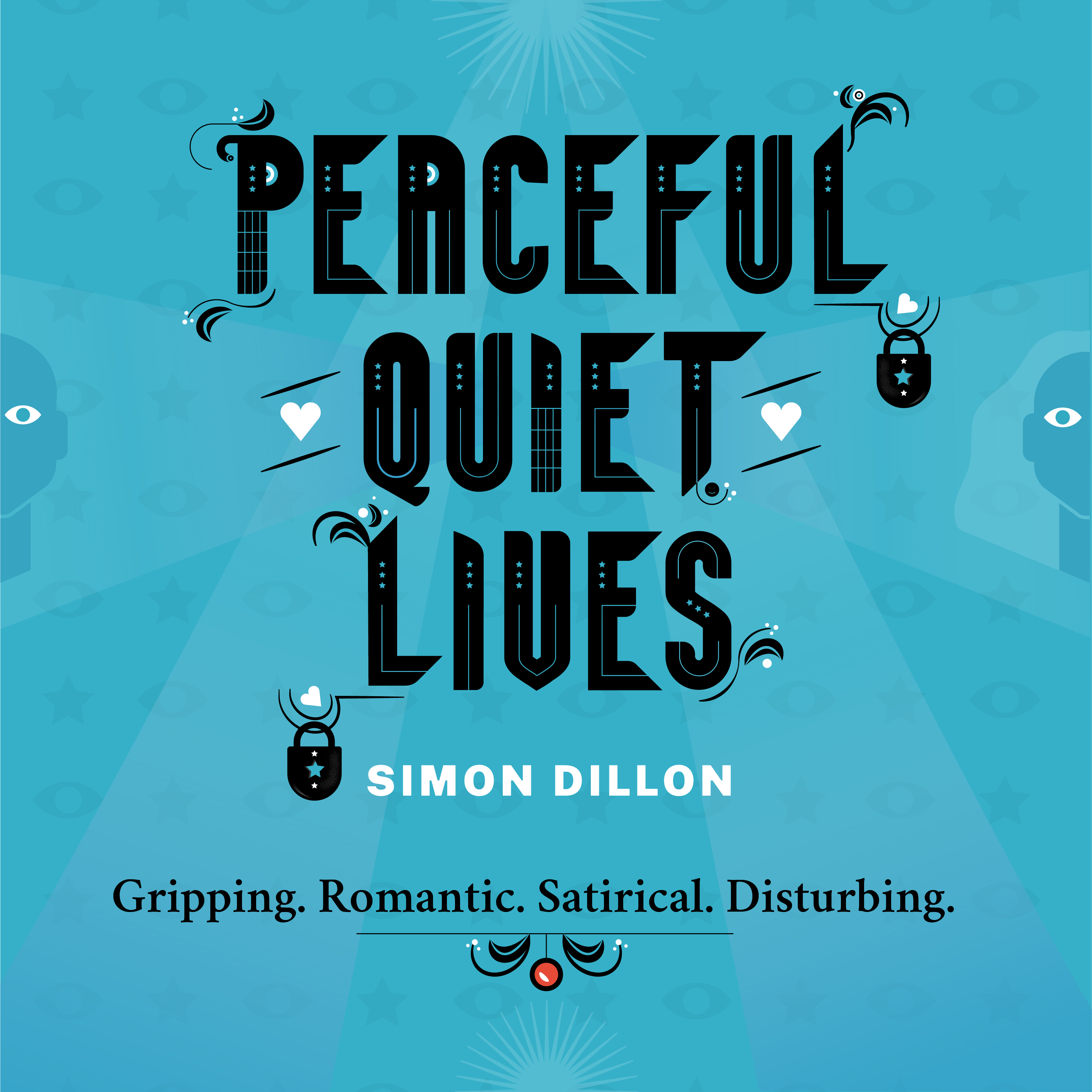
My latest novel, Peaceful Quiet Lives, has a superb cover, courtesy of my graphic designer friend, the excellent Denisa Trenkle.

Denisa and I discussed a variety of concepts. One early rough mock-up (complete with amusing typo) emphasised the surveillance angle of the novel.

Another explored the brainwashing angle, and another featured the provocative image of lovers trapped behind prison bars in the shape of a map of the USA. A revised version of the latter, without the figures, was fully completed. We considered using this one as an alternative.

At one point, this cover (created by me – nothing whatsoever to do with Denisa) was used as a temporary measure, but never intended to make it to publication. For complicated reasons, a couple of these were printed, so if this novel is ever hugely successful, these two copies featuring my inept attempts at graphic design will end up being worth a fortune.

However, in the end, we settled on this cover:

The final cover subtly hints at different elements of the narrative around the central title text, through use of colour and symbolism. It also looks nothing like any of my other novel covers, which was a key part of the brief I gave Denisa. Given that the subject matter is outside my usual gothic horror or children’s adventure oeuvre, it really needed to stand out.

What is the subject matter? Check out the blurb from the back of the book:

Two Nations Under God. Can their love survive in either nation?

Life, love, liberty, and the pursuit of happiness are a distant dream for Sam and Eve. Their forbidden love falls foul of laws in both nations born from the ashes of the Second American Civil War.

A satire of political and religious fears, Peaceful Quiet Lives is a thought-provoking and powerful dystopian future shock.

Peaceful Quiet Lives is available as a download or paperback from Amazon. Pick up your copy here (in the UK) or here (in the US). It is also available from Smashwords here.

To see more of Denisa’s splendid work, click here.

Peaceful Quiet Lives: Second Excerpt

My latest novel, Peaceful Quiet Lives, is out now. Last year, this post revealed the opening of the novel. Here’s a taster from early in the second half.

‘You will be expected here, at the Department of Tolerance, to begin your Enlightenment Conditioning classes tomorrow morning at nine o’clock sharp.’

‘Thank you. What about Eve?’

‘As I said, we are not quite finished with her.’

‘But how will I reach her?’

‘She will be told where you are staying in due course, and obviously we will rehouse her as well. For the time being, you cannot have any contact with her.’

I stare at Adams and Lucas. Something isn’t right.

‘What aren’t you telling me about Eve?’

‘We have told you everything. She simply needs further time for processing. Remember, she has been the victim of patriarchal oppression in a society that hates women. She has suffered a lot more than you, and we need further time to ensure she is not a political threat.’

‘A political threat? You just said she was a victim!’

‘It is precisely because she was a victim that she could be a political threat. Women who are oppressed the way Eve has been oppressed will often fall back on expected behaviour patterns, even unconsciously. We need to be sure that she will not display or even encourage such behaviour in the DEAR.’

I can scarcely believe my ears. ‘You’re telling me you’re worried Eve will go around telling women in the DEAR that they need to be subservient to men?’

‘I don’t think she would do so intentionally,’ Lucas says. ‘But we have to be sure, nonetheless.’

I slump back in my chair, unable to believe my ears. ‘This is farcical. Just spend some time with Eve. Have a conversation with her. She is one of the strongest, boldest, most independent people you will ever meet. She has such a great sense of humour, and she is…’

‘Ah yes, humour… Another area where you and Eve will doubtless require Enlightenment Conditioning.’

‘Humour?’

‘Given the situations you were in, I expect you and Eve used dark, offensive, and insensitive humour as a means of coming to terms with your predicament. Here we cannot allow such things. There is no need for it, and such jokes will only cause distress.’

‘You want to make sure we don’t make the wrong jokes?’

‘The Department of Tolerance has many sub-divisions, including an Office of Humour, which regularly advises citizens on what is and isn’t funny.’

I burst out laughing. ‘You can’t legislate humour!’

‘Humour isn’t a laughing matter, Sam. It can be perverted into a terrible weapon of oppressive propaganda.’

‘Eve and I are hardly Goebbels! We’re just two people who love each other and want to live together in peace. I can assure you we will not make offensive jokes to anyone else.’

‘That is good Sam. But we must also make sure you don’t make them to each other. As I said, you will both require Enlightenment Conditioning, if you wish to live as successful citizens in the DEAR.’

Intrigued? Here’s the blurb from the back of the book.

Two Nations Under God. Can their love survive in either nation?

Life, love, liberty, and the pursuit of happiness are a distant dream for Sam and Eve. Their forbidden love falls foul of laws in both nations born from the ashes of the Second American Civil War.

A satire of political and religious fears, Peaceful Quiet Lives is a thought-provoking and powerful dystopian future shock.

Peaceful Quiet Lives is available as a download or paperback from Amazon. Order your copy here (in the UK) or here (in the US). It is also available at Smashwords here.

Peaceful Quiet Lives: Influences and Inspirations

My latest novel, Peaceful Quiet Lives, is informed by a number of classic novels, whilst also being very much its own unique story. Here are five texts that were influential in some way.

Nineteen Eighty-Four (George Orwell) – Orwell’s masterpiece casts a long shadow over all modern dystopian fiction, and to not acknowledge it would be disingenuous. The Winston and Julia romance informs some of what Sam and Eve experience, as does their suffering at the hands of the authorities. However, the central relationship has a very different purpose and outcome in my novel. There are also parallels between the censorship of Nineteen Eight-Four (including “newspeak”) and the censorship rules in both nations in my novel, which operate at opposite political extremes. However, once again, the kind of censorship is very different.

The Handmaid’s Tale (Margaret Atwood) – The religious oppression of the Gilead regime to a degree did inform the oppression of women in the NPAR (New Puritan American Republic), in my novel. However, there are vitally important differences. For one thing, there is no population crisis, and women are not forced into marriages for breeding purposes in the NPAR. However, women are strictly controlled in terms of the lives they can lead, the careers they can pursue, and so forth. Furthermore, marriages have to authorised by religious authorities.

A Clockwork Orange (Anthony Burgess) – The brainwashing of young Alex to “cure” him of his wicked ways did in some way influence the torment Eve suffers at the hands of interrogators in the DEAR (Democratically Enlightened American Republic), in my novel. However, unlike Alex, Eve is a far less contentious subject, nor is the reader invited to feel torn or backed into a corner over her treatment. I expect and indeed hope that unambiguous sympathy is the reader’s response in her case.

Fahrenheit 451 (Ray Bradbury) – A state where all books are banned is the horrifying premise of Bradbury’s most notorious novel (the title refers to the temperature at which paper burns). Not all books are banned in the two nations of my novel, but many are. Sometimes the same novel is banned in both states, but for entirely different reasons. For example, a novel banned for sexual content in the NPAR could also be banned for perceived sexism in the DEAR.

The Trial (Franz Kafka) – Like the protagonist of Kafka’s novel, Sam finds himself chewed up by the inexplicable and unfair machinery of legal processes in both the NPAR and the DEAR. The prosecutions he faces are nonsensical, but are intended as a satire of the fears often expressed by extremists on both ends of the left/right political spectrum. In particular, the trial in the latter part of the second section of the novel reaches an absurdity of hair-clutching proportions, but I shan’t explain how, for fear of spoilers.

Peaceful Quiet Lives was also informed, to a lesser degree, by Gulliver’s Travels, Brave New World, The Hunger Games, and even satirical BBC classic comedy series Yes Minister. Here’s the blurb from the back of the book to whet your appetite:

Two Nations Under God. Can their love survive in either nation?

Life, love, liberty, and the pursuit of happiness are a distant dream for Sam and Eve. Their forbidden love falls foul of laws in both nations born from the ashes of the Second American Civil War.

A satire of political and religious fears, Peaceful Quiet Lives is a thought-provoking and powerful dystopian future shock.

Peaceful Quiet Lives is available as a download or paperback from Amazon. Order your copy here (in the UK) or here (in the US). It is also available at Smashwords here.

Peaceful Quiet Lives: Themes

There can be no doubt that my latest novel, Peaceful Quiet Lives, has been informed by the ongoing so-called culture wars in America. These culture wars, whether social, political, or religious have been a simmering division in America as far back as I can remember, and in one sense, are nothing remarkable in a western democracy.

However, in recent years, these divisions have become a lot more exacerbated. I’ve also noticed a militant tendency in the language and behaviour of extremists on both sides that is remarkably similar. This militancy, fuelled by social media, television news, and opportunistic politicians, has stirred up some serious unpleasantness. One need only look at the aftermath of the recent US election for evidence.

Let me be absolutely clear: Peaceful Quiet Lives is not a political statement of any kind. It came to me in a strange download in early 2018, whilst writing my (as yet unreleased) Dark Ages set romantic fantasy tale Ravenseed. After getting this download, I wrote Peaceful Quiet Lives purely because I thought it was a good story. I had no political agenda at all.

The central idea – regarding opposite extreme authoritarian states being two sides of the same militant coin – I thought would make an intriguing backdrop for a doomed romance. But I also wanted the novel to be a satire of the worst fears of both sides in the US culture wars. The first half of the novel plays on fears that the US could turn into a religious theocracy. The second half sends up fears that the US is headed for a “woke” dystopia. The novel isn’t so much intended as a warning against both scenarios, neither is it an attempt to lash out in despair at the current problems in America, but rather it is an exercise in absurdity. I hope the tragic lunacy of such a future is inherent within the text, and that as a result, perhaps the fears of both sides will be eased, just a little.

Despite such grandiose ambitions, I hope people enjoy the novel as simply a damn good read.

By the way, the title derives from a couple of New Testament verses; one urging people to live a quiet life and mind our own business (in 1 Thessalonians chapter 4), and another passage urging prayer for those in authority, that we might live peaceful and quiet lives (in 1 Timothy chapter 2). The title is ironic on a number of levels, since events in lives of Sam and Eve are neither peaceful nor quiet.

Here is the blurb from the back of Peaceful Quiet Lives:

Two Nations Under God. Can their love survive in either nation?

Life, love, liberty, and the pursuit of happiness are a distant dream for Sam and Eve. Their forbidden love falls foul of laws in both nations born from the ashes of the Second American Civil War.

A satire of political and religious fears, Peaceful Quiet Lives is a thought-provoking and powerful dystopian future shock.

Peaceful Quiet Lives is available as a download or paperback from Amazon. Order your copy here (in the UK) or here (in the US). It is also available from Smashwords here.

Life, Death, and Iceland: An interview with Zena Shapter

Award-winning author Zena Shapter has just had her new novel – a gripping, speculative fiction techno-thriller entitled Towards White – released by IFGW Publishing. Here’s the blurb from the back cover:

They know what’s going to happen to you… after you die.

Scientists in Iceland think they’ve figured out one of our greatest mysteries – where the electrical energy in our brains goes after we die. According to the laws of physics, one form of energy must always become another form. So the electrical energy in our brains and nervous system can’t simply disappear…

When ex-lawyer Becky Dales travels to Iceland to track down her missing brother, she doesn’t care about the groundbreaking discoveries, or the positive-thinking practiced by the Icelanders – she just wants her brother back. Having stumbled on something she thinks the Icelandic government wants covered up, Becky must piece together the answers fast… before she becomes a victim herself.

In this post I interview Zena, discussing the novel and all things writing, as well as her inspirations, metaphysical matters and more.

What inspired Towards White?

I grew up around elderly people, for whom death was never far away, and loved studying science at school, so knew all about the energy and nitrogen life cycles. As a teenager, I also enjoyed philosophical contemplations – wherever I could get them! So when I was about eighteen – home from University where I was reading English – I was up late one night philosophising with friends about life after death and I found myself layering our discussion with my scientific background. The conservation of energy theory states that one form of energy must always become another form of energy, energy cannot simply disappear. Our brains are powered by electricity, so I simply made the leap to wondering what happened to it after death. Our bodies go to the worms, what about our electricity? It can’t simply disappear, and it’s far too efficient an energy to simply dissipate, or entropy, as heat. I dwelled on the idea, pondered it, and extended it as far as I could. What if… what if that was the answer to one of man’s greatest mysteries: life after death?

Over the years I played with the idea but it wasn’t until I went to Iceland in 2001 that the story that would become Towards White took shape. I fell in love with the country’s austere beauty and inspiration simply poured into my brain from there. There were some delays along the way – moving to Australia, marriage, two children, a new career and finding the right publisher – but the story evolved so much it demanded to be told, and finally it’s here!

Is the protagonist Becky based on you in any way?

I try to put a little of myself into every story, not only because it helps make characters more authentic, but because I read to connect with others, their stories and challenges, and assume others do too. So when I’m writing, I like to offer readers the opportunity to spend time in another person’s shoes, and to do that I have to search through my own closet of shoes and find the right pair to offer up (BTW I don’t actually have a closet for shoes, my shoes are bundled up on wardrobe shelves!). Once I’ve found an experience I might be able to share, I imagine what it would be like to intensify that experience and go through it in extreme conditions, and once I know what those conditions might be, I build my character. During character development, I also think of friends and family who resemble my character in some way, and borrow bits of them to add into the mix. So there’s a bit of me in Becky Dales, there are bits from a few lawyer friends I know, but Becky’s also herself because none of us have ever been in her situation in Towards White – I’m sure we wouldn’t want to be either! We all fall apart sometimes, face the darkest of dark hours, question the essence of our being, then seek a way back to ‘normal’ life. Unfortunately for Becky, she faces having to do this during a crisis. Sometimes when it rains, it pours!

Becky has some strong views on those in the legal profession. Is that inspired by personal experience?

No comment (he he!).

Does Towards White hint at your personal philosophy of the afterlife, or are you simply speculating during the metaphysical aspects of the novel?

Since I like to write stories in first person from a single character’s perspective, I need to understand everything I can about that character before I write – where they come from, what they think and why they do the things they do, what they want to do in the future. This allows me to know them so well they start to take over the plot I’ve created for them and do things I hadn’t planned for them to do. I love it when that happens! This also means that, when I’m writing, I believe what they believe 100% – their personal philosophies become mine, I make discoveries with them, I wonder at life the same as they do. Their personal philosophies become mine. But when I switch to a new story, I leave those philosophies behind me and immerse myself in a new character.

Outside of that process I’m an agnostic atheist who speculates a lot!

Did any other personal experiences inform the novel?

My love of Iceland! There’s something magical about Iceland. Nothing can prepare you for the stark beauty of its geography – its lonely lava plains, steamy natural springs, volcanoes, glaciers, geysers, waterfalls and auroras. Once you’re exploring, you can’t help but develop a profound connection with the landscape. It’s also an incredibly friendly and open-minded place and, when I was there in 2001, this led me to think of it as a kind of utopia. I guess that’s why I then asked myself ‘what if’, added my life-after-death theories, and went from there.

Do the Heimspeki philosophy and the Sannlitro-Volva technology have any basis in fact?

Of course! Once I knew I wanted to write a story based on my scientific ideas set in Iceland, I thoroughly researched those ideas. For the scientific side of things, I went to libraries in the UK and over here in Sydney, read online and asked scientist friends, putting together a folder of research and ideas about energy. I researched all kinds of other relevant things too like gravity and electromagnetism, how colour works, magnetic field therapy, Reiki, astronomy, genes, artic phenomena, the auroras, the constitution and history of Iceland, and of course the brain and nervous system, including brain death and methods of execution. I also bought an Icelandic dictionary and got to know the language as best as I could, including famous cultural quotes and swearing. Many of these ideas have been ingrained in the story from the very first draft back in 2002, but I cut out a lot of the language as my writing technique developed because it didn’t bring anything to the story but ambiguity. Some of the research I cut too because it was too lengthy – but I still have it all somewhere! So there are tons of facts and figures behind the creation of both the Heimspeki philosophy and Sannlitro-Volva technology – that’s why they’re intriguing so many people!

Human corruption interfering with what could be a perfect system lies at the core of the questions raised by Towards White. Were a device akin to the Sannlitro-Volva come about in reality, to what extent should we be suspicious and distrustful of such a major scientific advance?

One of my favourite movie quotes of all time is by Dr Ian Malcolm in Jurassic Park: “Your scientists were so preoccupied with whether or not they could, they didn’t stop to think if they should.” We should always be sceptical and distrustful of major scientific advances.

How difficult was it to get from initial draft to final draft on Towards White?

Enormously. I finished my first draft in late 2003 though, at that time, hadn’t yet developed my writing voice. Between raising two kids as a full-time mum, developing a full-time creative support business and moving continents, twice, it took me another nine years to find my voice. In late 2012, an Australian agent signed Towards White after absolutely falling in love with it. I was so excited! Little did I know how downward the Australian publishing market would turn over the next few years. It came extremely close several times, but it wasn’t until mid-2016 that I actually sold it – and at that time I had a choice of two publishers at once, typical! Copy edits and proofreading happened mid-2017, publication late 2017. Finally, yay!

Zena Shapter Towards White Pull Up Banner

What is the best thing about being a writer?

The best thing about being a writer is the creativity. A blank page can be a difficult landscape to navigate, but when you fill it with delicious words you create something that didn’t exist before. That creative process gives me an enormous sense of achievement, no matter what I ultimately do with my words. I love it!

What is the worst thing about being a writer?

There isn’t a worst thing! There are plenty of challenges of course, including isolation, persevering through rejection, and diversifying your skills to support yourself financially. But those can be overcome. As long as you enjoy writing, which of course I do, and you’re doing something you enjoy, it’s never too much trouble to make it work somehow. Every job has its ups and downs.

Oh okay, more money would be nice. The worst thing about being a writer is that it’s a very low-paid job!!

To what extent do you agree with the statement “write what you know”?

When you first start writing, it’s easier to develop your writing technique if you do write what you know, which means writing from a perspective already familiar to you – that way you can focus on developing your writer’s voice. As you progress as a writer, however, you can branch out and write from different perspectives, as long as you make yourself familiar enough with that perspective that you can represent it accurately and sensitively. If you can do that, you don’t have to write only ‘what you know’.

Are you promiscuous or monogamous with your choice of genre?

Promiscuous. For me ‘story’ is paramount, over and above what shelf my book may be stocked on in a bookstore or library. I focus on character, the challenges they face and the changes they must make. After I’ve finished a story I look at genre and at finding an audience. Every well-told story has an audience. If you write specifically for that audience you may find yourself predicting their expectations, and writing something they’ve already read before. However if you write a story simply because it needs to be told, you’ve a greater chance of being original and offering readers something different or even unique. That said, I often have a primary genre in the back of my mind when I start a story, because the concept itself is likely to fall into one category or another.

Which writers inspire you?

I read widely and enjoy a huge range of writers. However, these writers definitely inspired me in some shape or form over the years:

  • Cormac McCarthy, “The Road”
  • Margaret Atwood, “The Handmaid’s Tale”
  • Laura Ingalls Wilder, “Little House on the Prairie” series
  • Malory, “Morte d’Arthur”
  • Daniel Defore, “Robinson Crusoe”
  • Mary Shelley, “Frankenstein”
  • H. G. Wells, “The War of the Worlds”
  • Salman Rushdie, “Haroun and the Sea of Stories”
  • Veronica Roth, “Divergent”
  • Suzanne Collins, “The Hunger Games”
  • Stephen King, “The Green Mile”
  • John Grisham, “The Firm”
  • Shakespeare, “Hamlet”
  • Mark Haddon, “The Curious Incident of the Dog in the Night-time”

How important is social media if you are a writer?

It can be useful as a resource for information and as a support group, especially if you work from home and need the interaction/encouragement. So far, however, it’s been my writing that’s helped me stand out in the crowd. Nothing is as important as having an incredible manuscript to offer publishers. Social media can also drain you of valuable time and, if you encounter any trolls, energy. So – writer beware!

What are your future writing plans?

My immediate plans involve editing a novel I’ve written, following a course I took earlier this year on ‘Writing Inclusive Fiction’. Beyond that, I’m planning writing world domination of course!

What advice would you give to any writer searching for mainstream publication?

Be prepared for a long-haul journey. Publishing is a slow business. It can take months and months for mainstream editors to read your work, take it to acquisitions, negotiate a contract, and then you have to join a queue of authors whose books are already scheduled for print. It also takes time to perfect your writing style and voice. So the key is not to get downhearted or frustrated. Set yourself realistic goals but be tenacious. Push onwards and upwards, constantly. To keep motivated, be sure to enjoy the highlights as they happen too – it’s so easy to always focus on what you’re yet to do rather than acknowledge what you’ve already achieved.

Towards White is out now. Copies can be ordered here.